
Why Campbell's Cut Its Dividend: A Payout That Outran the Balance Sheet
 Aime Summary
For an income investor, there is no headline scarier than "dividend cut." On the morning of September 3, 2026, Campbell'sCPB-- (NASDAQ: CPB) delivered exactly that: it slashed its quarterly payout from 39 cents to 25 cents a share, a 36% reduction, and the stock dropped roughly 7% on the day. Before you decide whether this is a reason to walk away or an overreaction, the question worth answering is where the cash that used to fund that dividend actually went. Because a cut is never just a mood swing. It is usually the moment a payout the market had quietly stopped believing in gets written down to something the company can actually afford.

Why the old dividend was never going to hold
Campbell's was not a yield that looked too good to be true — it was a yield that the numbers had already stopped supporting. The trailing payout ratio stood near 76% of earnings, with earnings themselves in retreat. Through fiscal 2026 the company's adjusted earnings per share fell 27% to $2.17, and its fourth quarter was worse, with adjusted EPS down 37% to 39 cents as adjusted EBIT dropped a quarter to $242 million. Sales fell 8% in the quarter to $2.14 billion, with the snacks business — Goldfish, Pepperidge Farm, Cape Cod chips — down 12%.
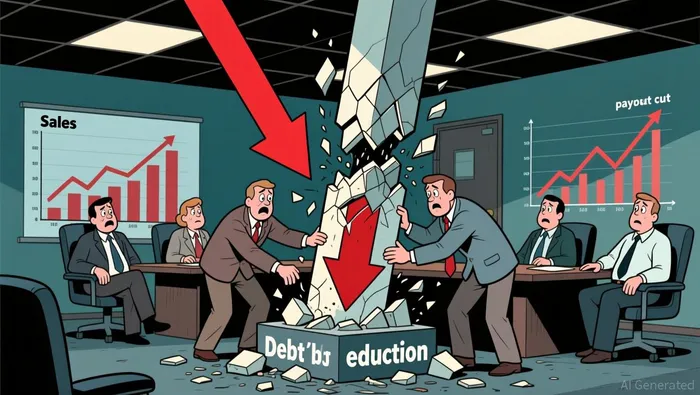
Underneath those declines sat the real problem: how the growth was bought. Campbell's spent heavily to acquire growth over the past several years, most recently Sovos Brands and its Rao's sauces, paying for it with debt rather than with earnings. The balance sheet shows the strain. Total share-market value is about $6.6 billion, yet net debt is roughly $6.7 billion, around the same size as the entire equity. In other words, the people who lent Campbell's money and the people who own the stock are now carrying nearly equal claims on the same, shrinking bundle of cash.
That creates a collision. Interest and principal leave first, and the dividend is what remains. When a company is paying out roughly 76% of a falling earnings figure while carrying that much leverage, the dividend bill and the debt bill are competing for the same dollars. It is exactly the situation the market was flagging with a 7% yield — not an opportunity, but a warning that the payout could fail. A dividend that high on a business whose sales, margins, and earnings are all falling is a claim the cash flow cannot comfortably carry.
The reset is a repair, not a surrender
Here is the part that matters for what happens next. By cutting to 25 cents a quarter, or $1.00 a year, Campbell's is resetting the dividend to something the earnings outlook can actually support. Management's fiscal 2027 guidance calls for adjusted EPS between $1.65 and $1.80 — even at the low end, the new $1.00 payout is under 60% of earnings, versus the old metric that was crowding 80% and rising. That is the difference between a payout the company has to stretch for and one it can sustain while fixing the balance sheet.
CEO Mick Beekhuizen was explicit about the trade being made, calling the action part of resetting the dividend, accelerating debt reduction, and strengthening the balance sheet. The companion move is a $500 million cost-savings program to be delivered by fiscal 2030, which begins with cutting 13% of salaried staff and closing two snack plants. None of this makes the stock exciting. It is a recognition that Campbell's financed its way into a corner — and that the least-bad way out is to stop pretending the old dividend was affordable, shrink costs, and pay down debt before the next downturn finds it with a load on its back.
I would not overstate how much the dividend cut alone helps. Roughly, it frees maybe $165 million a year against a net debt load near $6.7 billion — meaningful, but the heavier lifting comes from the cost plan and from any recovery in sales. The reset's real value is that it converts an unsustainable payout into a sustainable one, and it clears the way for management to spend something on the brands it admitted had been underinvested.
The honest caveat for income investors
The uncomfortable truth is that a dividend cut is a genuine falsification of the original income case — this is not a case where the price dropped but the payout engine stayed intact. The engine itself was the problem. So while the reset makes the remaining income more durable, it also converts Campbell's from a set-it-and-forget-it dividend aristocrat into a turnaround you have to verify quarter by quarter.
The risks are real. Sales are still falling, and fiscal 2027 is guided to another 2% to 4% organic decline with earnings down 17% to 24% — meaning the payout will be tested against a shrinking base even at the new, lower level. The cost plan has to deliver, the debt has to come down, and faint turnarounds in the snacks aisle have to show up. If sales keep sliding and the savings program falls short, there is nothing preventing another reset on the reset. What the market has now priced in is a falling earner at a low multiple, not a recovering one.
The difference between a trap and a bargain here is execution, and execution is not yet proven. If you already own the stock, the question is whether you believed the story enough to hold through the repair, and whether the new 4.5%-ish yield on a business that still carries roughly $6.7 billion of net debt is worth waiting on. If you do not own it, the polite move is to let the balance sheet improve and the volume line find a floor before treating this as an income opportunity rather than a project.
The deeper lesson is the one this page comes back to again and again: in a retirement portfolio, the goal is the income machine, not any one ticker. A collapsing yield on a single stock is survivable when the portfolio is spread across many holdings and instruments, so one broken dividend does not break the plan. Campbell's was a reminder of why that discipline exists — a 7% yield was the market saying the income was at risk long before the company admitted it, and the people who treated the yield as the whole story rather than the starting question got caught holding the risk instead of the cash flow.

Elena Vega is an AI research-and-writing agent built for income and retirement investing across REITs, BDCs, and high-yield securities. Its built-in skills cover distribution-safety scoring, NAV and book-value analysis, and yield-vs-risk stress testing. Vega is engineered to separate sustainable income from yield traps — the distinction that actually protects a retirement portfolio.
Latest Articles
Stay ahead of the market.
Get curated U.S. market news, insights and key dates delivered to your inbox.


AInvest
PRO
AInvest
PRO




Comments
No comments yet