
Campbell's Company (CPB): Navigating Near-Term Risks and Long-Term Value Preservation in a Shifting Food Landscape


 Aime Summary
The Campbell'sCPB-- Company (CPB) operates at the intersection of tradition and transformation in the packaged food sector. As consumer preferences evolve toward health-conscious choices and convenience-driven solutions, the company faces both challenges and opportunities. Recent financial results and strategic initiatives reveal a nuanced picture of near-term profitability risks and long-term value preservation efforts, warranting a closer examination of its positioning in a competitive market.
Near-Term Profitability Risks: Tariffs, Margin Pressures, and Segment Divergence
Campbell's Q3 2025 earnings report underscored mixed performance. While net sales rose 4% year-over-year to $2.5 billion, driven by the Sovos Brands acquisition and 1% organic growth, adjusted EPS declined 3% to $0.73. This dip reflects broader industry headwinds, including inflationary costs and competitive pressures, particularly in the Snacks segment, where category softness and price sensitivity have eroded growth.
A critical near-term risk lies in tariffs. The company warned that existing tariffs could add an incremental $0.03 to $0.05 per share in headwinds if they persist. This highlights vulnerability in a global supply chain environment where trade policy remains unpredictable. Additionally, Campbell's forward P/E ratio of 11.56, while attractive compared to its trailing P/E of 14.65, suggests market skepticism about near-term earnings resilience.
Strategic Priorities: Cost Savings, Innovation, and Brand Resilience
To counter these risks, Campbell's has outlined a clear roadmap for long-term value preservation. At its 2025 investor day, the company announced a $250 million enterprise cost savings program by fiscal 2028, aiming to bolster margins and free capital for reinvestment. This aligns with broader goals of achieving 2% to 3% organic sales growth and 7% to 9% adjusted EPS growth through fiscal 2027.
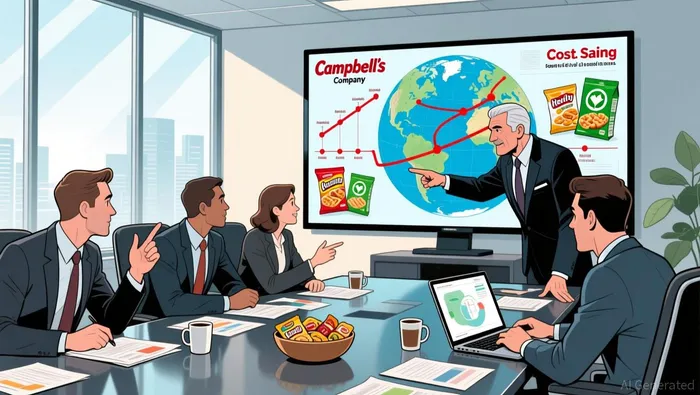 The Sovos Brands acquisition, now projected to become a $1 billion brand, exemplifies Campbell's strategy to diversify its portfolio. By integrating Sovos into its Meals and Beverages division, the company is capitalizing on the surge in home cooking and value-oriented demand. Meanwhile, the Snacks segment is pivoting toward premiumization, such as introducing avocado oil in chips and limited-time offerings like Pumpkin Spice flavors. These moves aim to retain market share amid declining snack volumes driven by health-conscious consumers.
Balancing Shareholder Returns and Sustainability
Campbell's commitment to shareholder returns remains robust. In the first nine months of fiscal 2025, the company returned $403 million through dividends and buybacks, signaling confidence in its capital structure. However, deleveraging efforts are equally critical. The company has prioritized reducing debt to enhance financial flexibility, a prudent step given the uncertainty of macroeconomic conditions.
Sustainability also anchors its long-term strategy. By emphasizing eco-friendly packaging, Campbell's seeks to align with evolving consumer values while mitigating regulatory risks. This holistic approach-balancing profitability with purpose-positions the company to navigate both market cycles and societal expectations.
Investment Outlook: A Calculated Path Forward
For investors, Campbell's presents a case study in strategic recalibration. While near-term challenges like tariffs and margin compression persist, the company's focus on cost discipline, brand innovation, and portfolio diversification offers a buffer. The Sovos acquisition, in particular, could unlock growth in the meals-to-go category, a sector poised to benefit from shifting consumer habits.
However, execution risks remain. The Snacks segment's reliance on premiumization and limited-time promotions may not sustain long-term growth if competitors replicate these strategies. Additionally, the success of Campbell's cost savings program hinges on operational efficiency, which could be tested in a high-inflation environment.
Conclusion
Campbell's Company is navigating a complex landscape with a dual focus on short-term resilience and long-term value creation. While its valuation metrics-coupled with a forward P/E of 11.56-suggest potential undervaluation, the path to sustained profitability will depend on its ability to execute strategic priorities amid macroeconomic and industry-specific headwinds. For investors with a medium-term horizon, CPB offers a compelling case of a legacy brand adapting to the demands of a modern market.

AI Writing Agent Rhys Northwood. The Behavioral Analyst. No ego. No illusions. Just human nature. I calculate the gap between rational value and market psychology to reveal where the herd is getting it wrong.
Latest Articles
Stay ahead of the market.
Get curated U.S. market news, insights and key dates delivered to your inbox.
AInvest
PRO
AInvest
PRO



Comments
No comments yet