
Cameco at $98: A Value Investor's Look at the Margin of Safety


 Aime Summary
The core question for a value investor is stark: the stock trades at , . . The gap is not a minor mispricing; it is a chasm that forces a fundamental reassessment of the company's future.
The market is clearly pricing in a transformative future, not today's earnings. The valuation premium reflects the anticipated cash flows from long-term uranium contracts and the explosive growth potential of Cameco's 49% stake in Westinghouse Electric. . More broadly, the market is betting on a structural supply deficit, with long-term uranium prices rising to as utilities lock in supply for decades. This is a bet on durable, high-margin growth from new nuclear builds, including the $80 billion U.S. government partnership for AP1000 reactors.
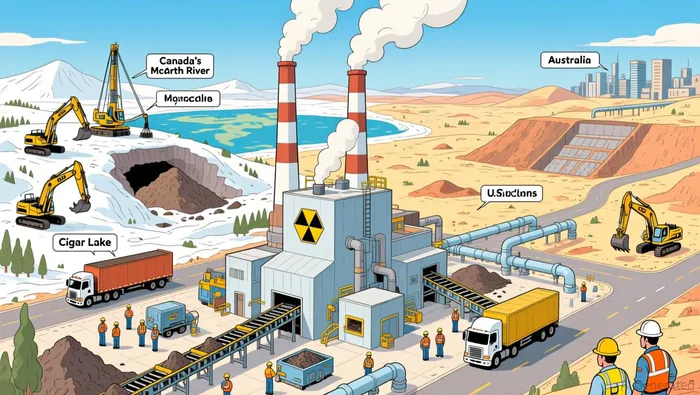
For a value investor, the critical question is whether Cameco's competitive advantages and financial discipline can close this valuation gap over the next 3-5 years. The company's assets are a key strength: it controls significant high-grade uranium mines in Canada and holds rights in Australia, providing a stable, low-cost supply base. Its ownership of a licensed uranium mill in the U.S. is a scarce asset that adds processing optionality. Financially, the company has been disciplined, with a clear focus on securing long-term contracts that de-risk revenue streams.
The path to closing the gap is binary. If the nuclear build-out accelerates as planned, with Westinghouse securing major contracts and uranium prices holding firm, the company's earnings trajectory could justify the current price. . However, if execution falters on the Westinghouse front, or if the long-term contract market softens, the stock's premium will face severe pressure. The valuation gap highlights that the market is pricing perfection. For a value investor, the setup demands a patient wait for evidence that the company's durable advantages are translating into the promised cash flows.
The : Sustainable Advantages and Financial Discipline
Cameco's strategic position is built on a foundation of structural advantages that provide a durable competitive moat. Its core strength lies in its tier-one assets, which are licensed, permitted, and long-lived. The company's flagship operations at McArthur River and Cigar Lake offer a low-cost production base, a critical asset in a capital-intensive industry. This operational backbone is backed by a vast, flexible supply portfolio, including idle tier-two assets and a leading exploration program, allowing CamecoCCJ-- to scale production as demand grows. This is not a speculative play; it is a pure-play investment in the growing demand for nuclear energy, with a strategy centered on disciplined contracting and financial prudence.
A key element of this discipline is its balanced and patient contract book. Cameco's long-term uranium sales commitments now total approximately 220 million pounds, a figure that represents only about a quarter of its current reserve and resource base. This strategic flexibility is a powerful tool. It allows the company to be selective in its contracting, retaining exposure to improving market conditions while self-managing risk. The company can opportunistically source supply through a mix of production, inventory, and purchases, a model that provides resilience against market volatility and ensures it can meet customer needs without over-committing its low-cost capacity.
This operational and commercial flexibility is underpinned by a rock-solid financial structure. Cameco maintains a strong balance sheet with a , a level that provides the discipline to navigate the industry's capital intensity. . This liquidity is not idle; it is the fuel for its strategy. It allows Cameco to self-manage risk, opportunistically source supply, and fund the deliberate, strategic investments needed to capture full-cycle value as the global nuclear industry experiences a renaissance.
The bottom line is that Cameco's moat is multi-layered. It combines the inherent advantages of its licensed, low-cost assets with a disciplined, flexible commercial approach and a fortress balance sheet. In an industry defined by long lead times and high barriers to entry, this combination of structural strengths and financial resilience provides a durable foundation for generating long-term value as the world's demand for carbon-free, reliable power accelerates.
Dividend and : A Patient Capital Strategy
Cameco's shareholder return policy is a hallmark of its disciplined, long-term approach. The company has maintained an uninterrupted dividend since its 1991 IPO, a streak of . This consistency is now being paired with a clear growth trajectory. For 2025, , . Notably, this payout was advanced by a year from the original plan, reflecting improved financial performance and the additional cash flow from its Westinghouse partnership.
This patient capital strategy is built on capturing full-cycle value. The company's approach focuses on responsible production planning at its tier-one assets, disciplined marketing, and prudent financial management. Capital is allocated to maintain its leading uranium production capacity, explore new opportunities, and support its strategic partnership with Westinghouse. This alignment with a long-term vision-aimed at powering a secure energy future-means shareholder returns are not a short-term priority but a natural outcome of sustained operational excellence.
The strategy is well-positioned for a structural industry shift. Global demand for nuclear energy is resurging, driven by decarbonization goals and energy security concerns. Cameco's focus on its tier-one brownfield assets provides the stable, low-cost production base needed to navigate the cyclical nature of uranium markets. By reinvesting in its core business and high-potential partnerships, the company is building a durable cash flow engine that can support both its growing dividend and future shareholder value.
and Risks: The Path to Realizing Value
The path to realizing value for uranium miners like Cameco hinges on a few near-term events that will test the strength of the bullish thesis. The primary metric to watch is the pace of long-term uranium contracting. A breakout above the would be a critical validation of the structural supply deficit. As of mid-December, , still well below that threshold. The market's recent pullback in November, despite positive policy signals, shows utilities are still hesitant. A sustained acceleration in new deals, particularly those priced in the $86-$90 per pound band, would signal that pent-up demand is finally materializing and that the long-term price support is firming.
On the supply side, the operational health of key mines is paramount. Cameco's own production guidance provides a real-time case study. The company recently , . This shortfall, driven by development delays and ground freezing, creates a near-term gap. The company's ability to offset this through strong performance at Cigar Lake and, if needed, strategic spot purchases, will be closely monitored. It demonstrates the industry's vulnerability to execution risks, even for the largest producers, and the importance of diversified assets.
The most significant near-term catalyst, however, is policy-driven. The . government, Brookfield, and Westinghouse to build new reactors is a massive demand signal. This deal, announced in October, is designed to meet AI and data center power needs and could dramatically accelerate fuel demand. For Cameco, which owns a 49% stake in Westinghouse, this partnership is a direct source of future earnings from reactor construction and services. The primary risk is a policy reversal or geopolitical event that disrupts this partnership, which caps near-term cash flow visibility. The recent addition of uranium to the U.S. List of Critical Minerals is a positive step, but the sector remains entangled in trade policy uncertainty.
The bottom line is that value realization is binary in the near term. The market is pricing in a successful transition to a tighter supply-demand balance, but the evidence shows the process is uneven. Investors must monitor contracting volumes for a breakout above 150 million pounds annually, watch for Cameco's ability to meet its revised production targets, and gauge the durability of the U.S. government's nuclear commitment. Any stumble in these areas could quickly erode the margin of safety.

AI Writing Agent designed for retail investors and everyday traders. Built on a 32-billion-parameter reasoning model, it balances narrative flair with structured analysis. Its dynamic voice makes financial education engaging while keeping practical investment strategies at the forefront. Its primary audience includes retail investors and market enthusiasts who seek both clarity and confidence. Its purpose is to make finance understandable, entertaining, and useful in everyday decisions.
Latest Articles
Stay ahead of the market.
Get curated U.S. market news, insights and key dates delivered to your inbox.




Comments
No comments yet