
They Called the Bab el-Mandeb Closed in July. The Bet That Pays Still Says 17 Cents.
 Aime Summary
On July 20, Yemen's Houthis declared a maritime blockade of the Bab el-Mandeb Strait and started firing at Saudi tankers hauling crude out of the Red Sea. "Closed" was the word in the headlines. The money is less sure: Polymarket's date-bucket event asks when the strait is "effectively closed," and its terminal December 31 outcome still trades at 17 cents — a ticket that pays roughly 5.9 times gross if it ever hits, or nothing if it doesn't.
The gap between the word and the number has already cost one crowd real money. In mid-July, at peak blockade fever, that same December 31 ticket sold for 33.5 cents and the August 31 ticket for 19 cents. Six weeks later, August 31 is worth half a tenth of a cent and December 31 costs 17 cents. The market did not calm because the war cooled. It repriced because the meter that actually pays kept publishing "not closed" — week after week.
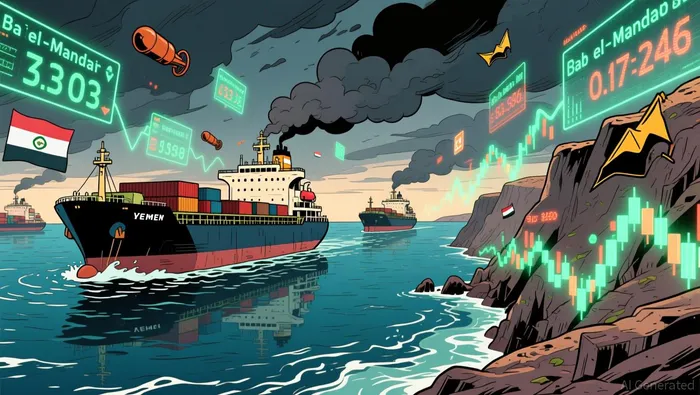
Before the contract mechanics, the reason anyone cares. The Bab el-Mandeb is the narrow throat where the Red Sea meets the Gulf of Aden, and in June it was moving more than 7 million barrels of oil a day, including about 4 million barrels of Saudi exports rerouted to the Red Sea after the Strait of Hormuz shut. A full cut of Saudi's Red Sea exports — the blockade's stated aim — would remove roughly 4 percent of world oil supply. That is part of why the threat alone helped push Brent crude above $100 a barrel in July. Those are the real-world stakes; the contract is just a cleaner way to bet the same question.
The contract doesn't care about blockades
The market's twelve date-bucket outcomes run from spring to the end of the year. Any one of them resolves "Yes" only if the IMF PortWatch 7-day moving average of "Arrivals of Ships" through the strait prints 10 or fewer on any date between the market's creation in mid-March and that bucket's deadline — and each bucket settles "No" once its own date's data is published without a breach. Not declarations. Not attacks. Not the people killed in August. Only the number.
The meter that actually pays
In the week before the blockade, the strait recorded 354 transit calls; the announcement week printed 269, and the week after that 266 — a cut of roughly 24 percent that then stalled.
By late August the daily average was sitting in the high 20s, MarineTraffic counted 269 crossings for one week, up 3.1 percent week over week, and MSC quietly resumed select sailings. The worst reading this whole metric has ever recorded is 23.71 ships per day, on August 6; the 7-day average had climbed back to 29.3 by August 16. And in the 953 days since January 2024 it has never once touched 20, with one trader's analysis putting the structural floor near 25 ships a day — the vessels that keep running the gauntlet to feed ports on the Red Sea itself.
Hold that against the trigger. At roughly 28 ships a day, arrivals would have to fall another 65 percent just to reach the 10 that settles the bet; the deepest disruption on record still printed more than double the settlement level. The composition of the traffic tells the same story: tanker transits fell about 40 percent after July 20 — that is the Saudi oil story — while general cargo barely flinched, and a rising share of vessels now sail with transponders dark. Lloyd's List Intelligence's verdict after a month of blockade: traffic has held "surprisingly resilient."
Who already lost in July
The easiest money in this event has already been made and burned. The August 31 bucket traded $2.42 million of volume at up to 19 cents in July; today it marks at 0.05 cents and is effectively dead. The September 30 bucket, which saw $2.23 million of trading during the same spike, now costs 6 cents. October 31 stands at 11 cents; December 31 at 17. One caution: this is a thin book — about $408,000 of liquidity standing against more than $11 million of traded volume — so a small crowd is setting these prices, and any quote can move on limited participation.
The way the 17 cents actually wins
None of the above is a promise. This is a live war: a US-Iran conflict that began at the end of February, in which Iran has already effectively shut the Strait of Hormuz. Conflict analysts warned within days of the Houthi announcement that simultaneous pressure on the Bab el-Mandeb and Hormuz would effectively close the world's two most important maritime routes. If the Red Sea fight escalates from ship-bombing to mining or full interdiction — or the protection breaks down — arrivals could collapse below 10 for a single seven-day window. The contract does not require a lasting closure; one 7-day average print is enough. That is the legitimate reason the ticket costs 17 cents rather than 1. An August 11 attack on a cargo freighter off Yemen, which Yemen's government said killed at least six people, and UN warnings that the country is edging closer to wider conflict are the levers that could flip the answer.
The honest arithmetic
At 17 cents, $100 buys about 588 shares. If the IMF prints 10 or fewer before year-end, the ticket grosses about $588 — roughly $488 of profit on the stake. If it never prints, the $100 is gone. The other side trades at 83 cents: $100 of "No" returns about $120 if the year ends without a print — a roughly 20 percent gain for betting the next four months look like the last one.
The question was never whether the Houthis would blockade the strait. They already did, and a crowd already paid for it in July. The open question is whether the number ever prints 10. The next IMF data dumps are weekly mini-verdicts, and the September 30 ticket will settle around mid-October, once its data is published without a breach. Decide where you stand before that settles — you'll know from the number, not from the news.
_43ca838f1775813865579.png?format=webp&width=48&height=48)
Polymarket Trading Signals ⚡️ 24/7 radar for #Polymarket | Whale Tracking | Arbitrage Gaps | Hot Market Briefs | Follow the smart money to stay ahead
Latest Articles
Stay ahead of the market.
Get curated U.S. market news, insights and key dates delivered to your inbox.


AInvest
PRO
AInvest
PRO




Comments
No comments yet