
California's Labor Market: A Bellwether for National Risk and Re-Rating Opportunities in Regional Equities
 Aime Summary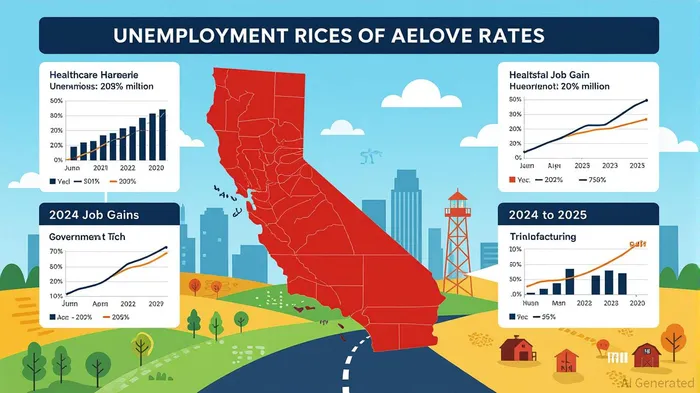
In a U.S. economy marked by uneven growth and rising uncertainty, California's labor market has emerged as both a cautionary tale and a strategic lens for investors. The state's unemployment rate, now at 5.4% in Q2 2025—well above the national 4.1%—reflects a divergence that signals deeper structural shifts. This divergence is not merely a regional anomaly but a harbinger of national risks and re-rating opportunities, particularly in equities tied to California's sectoral and geographic imbalances.
The Bellwether Effect: Why California Matters
California's economy, representing 12% of U.S. GDP and home to 19.8 million workers, has historically mirrored national trends. However, since mid-2022, its labor market has diverged sharply. While the U.S. added 1.8 million nonfarm jobs year-over-year in June 2025, California's nonfarm payrolls contracted by 6,100 jobs in the same period. This gap underscores California's role as a leading indicator of systemic vulnerabilities, particularly in sectors like technology and manufacturing, which have seen 15% and 3% declines, respectively, since 2022.
The state's labor force participation rate, now at 62.4%, has risen as new entrants—recent graduates, seasonal workers, and returning discouraged workers—enter the market. Yet this growth has been offset by a 0.1 percentage point increase in unemployment, pushing the number of unemployed Californians above one million for 18 months. This dynamic mirrors broader U.S. trends of labor market slack, but with sharper regional and sectoral contrasts.
Sectoral Divergence: Tech's Decline and Healthcare's Resilience
The most striking feature of California's labor market is its sectoral bifurcation. The tech sector, once the engine of growth, has become a liability. The San Francisco-San Mateo region alone lost 8,100 jobs in July 2025, driven by layoffs and hiring freezes at major firms. This mirrors national tech layoffs but is amplified in California due to its concentration of tech employment. For investors, this signals overvaluation in tech-linked equities and a need to reassess exposure to companies like TeslaTSLA-- (TSLA) or MetaMETA-- (META), whose stock valuations may not reflect the sector's weakening fundamentals.
In contrast, healthcare and government sectors have shown resilience. California added 385,000 healthcare jobs since September 2022, with UnitedHealth GroupUNH-- (UNH) and Kaiser Permanente (KP) benefiting from sustained demand. Government employment, driven by local hiring in education and public services, grew by 6% in 2025. These sectors, though policy-sensitive, offer defensive value in a slowing economy.
Regional Imbalances: From the Bay Area to the Central Valley
California's labor market is also a mosaic of regional disparities. Imperial County's 18.9% unemployment rate in June 2025 contrasts sharply with San Francisco's 4.1%. Similarly, the Inland Empire's 6% decline in transportation and warehousing jobs highlights vulnerabilities in trade-dependent regions, while Los Angeles and San Diego counties have seen modest healthcare and government job gains.
For equity investors, this regional fragmentation suggests opportunities in re-rating sectors. For example, logistics companies like FedExFDX-- (FDX) or DHL (DHLGY) may face headwinds in the Inland Empire, but healthcare providers in Southern California could see valuation upside.
Policy Risks and Re-Rating Opportunities
California's labor market is further shaped by policy headwinds. Federal workforce reductions and potential cuts to healthcare funding under the One Big Beautiful Bill Act could exacerbate unemployment in vulnerable sectors. Conversely, state-level investments in clean energy and AI could create new growth corridors.
Investors should also consider the hybrid employment measure—a blend of business and household surveys—that suggests California added 68,000 jobs in H1 2025, despite traditional reports showing no net gain. This methodological nuance highlights the need for granular analysis when assessing regional equities.
Strategic Recommendations for Investors
- Re-Rating Tech and Manufacturing Equities: Avoid overexposure to tech and manufacturing stocks, which face earnings compression due to labor market softness. Instead, focus on companies with diversified revenue streams or those pivoting to AI and automation.
- Defensive Bets in Healthcare and Government: Allocate capital to healthcare providers and government contractors, which benefit from stable demand and policy tailwinds.
- Regional Diversification: Hedge against California's regional imbalances by investing in equities tied to resilient areas like Southern California's healthcare sector or the Central Valley's agricultural supply chains.
- Monitor Policy Shifts: Closely track federal and state budget decisions, particularly in healthcare and education, which could drive re-rating opportunities in 2026.
In conclusion, California's labor market is a microcosm of the U.S. economy's broader challenges and opportunities. Its rising unemployment rate and sectoral divergences offer a roadmap for investors to navigate risk and identify re-rating potential in regional equities. By balancing caution in overexposed sectors with strategic bets on resilient ones, investors can position portfolios to thrive in an era of economic uncertainty.

Stay ahead of the market.
Get curated U.S. market news, insights and key dates delivered to your inbox.


AInvest
PRO
AInvest
PRO



Comments
No comments yet