
California's Gas Tax Hike: A Catalyst for Renewable Energy's Golden Age
The California gas tax increase, effective July 1, 2025, marks a pivotal moment in the state's climate strategy. By raising the tax by 1.6 cents per gallon and bolstering the Low Carbon Fuel Standard (LCFS), policymakers are engineering a fiscal nudge toward renewable energy adoption. This shift isn't just about infrastructure funding—it's a market signal to investors that fossilFOSL-- fuels are increasingly uneconomic, while renewables are primed for explosive growth. Let's dissect how this policy-driven disruption creates opportunities in solar, EV infrastructure, and green tech.
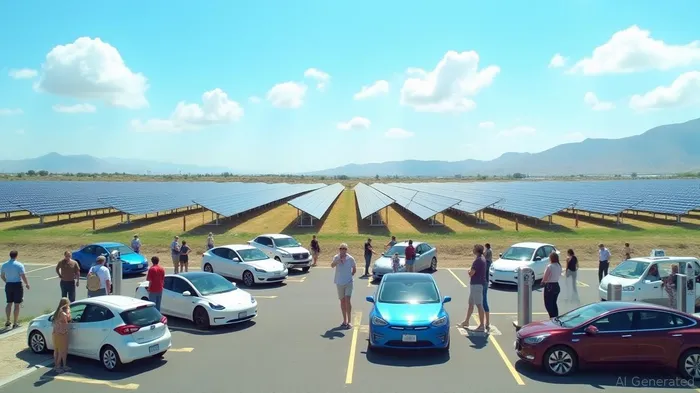
The Gas Tax: A Hidden Fuel Cost Hike and Behavioral Shift
While the gas tax itself adds only ~1.6 cents per gallon, the LCFS's stricter carbon intensity targets will amplify costs. Independent studies project gasoline prices could rise by 5–8 cents per gallon by 2025, far below industry doomsday scenarios of $0.65–$1.50. This subtler price signal avoids immediate consumer backlash while nudging demand toward cleaner alternatives.
Crucially, the tax's inflation-indexed design ensures gradual price increases, giving consumers time to adapt. Meanwhile, California's 2035 ban on new gas vehicles and rising EV adoption (now at 18% of new car sales) amplify the urgency for infrastructure. This creates a virtuous cycle: higher fossil fuel costs drive EV adoption, which in turn requires more charging stations, accelerating green tech investment.
Solar Power: Payback Periods Shrink to 5–7 Years
Solar is a prime beneficiary of California's dual policies. The Net Energy Metering 3.0 (NEM 3.0) and LCFS work in tandem to accelerate adoption:- NEM 3.0: While it reduces credits for exported solar energy, it incentivizes battery storage. Systems with batteries now achieve 5–7 year payback periods (down from 7–11 years pre-NEM 3.0) due to avoided peak grid costs and rebates like the Self-Generation Incentive Program (SGIP).- LCFS Credits: Solar-powered EV charging stations generate LCFS credits, adding revenue streams for infrastructure developers.
Investment Play: Target companies like Enphase Energy (ENPH), whose inverters dominate residential solar, or NextEra Energy (NEE), which is scaling utility-scale solar. For DIY investors, consider the Invesco Solar ETF (TAN), which tracks solar tech stocks.
EV Infrastructure: A Gold Rush in Concrete and Copper
California's 749 fast EV charger sites (as of 2024) and LCFS mandates for 30% carbon intensity reduction by 2030 mean EV infrastructure is no longer optional—it's essential. Key opportunities include:- Public Charging Networks: Firms like EVgo (EVGO) and ChargePoint (CHPT) are expanding rapidly. With 2 million EVs on California roads by 2030 (up from 1.2 million today), demand will outpace supply.- Hydrogen Fueling Stations: The LCFS's inclusion of hydrogen as a credit-eligible fuel has sparked projects like Shell's $1 billion hydrogen network. This sector is nascent but poised for growth.
Green Tech Startups: Betting on Policy Winners
The LCFS's $4 billion annual private investment draw is fueling innovation in sectors like:- Renewable Diesel: Companies like World Energy (a top LCFS credit earner) are scaling up biofuel production from waste oils. Look for startups in algae-based fuels or carbon capture-enhanced biofuels.- Battery Recycling: As EV adoption rises, firms like Redwood Materials (backed by Tesla's Elon Musk) are recycling lithium-ion batteries, reducing costs and environmental impact.
The Policy Alchemy: Why This Isn't a Passing Trend
- Regulatory Certainty: The gas tax hike and LCFS are baked into California law, with bipartisan support for infrastructure funding. This stability attracts long-term capital.
- ESG Compliance: Corporations under pressure to meet net-zero goals will ramp up renewable purchases. Apple (AAPL) and Google (GOOGL), for instance, are already signing massive renewable PPAs in CA.
- Market Dynamics: California's $4.59/gallon gas price (vs. the national $3.12 average) creates a price floor for fossil fuels, making renewables more cost-competitive.
Investment Thesis: Go All-In on Policy-Backed Green Assets
The gas tax-LCFS combo isn't just a tax—it's a market mechanism forcing capital toward renewables. Investors should prioritize:1. Scalable Solar/Storage: Firms with tech to cut installation costs or improve efficiency (e.g., Sunrun (RUN)).2. EV Infrastructure: Focus on companies with state contracts or proprietary software (e.g., Blink Charging (BLNK)).3. Carbon-Cutting Startups: Look for startups with LCFS credit generation potential (e.g., LanzaTech, converting waste CO2 to fuel).
Avoid laggards in fossil fuels: California's gasoline demand has already fallen 10% since 2019, and this trend will accelerate.
Final Take: The Golden State Leads, the World Follows
California's policies are a template for global decarbonization. Investors who align with its renewable push will capture outsized returns. The payback periods are shortening, the tailwinds are strong, and the tax hike is just the beginning.
Act now—before the market fully prices in this green revolution.

Stay ahead of the market.
Get curated U.S. market news, insights and key dates delivered to your inbox.
AInvest
PRO
AInvest
PRO



Comments
No comments yet