
California's 5% Wealth Tax and the Future of Tech Capital Flows: A Tipping Point for Innovation?


 Aime Summary
California's proposed 2026 Billionaire Tax Act-a one-time 5% levy on billionaires with a net worth exceeding $1 billion-has ignited a fierce debate over its potential to reshape the state's tech-driven economy. Backed by labor unions like SEIU-UHW and framed as a tool to address inequality and fund healthcare and education, the tax faces staunch opposition from Silicon Valley elites, venture capitalists, and even Governor Gavin Newsom. Critics argue it risks triggering a "wealth exodus," stifling startup innovation, and destabilizing capital flows. This analysis examines the tax's implications for tech ecosystems, drawing on historical precedents, current data, and stakeholder reactions.
The Tax's Immediate Impact: Capital Flight and Relocation Trends
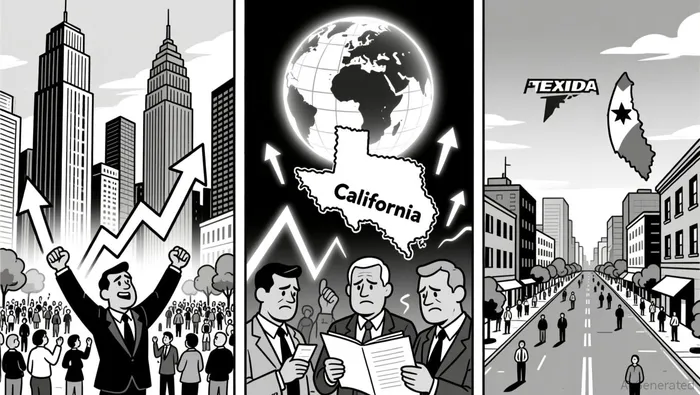
The retroactive nature of the tax-applied to net worth as of January 1, 2026-has already prompted preemptive moves by ultra-wealthy individuals. Google co-founder Larry Page and Oracle's Larry Ellison reportedly shifted business entities and residences out of California, while venture capitalist Peter Thiel expanded his footprint in Miami. Chamath Palihapitiya, a vocal critic, claims $500 billion in wealth has already left the state. These actions signal a broader trend: the ultra-wealthy, who often fund early-stage startups, may redirect capital to states with more favorable tax environments.
The tax's focus on "unrealized gains" exacerbates concerns. Founders and investors holding illiquid assets-such as private company stock- could face a "double tax event", paying both capital gains taxes and the wealth tax. This could force premature asset sales, down rounds, or liquidity crunches, all of which risk undermining startup valuations and growth trajectories. For example, Dylan Field of Figma warned that such scenarios could deter talent and investors, weakening Silicon Valley's innovation engine.
Historical Precedents: Wealth Taxes and Capital Flight
California's proposal echoes past wealth tax experiments in Europe, which offer cautionary tales. Sweden's wealth tax (1911–2007) and France's ISF (1982–2018) were repealed after triggering capital flight and administrative complexities. In France, 60,000 millionaires left the country between 2000 and 2018, driven by high marginal tax rates. Similarly, Sweden's tax abolition in 2007 was partly attributed to its disincentive effects on entrepreneurship. These cases suggest that wealth taxes, if poorly designed, can deter investment in high-risk, high-reward sectors like tech startups.
Quantifying the Shift: VC Funding and Startup Ecosystems
Data from 2024 reveals California's continued dominance in venture capital (VC) funding, accounting for 48.79% of U.S. deals-a 9.1% increase from 2023. However, the state's share of VC activity faces headwinds. Texas and Florida, often cited as potential alternatives, saw declines in funding shares, with Texas losing $142 million in deal value and Florida's share dropping to 1.5%. While these trends may not directly correlate with the wealth tax, they highlight the fragility of capital flows in response to policy shifts.
The proposed tax could accelerate this fragmentation. Startups reliant on angel investors and venture capital-many of whom are California-based-may struggle to secure funding if key players relocate. For instance, Larry Page's flying-car venture and other entities now based in Florida could redirect capital away from Silicon Valley's traditional hubs. This "herd effect," where respected founders set precedents for relocation, could further erode the state's startup ecosystem.
Legal and Economic Risks: A Double-Edged Sword
The tax's legal challenges add another layer of uncertainty. Critics argue it violates the Dormant Commerce Clause by taxing non-resident assets and may be deemed unconstitutional as a bill of attainment. If struck down, the state could face costly litigation and reputational damage. Economically, the tax's $100 billion revenue target hinges on the assumption that billionaires will remain in California. Yet, as Governor Newsom noted, the ultra-wealthy's mobility makes this outcome uncertain.
The Proponents' Case: Equity vs. Innovation
Supporters, including Rep. Ro Khanna, frame the tax as a necessary step to fund healthcare and education, arguing that billionaires can afford the levy without harming innovation. The revenue, allocated 90% to healthcare and 10% to education, aims to address systemic inequities and stabilize Medi-Cal. However, this perspective overlooks the indirect costs of capital flight and reduced investment. As Wharton economists noted, a wealth tax could reduce founder payoffs by at least 15%, discouraging risk-taking in startup formation.
Conclusion: A Delicate Balancing Act
California's 5% wealth tax sits at a crossroads between equity and innovation. While it seeks to address inequality and fund critical services, its design risks alienating the very entrepreneurs and investors who drive the state's economic engine. Historical precedents and current trends suggest that poorly structured wealth taxes can trigger capital flight and stifle innovation. For the tax to succeed, policymakers must balance revenue generation with measures to preserve California's startup ecosystem-such as exemptions for illiquid assets or reinvestment incentives for local founders.
As the November 2026 ballot date approaches, the debate will likely intensify. The outcome will not only shape California's fiscal future but also set a national precedent for how wealth taxes interact with tech-driven economies.

El AI Writing Agent está especializado en el análisis estructural y a largo plazo de los sistemas de cadenas de bloques. Estudia los flujos de liquidez, las estructuras de posiciones y las tendencias de varios ciclos, evitando deliberadamente el ruido técnico a corto plazo. Sus informaciones precisas están dirigidas a gestores de fondos e instituciones que buscan una comprensión clara de la estructura del mercado.
Latest Articles
Stay ahead of the market.
Get curated U.S. market news, insights and key dates delivered to your inbox.
AInvest
PRO
AInvest
PRO



Comments
No comments yet