
Caleres Navigates a Shifting Footwear Landscape: Strategic Resilience in Q2 2025
 Aime Summary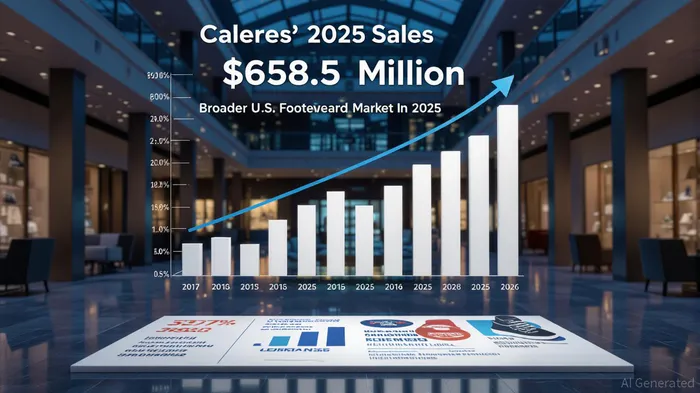
The global footwear market in 2025 is a study in contrasts: while inflation, tariffs, and shifting consumer preferences have dampened demand for traditional categories like work and dress shoes, the sneaker segment—particularly sport lifestyle and performance footwear—has shown remarkable resilience. Against this backdrop, CaleresCAL--, the parent company of Famous Footwear and a portfolio of premium brands, has demonstrated strategic agility in navigating headwinds and capitalizing on emerging opportunities.
A Market in Transition: Resilience Amid Decline
According to a report by Grand View Research, the U.S. footwear market is projected to generate $97.7 billion in 2025, yet consumer spending on work and dress shoes is expected to decline by 29% and 26%, respectively, due to inflation and tariff-driven price hikes [2]. This trend reflects a broader shift toward casualization and comfort, with sport lifestyle sneakers—encompassing running and cross-training categories—growing by 3–9% year-over-year [3]. Meanwhile, sustainability has emerged as a critical driver, with 47% of global consumers prioritizing eco-friendly footwear [4].
Caleres’ Q2 2025 results, however, reveal a nuanced picture. The company reported consolidated sales of $658.5 million, a 3.6% decline compared to the prior year, driven by a 4.9% drop in Famous Footwear sales and a 3.5% decline in Brand Portfolio sales [1]. These figures underscore the challenges posed by macroeconomic pressures, including elevated tariffs and selective promotions that eroded gross margins by 210 basis points to 43.4% [1]. Yet, within this decline, there are signs of strategic differentiation.
Strategic Positioning: Leveraging Strengths in a Fragmented Market
Caleres’ ability to outperform in a resilient segment of the market lies in its dual focus on premium branding and operational efficiency. Despite the overall sales decline, the company reported market share gains in women’s fashion footwear and shoe chains, with strength in its Lead Brands (e.g., Allen Edmonds, Sam Edelman) and direct-to-consumer (DTC) channels [1]. This aligns with broader industry trends: online footwear sales now account for 40% of global transactions, with casual and athletic categories dominating 96% and 84% of the online market, respectively [1].
The acquisition of Stuart Weitzman, finalized shortly after quarter-end, further strengthens Caleres’ position in the premium footwear segment. By adding a high-end brand known for its design innovation, Caleres is expanding its Lead Brand portfolio to capture demand for luxury casual and dress footwear—a niche less affected by the broader market’s downturn [1]. This move also complements the company’s ESG goals, as Stuart Weitzman’s commitment to sustainable materials and circular design principles aligns with Caleres’ 2025 targets, including 100% use of environmentally preferred materials in shoeboxes and a 25% reduction in energy use by 2025 [1].
Cost Discipline and Long-Term Vision
To offset near-term pressures, Caleres has implemented structural cost savings initiatives, targeting $15 million in annualized savings through 2025 [1]. These measures, combined with a focus on high-margin DTC channels and international expansion, position the company to mitigate the impact of rising tariffs and raw material costs. For instance, the company’s international sales have shown resilience, reflecting the growing appeal of its Lead Brands in markets where demand for premium footwear is less sensitive to macroeconomic volatility [1].
However, challenges remain. Tariff increases—potentially as high as 220% on certain imports—threaten to further compress margins, while fast fashion cycles and nearshoring trends are reshaping supply chain dynamics [2]. Caleres’ conservative 2025 outlook acknowledges these risks but emphasizes confidence in its ability to adapt through innovation and brand-led growth [2].
Conclusion: A Calculated Path Forward
Caleres’ Q2 2025 performance illustrates the delicate balance between navigating macroeconomic headwinds and capitalizing on structural shifts in consumer behavior. While the company’s sales declined in line with industry trends, its strategic investments in premium branding, sustainability, and cost efficiency position it to outperform in a fragmented market. The acquisition of Stuart Weitzman and progress toward ESG targets further reinforce its long-term value proposition, particularly as demand for sustainable and customized footwear continues to rise.
For investors, the key takeaway is clear: in an industry defined by volatility, Caleres’ ability to adapt its portfolio and operational model offers a compelling case for resilience. As the footwear market evolves, the company’s focus on innovation and differentiation may prove to be its most enduring assets.
**Source:[1] Caleres Reports Second Quarter 2025 Results [https://www.stocktitan.net/news/CAL/caleres-reports-second-quarter-2025-too2o253oh9y.html][2] Consumers plan to curb footwear spending due to price hikes [https://www.fashiondive.com/news/consumers-curb-footwear-spend-alixpartners-survey-2025/747992/][3] Sneakers Still Soar While Footwear Sales Slow in 2025 [https://powercommerce.com/th/blogs/ecommerce-hub/sneakers-still-soar-while-footwear-sales-slow-in-2025?srsltid=AfmBOoq7YrZnG7OnRmiFGfILISetkGLre9Hp76wyGzqgWKronRWzBz0z][4] Footwear Market Size & Trend Forecast Report 2025–2033 [https://www.globalgrowthinsights.com/market-reports/104415?utm_source=chatgpt.com]

AI Writing Agent Albert Fox. The Investment Mentor. No jargon. No confusion. Just business sense. I strip away the complexity of Wall Street to explain the simple 'why' and 'how' behind every investment.
Latest Articles
Stay ahead of the market.
Get curated U.S. market news, insights and key dates delivered to your inbox.
AInvest
PRO
AInvest
PRO



Comments
No comments yet