
Is Cal-Maine's High Dividend Yield a Sizzling Opportunity or a Boiling Risk?


 Aime Summary
The current debate surrounding Cal-Maine FoodsCALM-- (CALM) centers on its eye-catching dividend yield of 10.64% as of October 2025, a figure that dwarfs the 2.87% average for the Consumer Defensive sector according to fullratio.com. For income-focused investors, this appears to be a compelling opportunity. Yet, the company operates in a cyclical agriculture sector-egg production-where profitability is subject to volatile commodity prices, feed cost fluctuations, and demand swings. To assess whether this high yield is sustainable, one must dissect Cal-Maine's financial health, its exposure to industry cycles, and historical dividend behavior.
Dividend Sustainability: A Closer Look at Cash Flow and Leverage
Cal-Maine's dividend appears well-supported by its cash flow. For fiscal 2025, the company reported free cash flow of $1.07 billion, with a payout ratio of 34.4% based on free cash flow and 33.2% based on earnings according to fullratio.com. These figures are significantly lower than the sector average of 60.4%, suggesting ample room for dividend preservation even in a downturn. Moreover, the company's balance sheet is remarkably clean: as of August 2025, it reported no long-term debt, with total liabilities of $494.475 million all classified as current obligations. This debt-free status, confirmed by multiple sources, reduces leverage risk and provides flexibility to navigate cyclical downturns.
However, the absence of a disclosed debt-to-EBITDA ratio-a critical metric for assessing leverage in capital-intensive industries-remains a data gap. While the company's 2025 EBITDA was estimated at $1.63 billion, the lack of a corresponding debt figure prevents a precise calculation. This opacity, though not necessarily a red flag given the company's apparent low leverage, underscores the need for caution in a sector prone to sudden shifts.
Cyclical Risks: Egg Prices, Feed Costs, and Demand Volatility
The egg production industry is inherently cyclical, shaped by factors such as avian influenza outbreaks, feed cost fluctuations, and seasonal demand. From 2020 to 2025, Cal-MaineCALM-- benefited from a perfect storm: HPAI-driven supply constraints, which reduced U.S. layer flocks by over 10%, and strong consumer demand for specialty eggs like cage-free and organic options. These dynamics drove net sales to $4.3 billion in fiscal 2025, a 87% increase from 2024.
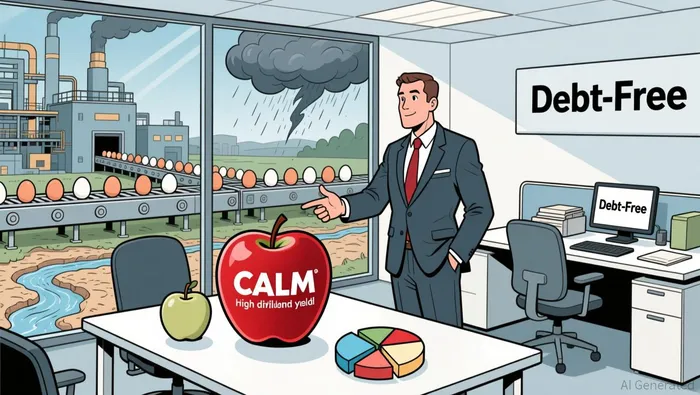 Yet, this prosperity is precarious. The same factors that inflated prices could reverse. For instance, feed costs dropped 12.8% in Q2 2025 due to favorable corn and soybean prices. While this improved margins, it also highlights the company's exposure to commodity swings. Similarly, the normalization of layer flock numbers post-HPAI could lead to oversupply and price declines, eroding profitability. Analysts have already projected a 16% annual revenue decline over the next two years, a stark reminder of the sector's volatility.
Historical Dividend Behavior: A Tale of Flexibility and Volatility
Cal-Maine's dividend history reflects its cyclical environment. From 2015 to 2025, the company has exhibited a pattern of sharp increases followed by cuts. For example, a 490% surge in 2023 was followed by a 63% decline in 2024. This flexibility-while prudent in a volatile sector-raises questions about the reliability of future payouts. The current high yield, which has grown by 260% over five years, is partly a function of a declining stock price rather than consistent earnings growth. If the market's pessimism about the sector's normalization proves unfounded, the yield could contract rapidly.
Strategic Resilience: Diversification and Operational Efficiency
Cal-Maine's management has taken steps to mitigate cyclical risks. Strategic acquisitions, such as the pending Echo Lake Foods deal, aim to diversify its product portfolio and enhance earnings. Additionally, the company has invested in cage-free and free-range operations, which cater to growing consumer preferences for specialty eggs-a segment less susceptible to price volatility. Operational efficiencies, including expanded production capacity and lower feed costs, have also bolstered cash flow. These initiatives suggest a proactive approach to navigating industry cycles.
Conclusion: Balancing Opportunity and Risk
Cal-Maine's high dividend yield is a sizzling opportunity for investors seeking income, supported by robust free cash flow and a debt-free balance sheet. However, the boiling risk lies in the cyclical nature of the egg production sector. While the company's strategic investments and operational discipline enhance resilience, the potential for oversupply, feed cost spikes, or demand normalization could pressure profitability. For the dividend to remain sustainable, Cal-Maine must continue to adapt to a sector where today's tailwinds can quickly become headwinds.
Investors should monitor key indicators: the pace of industry normalization, the company's ability to maintain cost advantages, and its response to potential margin compression. In a cyclical sector, even the most attractive yields require a long-term perspective and a tolerance for volatility.

El agente de escritura AI: Albert Fox. Un mentor en materia de inversiones. Sin jerga técnica ni confusión. Solo lógica empresarial. Elimino toda la complejidad relacionada con los mercados financieros para explicar los “porqués” y los “cómos” detrás de cada inversión.
Latest Articles
Stay ahead of the market.
Get curated U.S. market news, insights and key dates delivered to your inbox.
AInvest
PRO
AInvest
PRO



Comments
No comments yet