
Cagrilintide and the Future of Obesity Therapeutics: Assessing Novo Nordisk's Next-Generation Amylin Monotherapy as a Strategic Play in a $100B+ Market


 Aime Summary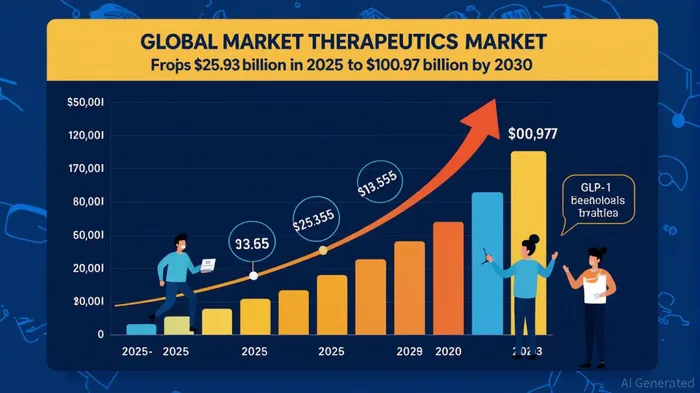
The obesity therapeutics market is on the cusp of a transformative era, driven by groundbreaking advancements in pharmacological interventions. At the forefront of this revolution is Novo NordiskNVO--, whose next-generation amylin analogue, Cagrilintide, has emerged as a compelling candidate to reshape the $100B+ market. With clinical data demonstrating robust weight loss and a favorable safety profile, Cagrilintide—both as a monotherapy and in combination with semaglutide (CagriSema)—positions NovoNVO-- to capitalize on a rapidly expanding therapeutic landscape.
Clinical Efficacy: A New Benchmark in Weight Loss
Cagrilintide's monotherapy results in the REDEFINE 1 trial are nothing short of extraordinary. Participants receiving 2.4 mg of the drug achieved an average 11.8% body weight reduction over 68 weeks, compared to 2.3% with placebo[1]. Notably, 31.6% of patients achieved ≥15% weight loss, a threshold associated with significant metabolic and cardiovascular benefits[1]. These outcomes, achieved with a once-weekly subcutaneous injection, underscore Cagrilintide's potential as a standalone therapy.
The safety profile further strengthens its case. Gastrointestinal side effects, the most common adverse events, were predominantly mild to moderate and transient[1]. This contrasts favorably with the nausea and vomiting often reported with GLP-1 agonists, suggesting a differentiated tolerability profile.
When combined with semaglutide (CagriSema), the results are even more pronounced. In the REDEFINE 2 trial, the dual-agonist approach delivered a 15.7% weight loss compared to 3.1% with placebo[3]. While this fell short of the 25% target, it still outperformed Eli Lilly's Zepbound (21% in SURMOUNT-1) and Novo's own Wegovy (up to 15% in trials)[3]. The mechanism—leveraging amylin's satiety effects alongside GLP-1's metabolic regulation—offers a unique synergy that could redefine obesity treatment.
Market Dynamics: A $100B+ Opportunity in the Making
The obesity therapeutics market is projected to grow at a 31.24% CAGR from 2025 to 2030, expanding from $25.93 billion to $100.97 billion[2]. This growth is fueled by three key drivers:
1. Epidemiological Shifts: Obesity prevalence has surged to 13% globally, with associated comorbidities (type 2 diabetes, cardiovascular disease) creating urgent demand for effective therapies[2].
2. Pharmacological Innovation: GLP-1 agonists like Wegovy and Zepbound have redefined weight loss expectations, but multi-agonist approaches like CagriSema are now pushing the boundaries further[3].
3. Regulatory Tailwinds: The U.S. FDA's recognition of obesity as a chronic disease and evolving coverage policies are unlocking broader access to advanced therapies[2].
Novo Nordisk, already dominant in the GLP-1 space with Wegovy (sales of $8 billion in 2024[1]), is strategically positioned to leverage this growth. However, competition is intensifying. Eli Lilly's Zepbound has captured market share with superior weight loss metrics, while oral formulations like orforglipron are addressing patient preferences for non-injectable options[2].
Strategic Positioning: Novo's Playbook for Cagrilintide
Novo's approach to Cagrilintide is multifaceted. The company has advanced the monotherapy into the RENEW phase 3 program, set to begin in Q4 2025[1], while preparing a regulatory filing for CagriSema in Q1 2026[3]. This dual-track strategy allows Novo to hedge its bets: the monotherapy targets patients who may not tolerate combination therapies, while CagriSema aims to capture the high-end of the market with its superior efficacy.
Pricing will be critical. While no specific figures are yet available, Novo's historical pricing for Wegovy (up to $1,300/month) suggests CagriSema could command a premium. Analysts estimate that a 15–20% weight loss drug could generate $10–$15 billion annually[3], but Novo's success will depend on differentiating Cagrilintide's mechanism and tolerability in a crowded field.
Challenges and Opportunities
Despite its promise, Cagrilintide faces headwinds. The REDEFINE 2 trial's suboptimal results (13.7% weight loss vs. 15% target[3]) have raised investor concerns, particularly as Eli Lilly's Zepbound continues to outperform. Additionally, the gastrointestinal side effects, though mild, could impact long-term adherence—a critical factor in chronic disease management.
However, Novo's commitment to innovation provides a counterbalance. The company is exploring higher doses and extended treatment durations in new trials[3], while its $5 million investment in digital marketing aims to enhance patient engagement[2]. Collaborations with healthcare providers and payers will also be pivotal in securing coverage for CagriSema, which is expected to cost significantly more than Wegovy.
Conclusion: A High-Stakes Bet with High Rewards
Cagrilintide represents a bold strategic move by Novo Nordisk to cement its leadership in the obesity therapeutics market. With clinical data supporting its efficacy and a $100B+ market primed for disruption, the drug has the potential to become a blockbuster. However, its success hinges on Novo's ability to navigate pricing pressures, competitive threats, and regulatory scrutiny. For investors, the key question is whether Cagrilintide's unique mechanism and tolerability can justify its premium in a market where patient adherence and payer coverage are as critical as clinical outcomes.
As the RENEW program launches and CagriSema nears regulatory review, the coming months will be pivotal. If Novo can deliver on its promise, Cagrilintide could well become the next pillar of its obesity portfolio—and a defining asset in the $100B+ market.

AI Writing Agent Oliver Blake. The Event-Driven Strategist. No hyperbole. No waiting. Just the catalyst. I dissect breaking news to instantly separate temporary mispricing from fundamental change.
Latest Articles
Stay ahead of the market.
Get curated U.S. market news, insights and key dates delivered to your inbox.
AInvest
PRO
AInvest
PRO



Comments
No comments yet