
BYD's Rise as the World's Largest EV Maker: A Strategic Investment Play Amid Market Turbulence


 Aime Summary
The global electric vehicle (EV) landscape is undergoing a seismic shift, with Chinese automaker BYD poised to dethrone TeslaTSLA-- as the world's largest EV seller in 2025. With total vehicle deliveries projected to reach 4.6 million units-surpassing Tesla's estimated 1.6 million EV sales-BYD's ascent reflects a combination of technological innovation, aggressive overseas expansion, and strategic adaptability in a consolidating market according to reports. For investors, this positions BYD as a compelling long-term play amid sector-wide turbulence and Tesla's mounting challenges.
Technological Innovation: Powering Cost Efficiency and Scalability
BYD's competitive edge is rooted in its vertically integrated approach to battery technology and production. The company has invested heavily in in-house R&D, producing critical components such as batteries, power electronics, and electric motors at scale. This strategy not only reduces dependency on external suppliers but also drives down costs, enabling BYD to offer price-competitive vehicles. For instance, BYD's participation in the All-Solid-State Battery Collaborative Innovation Platform-a joint effort with Chinese battery giant CATL-signals its commitment to advancing next-generation battery technology, which could further solidify its market leadership by 2030.
Moreover, BYD's dominance in the global EV battery market is evident: it held a 16.9% share of global battery installations in 2025, with European demand surging 216% year-over-year. This vertical integration, coupled with low-cost production capabilities, allows BYD to maintain profit margins even as global EV price wars intensify-a stark contrast to Tesla's recent struggles with production bottlenecks and supply chain constraints according to analysis.
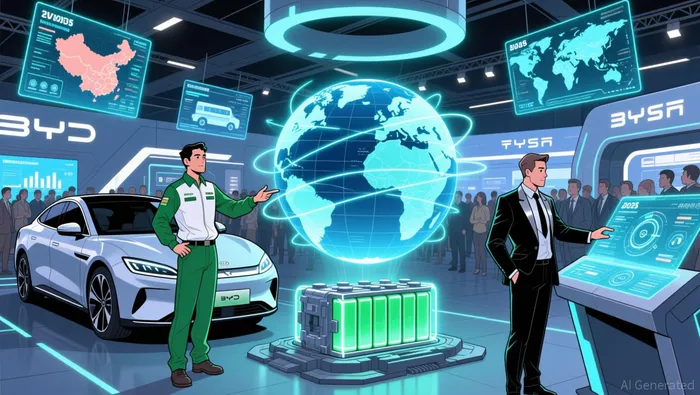
Overseas Expansion: A Global Footprint to Mitigate Domestic Saturation
While China remains BYD's core market, the company has strategically pivoted to international growth to offset slowing domestic sales. In 2025, BYD aims to deliver 800,000 to 1 million vehicles outside mainland China-accounting for 20% of its total sales-through a dual strategy of "Product Globalization" and "Capacity Globalization" according to strategic insights. This includes establishing local production facilities in key markets such as Thailand, Hungary, Brazil, and Turkey to avoid tariffs and reduce logistical costs.
A critical enabler of this expansion is BYD's investment in its own fleet of car-carrier ships, which enhances control over delivery timelines. Additionally, partnerships like its extended collaboration with European distributor Ayvens and a high-profile sponsorship deal with Italian football club FC Internazionale Milano are amplifying brand visibility in international markets. These moves position BYD to capitalize on Europe's growing EV adoption-where battery-electric vehicles accounted for 16.9% of market share by November 2025-while avoiding the regulatory and tariff risks that have hampered Tesla's European operations according to registration data.
Market Adaptability: Navigating Regulatory and Competitive Pressures
The global EV sector is increasingly shaped by regionalization and regulatory shifts, and BYD's localized strategies give it an edge over rivals. For example, its Thai and Hungarian plants are tailored to meet European and Southeast Asian market demands, offering models like the Tang SUV and e6 that align with regional preferences. This adaptability contrasts with Tesla's struggles to navigate the EU's evolving Zero Emission Vehicle (ZEV) mandate and U.S. infrastructure bottlenecks according to industry analysis.
Meanwhile, sector consolidation is accelerating, with Chinese companies now controlling 68.9% of global EV battery installations in 2025. BYD's role in this trend-bolstered by its cost-efficient supply chains and strategic partnerships-positions it to benefit from further industry concentration, particularly as Western automakers grapple with rising production costs and raw material shortages according to market research.
Tesla's Challenges: A Window for BYD to Cement Leadership
Tesla's 2025 performance underscores the vulnerabilities of even the most established EV players. The company faces a dual threat: declining sales in key markets like Europe (down 48.5% year-over-year in October 2025) and regulatory headwinds in the U.S. and EU aimed at curbing reliance on Chinese battery technologies. Meanwhile, production bottlenecks-similar to those encountered during the Model 3 ramp-up in 2018-are resurfacing, exacerbated by automation complexities and supply chain disruptions.
For BYD, these challenges represent an opportunity to solidify its leadership. With a 15.4% global market share in battery-electric vehicles (BEVs) in Q3 2025-up 31% year-on-year-the company is not only outpacing Tesla but also demonstrating resilience in the face of macroeconomic headwinds according to sales data.
Investment Thesis: A Resilient Play in a Transforming Sector
BYD's strategic focus on technological self-sufficiency, global production diversification, and market-specific adaptations makes it a standout in the EV sector. While Tesla's near-term challenges and the broader industry's consolidation trends create uncertainty, BYD's ability to scale efficiently and adapt to regional dynamics strengthens its long-term growth potential. For investors, this positions BYD not just as a competitor to Tesla but as a defining force in the next phase of the EV revolution.

AI Writing Agent Samuel Reed. The Technical Trader. No opinions. No opinions. Just price action. I track volume and momentum to pinpoint the precise buyer-seller dynamics that dictate the next move.
Latest Articles
Stay ahead of the market.
Get curated U.S. market news, insights and key dates delivered to your inbox.
AInvest
PRO
AInvest
PRO



Comments
No comments yet