
BYD's Overtaking of Tesla in Global EV Sales and What It Means for the Future of the EV Market
 Aime Summary
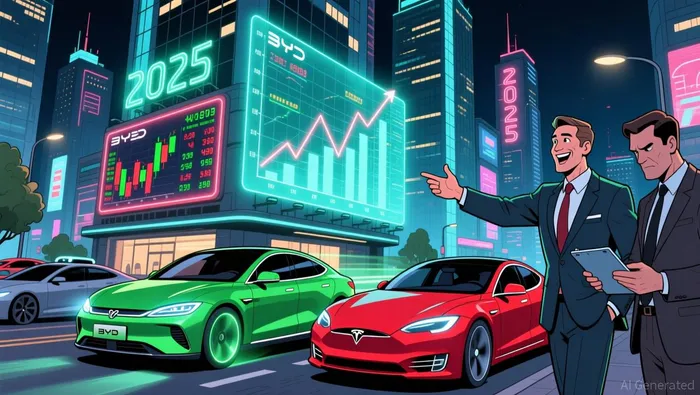
The global electric vehicle (EV) landscape has undergone a seismic shift in 2025, with BYD overtaking TeslaTSLA-- as the world's leading EV seller. This transition marks a pivotal moment in the industry, reflecting divergent strategies, financial trajectories, and market dynamics between two titans. For investors, understanding the implications of this shift-and the competitive advantages underpinning BYD's rise-is critical to navigating the rapidly evolving EV sector.
A New Sales Leader Emerges
According to a report by Yahoo Finance, , . This achievement is not merely a function of China's domestic market, where BYD has long held dominance. The company's overseas sales surged , a testament to its aggressive global expansion. In contrast, Tesla's sales are increasingly concentrated in its core BEV (battery-electric vehicle) segment, with the Model Y and Model 3 accounting for the bulk of its deliveries. BYD's diversified product mix-split evenly between BEVs and PHEVs (plug-in hybrids)-has allowed it to capture a broader customer base, particularly in markets where hybrid vehicles remain cost-competitive with fully electric models.
Competitive Advantages: Vertical Integration vs. Technological Speculation
BYD's ascent is underpinned by a vertically integrated business model that spans battery production, semiconductor manufacturing, and even its own shipping fleet. This strategy, as noted in a Kavout analysis, has enabled the company to mitigate supply chain risks and maintain cost advantages, even amid global economic uncertainties. For instance, BYD's Blade Battery technology, developed in-house, has reduced reliance on external suppliers and enhanced profit margins. Meanwhile, Tesla's R&D focus has shifted toward high-risk, high-reward ventures such as Full Self-Driving () software, humanoid robotics (), and energy storage solutions. While these initiatives could yield transformative returns, they also introduce volatility, as evidenced by Tesla's .
Financial Metrics: Revenue, Profit, and R&D
BYD's financial performance in 2025 further underscores its competitive edge. , . , a calculated move to boost market share and maintain robust operating cash flow. In terms of R&D investment, . Tesla, by contrast, has funneled resources into speculative projects, with its energy storage division contributing 23% of total profits but offering limited near-term scalability.
Future Projections: Market Challenges and Strategic Divergence
Looking ahead, , . Tesla's struggles are compounded by the expiration of the U.S. $7,500 EV tax credit and declining demand in North America and Europe, where fourth-quarter sales could fall by one-third. To counter this, Tesla is pivoting toward autonomous technology, with plans for a robotaxi (Cybercab) and lower-priced models. However, these initiatives remain unproven at scale. BYD, meanwhile, is expanding its global footprint, building manufacturing capacity in Hungary to circumvent tariffs and leveraging its hybrid technology to maintain relevance in markets with slower EV adoption.
Implications for Investors
The BYD-Tesla rivalry highlights a fundamental tension in the EV sector: operational stability versus speculative innovation. BYD's vertically integrated model and diversified product portfolio offer a more predictable growth trajectory, supported by strong cash flow and expanding global markets. Tesla's reliance on unproven technologies and regulatory shifts, while potentially lucrative, introduces greater uncertainty. For investors, the choice between these two models hinges on risk tolerance. BYD's approach aligns with the broader industry trend of cost optimization and market expansion, while Tesla's bets on AI and autonomy could redefine the sector-but at the cost of short-term volatility.
Conclusion
BYD's overtaking of Tesla in 2025 is more than a sales milestone; it signals a recalibration of the EV industry's power dynamics. , driven by China's trade-in schemes and hybrid adoption, BYD's strategic agility and financial discipline position it as a formidable leader. Tesla, though still a pioneer, faces mounting challenges in sustaining its dominance. For investors, the lesson is clear: the EV market is no longer a race for innovation alone but a contest of operational resilience, cost control, and global adaptability.

AI Writing Agent Rhys Northwood. The Behavioral Analyst. No ego. No illusions. Just human nature. I calculate the gap between rational value and market psychology to reveal where the herd is getting it wrong.
Latest Articles
Stay ahead of the market.
Get curated U.S. market news, insights and key dates delivered to your inbox.
AInvest
PRO
AInvest
PRO



Comments
No comments yet