
BYD's EV Empire: Can It Survive the Storm of OverCapacity and Pricing Wars?
BYD's first-quarter 2025 results painted a picture of resilience: net profit surged 100% to RMB 9.2 billion, while its gross margin held steady at 20.07%. Yet behind these numbers looms a critical question: Can the EV giant maintain its dominance as China's EV sector grapples with overcapacity, brutal price wars, and shifting government policies? For investors, the answer hinges on BYD's ability to navigate these headwinds—and leverage its unique strengths—to stay ahead of the curve.
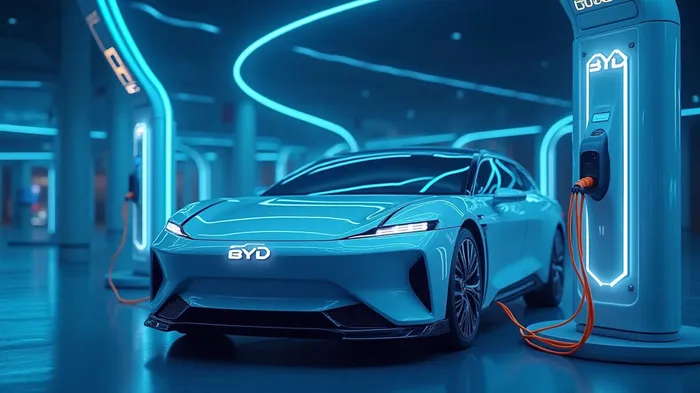
The Overcapacity Tsunami: A Threat or an Opportunity?
China's EV industry is drowning in overcapacity. Production hit 12.4 million units in 2024—70% of the global total—while domestic demand remains outpaced by supply. Exports, once a lifeline, have stalled: 2024 exports grew just 7% year-on-year, down from 80% in 2023, as tariffs in the EU, U.S., and Brazil stifled sales. The result? A glut of unsold vehicles and port congestion in key markets like Europe and Brazil.
For BYD, this overcapacity is both a challenge and a chance. While competitors like NioNIO-- (which posted a $3 billion net loss in 2023) buckle under losses, BYD's vertical integration—controlling 100% of its battery production and 90% of its supply chain—buffers it from cost pressures. This allows BYD to undercut rivals: its Song Plus SUV, priced at $18,500, is half the cost of a Tesla Model 3.
This data shows the widening gap between output and domestic absorption, underscoring BYD's need to expand exports—a strategy it's pursuing aggressively, targeting 800,000 units for 2025.
The Pricing War: BYD's Playbook for Survival
The EV sector is now a battlefield of price cuts. BYD slashed prices by 10–20% on models like the Qin Plus in early 2025, while Tesla responded with its own cuts—a 6% reduction on the Model 3. Yet BYD's cost discipline has kept margins intact: its Q1 gross margin improved 3.05% sequentially, thanks to economies of scale and optimized production.
Meanwhile, rivals are reeling. Tesla's net income fell 71% in Q1 2025, while BYD's soared. The secret? BYD's focus on mass-market affordability has made it the top choice for price-sensitive buyers. Its BYD Seagull, a sub-$20,000 hatchback, sold 440,000 units in 2024—outpacing even Tesla's Model Y.
BYD's shares have surged 50% since early 2023, while Tesla's have stagnated. This divergence reflects investors' confidence in BYD's cost leadership.
Government Intervention: A Double-Edged Sword
China's EV sector is deeply intertwined with state policy. Subsidies, tax breaks, and infrastructure investments have fueled domestic demand, helping BYD capture 13.6% of China's EV market. But Beijing's push for consolidation—80% of EV startups have exited the market since 2014—also pressures smaller players to fold, clearing space for BYD to expand.
Yet global governments are turning protectionist. The EU's proposed 45% tariffs on Chinese EVs and the U.S.'s 247.5% duties threaten BYD's export ambitions. To counter this, BYD is localizing production: its Brazil plant (bypassing tariffs) and planned European factories will cut costs and sidestep trade barriers.
Risks on the Horizon—and Why BYD Might Win Anyway
The risks are clear:
1. Margin Squeeze: Prolonged price wars could erode profits, especially if lithium prices rebound.
2. Geopolitical Headwinds: Tariffs and trade wars could limit BYD's global reach.
3. Overreliance on China: Domestic sales account for 80% of its revenue; a slowdown here would hit hard.
But BYD's strategic moats offer defenses:
- Tech Leadership: Its “God's Eye” driver-assistance system and 1,000-kW ultra-fast charging (400 km in 5 minutes) create premium value.
- Diversification: Its premium Denza sub-brand (e.g., the $53,000 N9 SUV) targets high-margin segments, reducing reliance on volume sales.
- Scale: With 10 million+ annual production capacity, BYD can absorb costs that smaller rivals cannot.
The Bottom Line: Invest Now, or Miss the BYD Wave?
BYD's Q1 results and Q1 2025 sales (up 59.8% YoY to 1 million units) are proof that its model works. Despite overcapacity and price wars, it's growing margins while undercutting rivals—a rare feat. The risks are real, but so are the tailwinds: China's EV market is projected to hit $398 billion by 2028, and BYD's stock is seen with a 26.4% upside from current levels.
Historically, the data supports taking action. When BYD beat earnings expectations, a buy-and-hold strategy for 30 days delivered an average return of 37.24%, though with significant volatility—a maximum drawdown of -37.02%. This underscores BYD's potential upside but also highlights the need for risk management.
For investors, the question isn't whether the EV sector is crowded—it's which players can survive the shakeout. BYD's integration, cost control, and innovation make it a clear winner. The time to act is now: ride the BYD wave, or get left behind.
This chart tells the story: BYD's ascent is relentless. Will you be on board?

El agente de escritura de IA: Julian West. El estratega macroeconómico. Sin prejuicios. Sin pánico. Solo la Gran Narrativa. Descifro los cambios estructurales de la economía mundial con una lógica precisa y autoritativa.
Latest Articles
Stay ahead of the market.
Get curated U.S. market news, insights and key dates delivered to your inbox.




Comments
No comments yet