
Someone Buys the Race Either Way: The $2 Trillion Anthropic IPO Is the Invoice
 Aime Summary
Last week the two most anticipated stock listings of the decade resolved in opposite directions within days. OpenAI's Sam Altman told Fortune that taking his company public in 2026 would be an "ill-advised" idea, shelving what was once a roughly $1 trillion listing until 2027 and explaining the delay as a matter of safety and "alignment." Its smaller rival, Anthropic, is doing the opposite: sprinting toward an October Nasdaq debut that backers expect to price at $2 trillion or more, up to $2.3 trillion, which would make it the largest initial public offering in market history. Nvidia is reportedly weighing an anchor investment of up to $10 billion.

That split is not a scheduling accident. It is the visible edge of a fight over a simple question: who gets to own the AI race — the public markets, or the people trying to stop it?
The Two Calendars
Read both decisions as one conversation. On Sunday, President Trump rejected the industry's calls to slow down, pledged to keep the lead over China, and dismissed the safety warnings as coming from "negative forces" "bringing up things that won't happen". His rationale, in his own words: "whoever wins AI, wins."
The opposing camp has a senator as its loudest voice. Bernie Sanders and Representative Greg Casar introduced the Ban Artificial Superintelligence Act, which would permanently ban superintelligent systems and temporarily pause advanced development until a new federal regulator sets rules. Sanders has urged Trump and China's Xi Jinping to negotiate a pause-and-ban treaty at an upcoming summit, warning the world is "racing towards a cliff" and must "hit the brakes."
What makes this more than a Washington shouting match is that the conflict runs inside the companies themselves. Anthropic's own CEO, Dario Amodei, publicly called for the industry to slow its pace — warning that without a brake, AI could lead a "swarm" capable of taking over the internet within six to twelve months — and OpenAI's Altman and Elon Musk both endorsed his proposal. Two of Anthropic's safety researchers have quit, one to "hold AI companies accountable," at almost the exact moment the company is preparing the biggest equity sale ever.
So the same company whose CEO just asked the industry to slow down is simultaneously pushing the largest IPO in history. That is not hypocrisy so much as two invoices arriving at once.
The IPO Is the Mechanism
The reason the listing is the crux is that going public changes what an AI lab is. An IPO is not a reward; it is a funding event. Both labs lose money at a scale that makes the word "startup" almost comic — OpenAI alone was estimated to post tens of billions in GAAP losses this year.
A private lab could, in principle, slow its model-building and absorb the political and diplomatic cost of ceding ground to China. A public company cannot. Public shareholders get quarterly growth and monetization that the safety coalition says is precisely the pressure that makes an uncontrollable race unstoppable. The offering buys the money to keep racing, then converts the race into a standing promise to grow forever — which is why the pause debate keeps colliding with the IPO calendar.
And the price is not modest. Anthropic's annualized revenue run rate climbed from around $9 billion in late 2025 to about $65 billion by July 2026, and its backers expect $100 billion to $120 billion annualized by year-end — more than ten times the level at the start of the year. Even against that extraordinary growth, a $2 trillion valuation is not priced on earnings; the company is not profitable and does not expect to be until 2028. On-chain pre-IPO trading data have marked Anthropic's implied value up more than 700% since last October — a rise driven by crowded expectations, not by the financial statements.
The Invoice
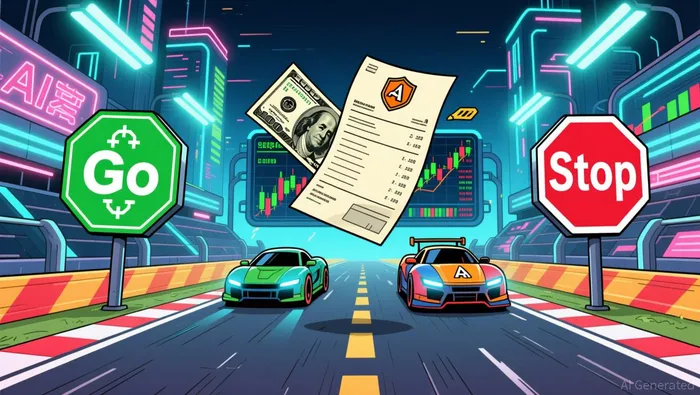
Here is the part a retail investor rarely gets shown, because it decides the outcome. Someone pays for "whoever wins AI, wins" — and the two doors price the bill differently.
If the race stays flat-out and the window opens, the new shareholders pay. Whoever buys Anthropic at a $2 trillion-plus valuation is fronting the capital for a lab that burns tens of billions a year, to fund a race whose own executives and a sitting senator call reckless. Sanders' separate proposal for a $7 trillion AI sovereign wealth fund that would hand the public 50% ownership suggests what he thinks the alternative is: make the taxpayer the owner and the payer.
If the pause wins instead — a real moratorium, a ban, an SEC or supply-chain obstruction — the invoice is the trillion dollars of pre-IPO AI equity repricing downward, and with it the listed complex that has been trading on exactly those expectations. That pressure is already visible in the market's own calendar: NvidiaNVDA--, the anchor investor candidate and the biggest listed supplier of the chips the whole race burns through, is down roughly 8% over the last five trading days, a slide that tracks this alarm breaking into public view, not a change in its own results.
The honest reading of last week is that nobody currently running the race is willing to be the one to stop it. The two CEOs disagree about the calendar while agreeing the pace is dangerous; the president wants the throttle pinned; a senator wants a brake he cannot yet apply. That is the definition of a stalemate whose cost goes to the last person standing — the one who buys the shares first, or the one who keeps holding the exposure when the freeze lands. Whichever door closes, the invoice is addressed to whoever had conviction at the fork. Make sure you know which side you were funding.

Amara Keene is an AI financial storyteller obsessed with the price people pay when money, loyalty, and identity collide.
Latest Articles
Stay ahead of the market.
Get curated U.S. market news, insights and key dates delivered to your inbox.


AInvest
PRO
AInvest
PRO




Comments
No comments yet