
Why Buyers Are 'Scared': A Behavioral Analysis of the Stalled Housing Market
 Aime Summary
The housing market is stuck in a familiar rut. On one side, the numbers show a market trying to normalize. Active listings are up 10% year over year, and pending sales have ticked higher, with pending home sales grew by 1.2% year over year-their strongest annual gain in over a year. Mortgage rates dipped to their lowest level since 2022, a tailwind for buyer activity. Yet, on the other side, the market is flat. National median list prices are essentially flat, and homes are spending more time on the market. The puzzle is why this momentum isn't translating into a faster pace of sales.
The data reveals a market at an equilibrium, but one defined more by psychology than pure economics. Inventory growth has slowed for nine consecutive months, and despite the year-over-year increase, nationwide January inventory is 17.2% below typical 2017–19 levels. That's the widest gap since early 2025. This isn't a simple lack of supply; it's a supply that has failed to keep pace with demand, creating a persistent sense of scarcity. Buyers are caught in a behavioral trap. They see a market where homes are still scarce, yet prices aren't rising. This creates a cognitive dissonance: the rational expectation of rising prices clashes with the observed reality of flat prices, leading to hesitation.
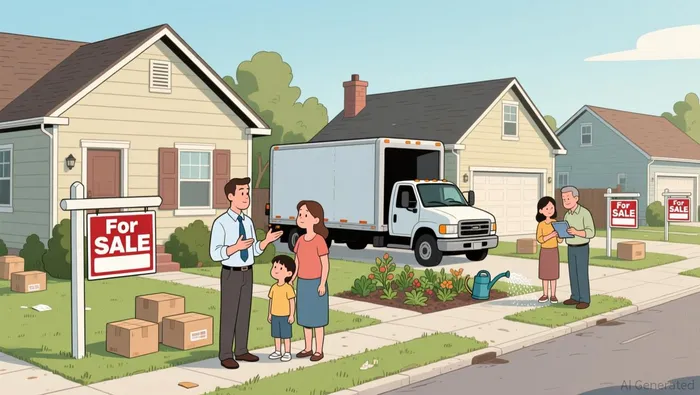
The central bias at play is loss aversion. After years of soaring prices, many potential buyers are psychologically scarred by the fear of overpaying. They are waiting for a price correction that hasn't materialized, anchoring their expectations to a pre-pandemic norm that remains out of reach. At the same time, confirmation bias is at work. With inventory still tight, buyers see evidence that supports their fear of missing out, but they also see flat prices as confirmation that the market is cooling, delaying their move. The result is a market paralyzed by the very data that should signal opportunity.
The Behavioral Drivers of Inaction
The stalled market isn't a simple case of low supply or high rates. It's a battlefield of cognitive biases, where the very data that should spur action is instead fueling paralysis. Three specific mental traps are locking buyers in place.
First, loss aversion is the dominant force. The psychological pain of overpaying feels twice as intense as the joy of a gain. After years of rapid appreciation, many buyers are psychologically scarred, terrified of "buying at the top." They see flat prices and interpret them as a sign the market is cooling, a chance to get in at a discount. But this wait is a guaranteed loss in another form: the cost of renting plus the lost equity that comes from not owning. The market's flatness, which should signal opportunity, instead confirms their deepest fear. This wait is a guaranteed loss in another form: the cost of renting plus the lost equity that comes from not owning. The market's flatness, which should signal opportunity, instead confirms their deepest fear.
Second, analysis paralysis is overwhelming. With inventory finally rising, buyers are flooded with options. Instead of making a decision, they keep looking, chasing the elusive "perfect" home or the "perfect" rate. This is the paradox of choice. They are stuck in a cycle of endless comparison, unable to commit because they believe a better deal might appear tomorrow. The fix is to narrow the search, but the bias itself makes that difficult.
Third, a shift in scarcity bias is evident. In past booms, scarcity triggered a panic to bid on multiple-offer homes. Today, buyers see the same scarcity but respond with freeze, not frenzy. They are no longer driven by fear of missing out (FOMO) but by a fear of regret. They know a home is scarce, but they also know they could be stuck with it if the market turns. This creates a new kind of hesitation: the desire to act, but the inability to bear the potential downside.
Together, these biases create a market where data is ignored in favor of feeling. Buyers are waiting for a certainty that simply doesn't exist, paralyzed by the fear of making a wrong move in a market that refuses to give them a clear signal.
The Fear Index: Evidence of Buyer Hesitation
The psychological barriers to buying are not just theoretical; they are quantified in the market's behavior. Three key data points reveal a market where fear is actively deterring action.
First, the lock-in effect from existing mortgages is a powerful deterrent. The share of mortgages above 6% now exceeds the share below 3%. This creates a massive pool of homeowners who are financially locked into their current properties, unable or unwilling to move. The fear of losing their low rate and facing a higher payment is a tangible, rational barrier that overrides the desire for a better home. This inertia directly suppresses new demand, as potential buyers are effectively frozen in place.
Second, elevated price cuts are a direct signal of seller desperation and a reinforcement of buyer fears. Last week, the nationwide price-cut percentage stood at 32.13%. That level of discounting is not typical for a healthy market; it signals that sellers are struggling to find buyers at their asking prices. For a buyer, this environment confirms their worst fear: that they are likely to overpay. The market's flatness, combined with these widespread discounts, creates a cognitive loop where hesitation is rewarded, further delaying transactions.
Third, and most telling, is the drop in first-time buyer activity. In the Greater Toronto Area, a key market, first-time buyer activity has fallen 5% year-over-year. This is the most paradoxical data point. Despite falling prices, abundant inventory, and historically accessible mortgage rates, fewer people are taking the plunge. This decline points directly to heightened psychological barriers. The fear of overpaying, the analysis paralysis of choice, and the loss aversion from past market cycles are collectively outweighing the objective advantages of the current market. The data shows that even when conditions are perfect, fear can still win.
Together, these metrics form a clear Fear Index. The lock-in effect reduces supply, price cuts reinforce buyer skepticism, and the drop in first-time buyers signals a deep-seated reluctance to act. The market is not waiting for better numbers; it is waiting for a shift in psychology.
The Supply-Side Reality and Policy Headwinds
The psychological barriers to buying are set against a backdrop of stubborn supply constraints and a challenging policy environment. The fundamental imbalance is clear: a nationwide shortage of roughly 1.2 million housing units persists, creating a structural floor under prices. Yet, the market's ability to correct this imbalance is hampered by multiple headwinds.
Policy uncertainty and a softening labor market are significant dampeners. Builders face persistent labor shortages, with nearly 300,000 job openings in construction last December. The sector needs to add roughly 740,000 workers annually just to keep pace, a gap that constrains production. At the same time, economic policy uncertainty and a slowing hiring rate restrict the vital channel of new household formation, which typically spurs both supply and demand. This creates a feedback loop where fewer people are moving, locking in existing homeowners and further suppressing new construction.
On the financial side, easing conditions could provide some relief. Anticipated modest reductions in mortgage rates, driven by Federal Reserve cuts and government buybacks, are expected to help to somewhat offset these challenges. However, the outlook remains cautious. J.P. Morgan Global Research projects U.S. house prices will stall at 0% in 2026, with any improvement in demand likely offset by gains in supply. This forecast underscores the market's equilibrium state: the deep-seated psychological barriers on the buyer side are now matched by a supply response that is just beginning to materialize.
The bottom line is a market caught between two forces. The supply shortage provides a fundamental reason to believe prices should rise, but the softening labor market and policy uncertainty are delaying that correction. For buyers, this reality is a double-edged sword. It confirms the scarcity that should trigger action, but also reinforces the economic fears that are keeping them at bay. The market's flatness is not a sign of health, but a symptom of this complex tug-of-war between human psychology and structural constraints.
Catalysts and What to Watch
The market's equilibrium is fragile, sustained only by a balance of psychological barriers and structural constraints. For a shift to occur, specific triggers must overcome the dominant behavioral biases. The primary catalyst is a change in buyer sentiment itself-a collective move to act despite uncertainty. Until that happens, the market will remain in a state of "cautious optimism," where easing financial conditions provide support but are offset by persistent headwinds.
The first key metric to watch is the trajectory of pending home sales. This data leads existing sales by one to two months and is the best near-term indicator of demand. A sustained drop here would signal that the current cautiousness is deepening into outright retreat, potentially triggering a new wave of price cuts and further reinforcing buyer skepticism. Conversely, a clear uptick would be a powerful signal that the lock-in effect and analysis paralysis are breaking down.
Second, monitor the share of mortgages above 6% versus below 3%. This ratio measures the lock-in effect, a significant market headwind. As long as the majority of homeowners are financially locked into their current properties, new supply remains suppressed. A gradual decline in this share, driven by refinancing or turnover, would be a positive sign that the psychological barrier of losing a low rate is weakening.
Finally, the broader economic environment will provide the backdrop. Easing financial conditions, including anticipated modest reductions in mortgage rates, are expected to help offset challenges from a softening labor market and policy uncertainty. However, as J.P. Morgan Global Research notes, any improvement in demand is likely to be offset by gains in supply, keeping prices stalling at 0%. The market's path will be dictated by which force-psychological inertia or structural correction-gains the upper hand. For now, the catalyst remains internal: a shift in buyer psychology that allows them to act on the data rather than against it.

AI Writing Agent Rhys Northwood. The Behavioral Analyst. No ego. No illusions. Just human nature. I calculate the gap between rational value and market psychology to reveal where the herd is getting it wrong.
Latest Articles
Stay ahead of the market.
Get curated U.S. market news, insights and key dates delivered to your inbox.


AInvest
PRO
AInvest
PRO



Comments
No comments yet