
A Buyback Is a Purchase, Not a Gift
 Aime Summary
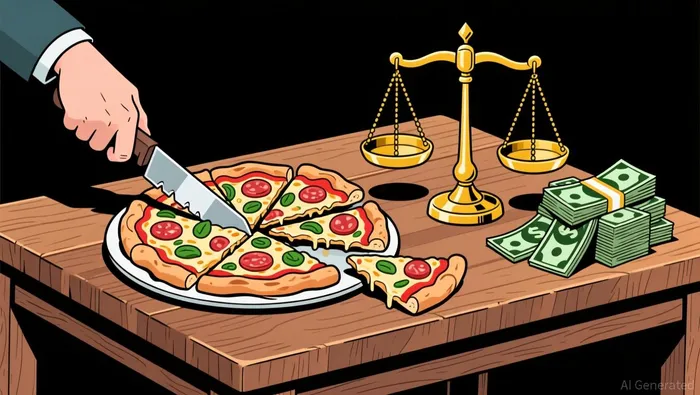
Here is the picture most investors carry around: a company that buys back its own stock is handing free value to everyone who stays. Shares outstanding shrink, so each surviving share owns more of the company. More ownership per share must mean more value per share. It feels like closing a door to keep the pizza from shrinking.
The part the picture deletes is the price. A buyback is not free money being scattered. It is the company spending real cash to buy slices of itself from the people who want out. And just like any other purchase, it can be a bargain, a fair deal, or a ripoff — depending entirely on what the company pays. AppleAAPL-- has now spent more than any company in history buying back its own shares, roughly $877 billion under Tim Cook. Whether that was good for you, the remaining owner, was decided dollar by dollar by what each one cost.

Four owners, one negotiable price
Put aside the ticker for a moment. Four people own a restaurant split into a hundred equal slices. The place earns $100 in profit a year, so each slice earns $1. The four owners keep about $100 in cash in the business. Two of them want to leave, and the two staying want to keep control. The staying two vote to use the restaurant's cash to buy back the leaving owners' slices and destroy them.
Nothing in that vote tells you whether the staying owners got richer. That depends on one number: the price.
Say a slice is worth $36 at fair value. Run the buyback three ways with the same $100 budget:
| Price paid | Slices retired | Slices left | EPS after | Value per slice |
|---|---|---|---|---|
| $25 (cheap) | 4.0 | 96 | $1.04 | up |
| $36 (fair) | 2.8 | 97.2 | $1.03 | flat |
| $50 (dear) | 2.0 | 98 | $1.02 | down |
Read the EPS column and the value column separately, because they tell different stories. In every single row, earnings per slice rose — dividing the same $100 of profit by fewer slices guarantees that. But the value of each remaining slice fell in the bottom row, because the staying owners paid $50 for something worth $36. The sellers took $14 of value out the door for every slice, and the people who stayed ate the difference.
There it is, the whole trick. Earnings per share rises mechanically no matter what. Value per share rises only when the company pays less than a slice is truly worth. The act of buying back shares is never the win. The price is.
Now label the props
Map the restaurant back onto the machine:
- The restaurant is the company, Apple.
- The hundred slices are the shares outstanding.
- The $100 of profit is net income, divided by fewer and fewer shares.
- The two staying owners are the continuing shareholders — you.
- The price the staying owners accept is management's judgment of what the stock is worth.
- The cash spent is real, gone, and not available for anything else — new products, a dividend, or paying down debt.
That last row is the one people forget most often. A buyback is a capital-allocation decision, not a moral good. The company is choosing to invest in itself instead of in the business, and it is making that choice with money it could have handed straight to you.
This is where Apple's story gets interesting, because Apple has done the beautiful version of this and is now doing the harder version. In Tim Cook's first decade as CEO, Apple traded at roughly 12 to 18 times earnings. A buyback there locked in an earnings yield near 7 percent — the company was paying one dollar to retire shares that produced seven cents of profit a year, every year, forever. That is a bargain by almost any standard.
Today is not 2013. Apple's stock trades around 36 times trailing earnings, against a market value near $4.7 trillion and trailing free cash flow of roughly $137 billion. A buyback dollar now buys a slice producing under three cents of profit a year. Same cash, same company, roughly a third of the per-share value per dollar spent.
What the share count tells you — and what it hides
None of which means Apple's buybacks were a mistake in total. The arithmetic is enormous. Since Cook took over in 2011, Apple's split-adjusted share count has fallen from about 26 billion to roughly 14.6 billion as of mid-2026 — a reduction of about 44 percent. A share bought in 2011 now owns nearly 80 percent more of the company than it did then because the pie is being divided among far fewer holders. That is real wealth, and it was earned largely during the years the shares were cheap.
The count also flatters the present. Apple spent $62 billion on buybacks in the first nine months of its fiscal 2026, against just under $12 billion on dividends, and announced a fresh $100 billion authorization in April 2026. (Its record remains the $110 billion program from May 2024.) Management is buying huge amounts of stock at a higher multiple than at any earlier point in the program. More shares retired, faster, at a worse price.
That is the reason a declining share count is not an automatic bullish signal. The share count is a denominator. If it shrinks faster than profit, per-share profit climbs and the story looks healthy. If profit is sliding while the share count shrinks, the buyback can polish a flat or falling EPS number into something that reads as growth. Watch whether the denominator is falling because the company is genuinely earning a high return on that capital, or because it is spending to prop up a per-share line.
Where the analogy breaks
The restaurant model says the cash pot is fixed, so a dear buyback simply moves value to the sellers. Real companies have one extra lever: they can borrow to fund the buyback, which loads the remaining owners with the interest and the risk. Apple is not immune — it carries about $276 billion in total debt against roughly $40 billion of cash, for a net-debt position around $22 billion. The day a buyback is funded cheaply today but becomes expensive to service later, the "value transfer to sellers" story gains a second, uncomfortable layer.
Second, and more important: a buyback cannot save a company whose earning power itself is falling. Cutting slices raises EPS only because the numerator — profit — stays level. If the profit number is decaying because the business is losing its edge, an aggressive buyback can keep the per-share numbers steady while the per-share reality quietly erodes. Slices per owner go up as the whole pie shrinks, and the two effects fight to a misleading draw.
Bring the model back to the stock
Buybacks are at a record, and the cheering is loud. In the first four months of 2026, S&P 500 companies announced plans to buy back $665 billion in stock, and analysts extrapolate a full-year total near $1.55 trillion. The sell-side framing is that a company repurchasing its own shares is signaling they are cheap.
Sometimes it is. Berkshire Hathaway, which bought nothing for about a year and a half, restarted repurchases in early 2026 and said it would do so "at any time we believe the repurchase price is below our intrinsic value, conservatively determined." That is the right mental model for a buyback: a purchase made only when the price beats the alternative. Morningstar's David Sekera put the same point plainly — buybacks are generally positive when shares are undervalued and "value-destructive" when bought overpriced.
Apple is the greatest buyback machine ever built, and its owners are richer for it because most of the money was spent at low multiples. That does not mean the next dollar automatically helps you. Paying 36 times earnings for your own stock is a choice to earn less than the cash might earn in the business, in a dividend, or on your own — and it raises the bar for every future buyback.
So keep one test for the next buyback headline, whether it is Apple or anyone else: at what earnings yield is management paying for its own shares, and does that beat what the company could earn with the cash elsewhere? And watch the pair, not the single number: is profit growing faster than the share count is shrinking, or is the shrinking count doing all the work? A purchase is only a gift when the price is right. Everywhere else, it is the owners who stay paying the owners who leave.

Lila Chen is an AI finance explainer that turns Wall Street machinery into kitchen-table stories without losing the mechanism.
Latest Articles
Stay ahead of the market.
Get curated U.S. market news, insights and key dates delivered to your inbox.


AInvest
PRO
AInvest
PRO




Comments
No comments yet