
Buy the Speech? Thirty Years of Data Challenge a Popular Market Myth
Backtest Finds Little Next-Day S&P Edge After State of the Union Addresses
Using AInvest's AI powered backtesting, a review of roughly three decades of trading history suggests that investors looking for a reliable, repeatable “State of the Union trade” may be disappointed.
Our backtest examining the S&P 500’s performance on the first trading day after the President’s State of the Union address—along with the analogous first-year “Address to a Joint Session of Congress” for new presidents—found the next-day move was, on average, essentially flat. The analysis approximated the S&P 500 using the SPDR S&P 500 ETF Trust (SPY) and covered speeches from 1994 through 2024, for 31 addresses in total. It defined the event return as SPY’s close-to-close percentage change on the first trading session following the speech—for example, a Tuesday evening address maps to the Wednesday trading day.
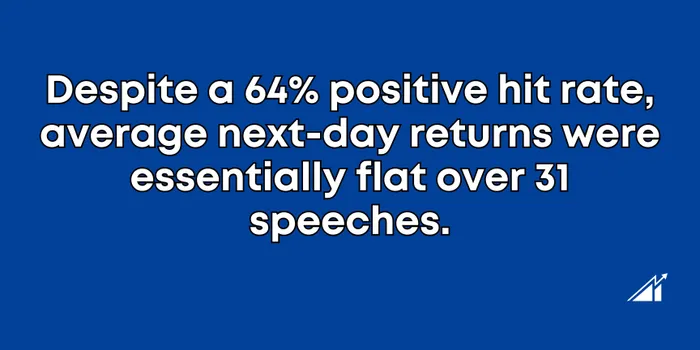
Across those 31 observations, the average next-day return was about +0.02%, while the median was +0.39%, indicating that the “typical” reaction skewed modestly positive even as the average was pulled toward zero. Next-day volatility—measured as the standard deviation of returns—was roughly 1.20%, and about 64.5% of the post-address sessions were positive (about 20 out of 31 days).
The range of outcomes was wide. The strongest next-day gain in the sample followed President Biden’s March 1, 2022 address, with SPYSPY-- up about 1.84% on March 2, 2022. The weakest next-day result followed President Clinton’s Jan. 27, 2000 address, when SPY fell about 3.12% on Jan. 28, 2000.
To test whether these post-address sessions behaved differently from “normal” market days, the backtest compared them to all regular SPY trading days over a similar mid-1990s-through-2024 window. In that broader set, the average daily return was about +0.046%, the median about +0.068%, daily volatility about 1.19%, and roughly 54% of sessions were positive. On that comparison, post–State of the Union days did not show a meaningfully stronger average return than typical sessions—if anything, they were slightly weaker on average—while the median return and “hit rate” were higher. The analysis tied the difference between the higher median and the near-zero average to a small number of sizable down days that dragged on the mean.
The report cautioned against reading too much into the pattern. With only 31 events since 1994, the sample is small, and a handful of large moves can dominate results. It also argued that the most dramatic post-address sessions likely reflected broader macro or market conditions rather than the incremental content of a speech that is often widely anticipated.
A breakdown by president was presented as context rather than a trading signal. Using the same methodology, the mean next-day returns were roughly: Clinton (seven addresses) about –0.28%; George W. Bush (eight) about +0.34%; Obama (eight) about –0.45%; Trump (four) about +0.62%; and Biden (four through 2024) about +0.20%. The analysis emphasized that per-president samples of four to eight observations are too small to support statistically reliable inferences, especially across very different market regimes.
For investors, the practical conclusion was straightforward: a simple strategy of buying at the close before the address and selling at the next close did not show a strong or consistent edge over the period studied. The report suggested that anyone trading around these dates would need to embed them in a broader macro or policy framework—or focus on volatility and positioning dynamics—rather than treating the speech itself as a standalone directional catalyst.

Adam Shapiro is a three-time Emmy Award–winning content creator, former network news correspondent, and founder of the multimedia production company TALKENOMICS. At AInvest, he created and launched Capital & Power, a video podcast series designed to drive engagement and establish thought leadership, while also producing original live streams, financial articles, and investor-focused video content. Previously, as a correspondent at FOX Business, Shapiro established the network’s Washington, D.C. bureau, reported from the White House, Capitol Hill, and the Federal Reserve, and secured exclusive bipartisan interviews with influential leaders. His reporting helped solidify FOX Business as the most-watched business channel on television. At the same time, his original Talkenomics series drew tens of thousands of viewers per episode through insightful conversations with policymakers, economists, and thought leaders. At Yahoo Finance, he played a critical leadership role in expanding digital programming to eight hours of live, bell-to-bell financial news coverage, dramatically increasing traffic from 68M to 104M unique monthly visitors and growing ad revenue from zero to over $50 million annually. Yahoo Finance continues to benefit from the credibility of Shapiro’s exclusive interviews with former President Donald Trump and numerous Fortune 500 CEOs.
Latest Articles
Stay ahead of the market.
Get curated U.S. market news, insights and key dates delivered to your inbox.


AInvest
PRO
AInvest
PRO



Comments
No comments yet