
U.S. Business Activity Slows to 11-Month Low as Oil Soars, Inflation Risks Reignite
 Aime Summary
U.S. business activity growth cooled to an 11-month low in March, as escalating conflict in the Middle East drove a sharp rise in energy costs and heightened economic uncertainty, reinforcing concerns that inflation could accelerate again in the months ahead.
According to S&P Global, its flash U.S. Composite Purchasing Managers' Index (PMI), which tracks both manufacturing and services, fell to 51.4 from 51.9 in February. While a reading above 50 still signals expansion, the decline marked a second consecutive monthly slowdown and the weakest pace since last April.
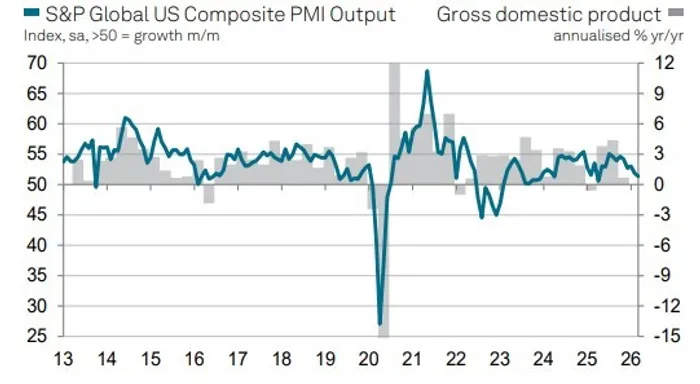
The slowdown was largely driven by the services sector, where activity slipped to 51.1 from 51.7, missing expectations and reflecting weakening demand. Businesses reported that rising living costs and increased uncertainty tied to the war weighed heavily on consumer spending, particularly across travel, transport, and tourism-related industries. In contrast, manufacturing showed modest resilience, with PMI rising to 52.4, supported in part by a slight easing in tariff-related pressures and improved order books.
Chris Williamson, chief business economist at S&P Global Market Intelligence, described the March data as an "unwelcome combination" of slowing growth and rising inflation following the outbreak of war. He noted that companies are facing a dual shock: softening demand alongside surging input costs, driven primarily by higher energy prices and disrupted supply chains.
Oil prices surged more than 30% amid the conflict, exacerbated by disruptions around the Strait of Hormuz, a critical artery for global crude flows. The spike pushed U.S. gasoline prices up by nearly $1 per gallon at their peak, intensifying inflationary pressures across the economy. Although oil pulled back slightly after President Trump signaled a temporary delay in military escalation, price levels remain elevated.
The surge in energy costs fed directly into broader price pressures. S&P Global's measure of input prices jumped to 63.2 from 60.0, while output prices—what firms charge customers—rose to 58.9, indicating that businesses are increasingly passing higher costs on to consumers. The data suggest consumer inflation could climb back toward the 4% range in the near term.
At the same time, firms are adjusting defensively to the uncertain environment. Many companies reported building precautionary inventories and cutting overheads, including reducing headcounts. The survey's employment gauge fell into contraction territory at 49.7, marking the first decline in private-sector employment in over a year, led by weakness in services.
Despite the softening PMI data, other labor market indicators, such as weekly unemployment claims, continue to signal relatively stable conditions, suggesting the broader slowdown may remain contained for now.
The PMI readings are consistent with a modest pace of economic expansion, pointing to annualized GDP growth of around 1.0%, with first-quarter growth estimated near 1.3%. However, the outlook remains highly uncertain.
The Federal Reserve, which last week held interest rates steady, has already acknowledged rising inflation risks and a murkier economic backdrop. Policymakers now face a growing dilemma: whether to prioritize containing inflation fueled by energy shocks or to support an economy that is beginning to lose momentum.
As Williamson noted, the Fed will need to carefully balance "intensifying upside risks to inflation against the growing risk of the economy losing growth momentum," with the trajectory of oil prices, supply chains, and the duration of the conflict likely to determine the path forward.

Crypto market researcher and content strategist with 3 years of experience in digital asset analysis and market commentary. Skilled at transforming complex blockchain data and trading signals into clear, actionable insights for investors. Experienced in covering Bitcoin, Ethereum, and emerging ecosystems including DeFi, Layer2, and AI-related projects. Passionate about bridging professional market research with accessible storytelling to empower readers and investors in the fast-evolving crypto landscape.
Latest Articles
Stay ahead of the market.
Get curated U.S. market news, insights and key dates delivered to your inbox.


AInvest
PRO
AInvest
PRO



Comments
No comments yet