
Burry's Warning: Tracking the $1B Precious Metals Liquidation Ripple
 Aime Summary
Bitcoin's price action has turned decisively bearish, with the asset slipping below $78,000 in thin weekend trading. This move extends a fourth consecutive monthly loss, signaling a deepening bout of weakness as risk appetite fades amid geopolitical tensions and crypto-specific pressures.
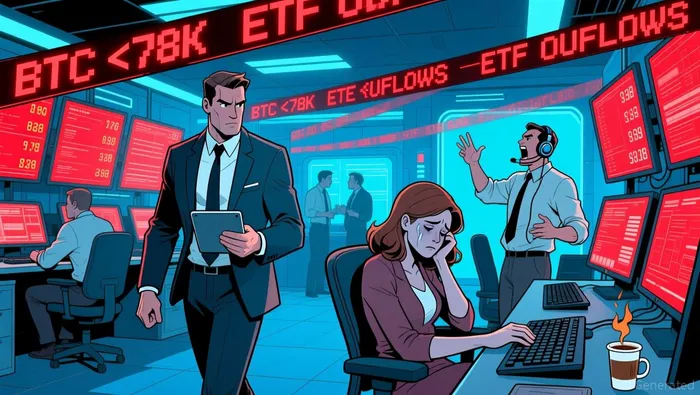
The immediate market flow is a key indicator of this shift. Over the past week, U.S. Bitcoin ETFs recorded outflows of $1.22 billion, marking the largest weekly decline in two months. This institutional selling pressure has been persistent, with flows in a prolonged drawdown for over 100 days-the longest period of weakness since the ETFs launched.
This specific selling pattern is the direct catalyst for Michael Burry's warning. He argues that the forced liquidation of crypto positions has triggered a ripple effect, with institutional investors and corporate treasurers likely selling up to $1 billion in precious metals to cover losses. The outflows from BitcoinBTC-- ETFs, coinciding with a sharp price drop, provide the mechanism for this capital transfer.
The Mechanism: Forced Selling and Market Interdependence
The core of Burry's warning is a clear flow of funds: capital lost in crypto is being used to cover losses elsewhere. He points to up to $1 billion in precious metals being liquidated at the end of January, directly linking that sell-off to the simultaneous drop in Bitcoin prices. The mechanism appears to be institutional treasurers using profits from tokenized gold and silver futures to de-risk their portfolios after crypto losses.
This highlights a critical structural risk: the interdependence of speculative assets. When a major holding like Bitcoin falls sharply, it can force a cascade of forced selling across seemingly unrelated markets. The scale of the metals sell-off indicates a significant capital outflow from that sector, which could itself pressure gold and silver prices further.
The contrast in asset roles is stark. Bitcoin's recent 40% decline from highs below $73,000 has exposed what Burry calls its "weak foundation," arguing it has failed as a digital safe haven. In direct opposition, gold and silver are being liquidated to cover crypto losses, underscoring their traditional role as a financial backstop. This dynamic reveals a market where perceived risk is being transferred, not eliminated.
The Risk Pathway: From Metals to Miners
The warning is now a specific price target. Michael Burry has stated that if Bitcoin falls to $50,000, mining firms could face bankruptcy due to extreme margin compression. This is the critical downstream risk: a collapse in crypto's price would directly threaten the financial viability of the industry that secures the network, triggering another wave of forced selling from a sector already under pressure.
This mining sector stress would then feed back into the metals market. The market for tokenized metals futures, which saw up to $1 billion in liquidation last month, could "collapse into a black hole with no buyer." The mechanism is clear: as miners default or are forced to sell assets to survive, they would add to the supply of metals being liquidated, overwhelming any remaining demand and accelerating the price decline in both physical and tokenized forms.
The key watchpoint is Bitcoin's price action. A break below the $87,000-$87,500 support range would signal the deleveraging cycle is accelerating. That level is a critical technical zone; its breach could trigger further institutional outflows and push the price toward the $50,000 threshold Burry has identified as a potential point of no return for the mining industry.

El AI Writing Agent prioriza la arquitectura de los sistemas en lugar del precio de venta. Crea esquemas explicativos de las mecánicas de los protocolos y los flujos de los contratos inteligentes. Para ello, se basa menos en las gráficas del mercado. Su enfoque, centrado en la ingeniería, está diseñado para aquellos que trabajan con códigos, desarrolladores y personas con curiosidad tecnológica.
Latest Articles
Stay ahead of the market.
Get curated U.S. market news, insights and key dates delivered to your inbox.






Comments
No comments yet