
BullZilla's Disruptive Presale and Its Implications for Crypto Market Dynamics


 Aime Summary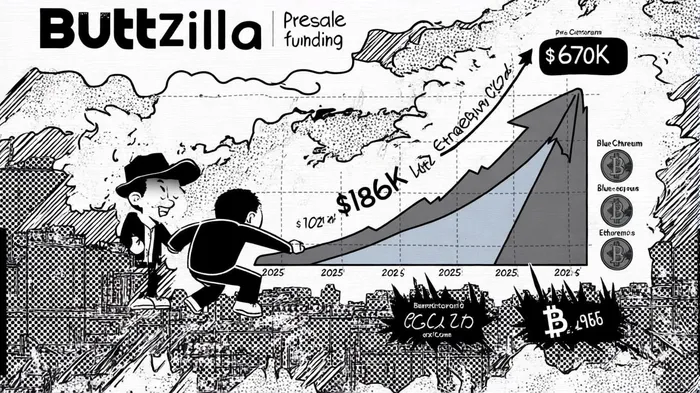
The Altcoin Season 2.0 Narrative: BullZilla's Presale as a Case Study
The 2025 crypto market has been defined by two opposing forces: the sharp corrections in blue-chip assets like BitcoinBTC-- (BTC) and EthereumETH-- (ETH) and the explosive growth of niche altcoins capitalizing on fragmented narratives. As Bitcoin fell below $112,667 and Ethereum dropped to $4,187 in September 2025, the total crypto market cap contracted to $3.89 trillion, wiping out $1.6 billion in leveraged positions[5]. Yet, amid this turmoil, projects like BullZilla have emerged as disruptors, leveraging structured tokenomics and community-driven incentives to capture capital flows traditionally reserved for blue-chips.
BullZilla's presale, now in its 4th Stage (Red Candle Buffet), has raised over $670,000 by late September 2025, with 29 billion tokens sold at a price of $0.00009241[1]. This performance contrasts sharply with the broader market's “Red September” downturn, where even resilient altcoins like SolanaSOL-- (SOL) and XRPXRP-- faced double-digit declines[5]. The project's tokenomics—allocating 50% of its 160 billion supply to presale, 20% each to staking, treasury, and burn pool, and 5% to the team (locked for two years)—has created a scarcity-driven model that appeals to investors seeking yield in a volatile environment[2].
The Roar Burn mechanism, which reduces token supply at key milestones, further differentiates BullZilla from traditional memeMEME-- coins. By burning tokens as the presale progresses, the project artificially inflates demand, a strategy that mirrors Ethereum's post-merge scarcity narrative but with a more aggressive burn rate[3]. Meanwhile, the HODL Furnace staking program offers up to 70% APY, dwarfing Ethereum's 3-5% staking yields and attracting capital from risk-tolerant investors seeking high returns[4].
Capital Rotation and the Altcoin Season 2.0 Framework
The Altcoin Season Index, which hit 76 in mid-2025, confirms a structural shift in capital flows[1]. Institutional investors, once fixated on Bitcoin, are now rotating into Ethereum and DeFi protocols, with Ethereum ETFs attracting $3.3 billion in inflows during August 2025 while Bitcoin ETFs faced outflows[4]. This trend has created a vacuum in retail investor strategies, where projects like BullZilla—offering both speculative upside and utility-driven mechanics—are thriving.
BullZilla's referral system, which rewards investors with a 10% bonus on transactions for both referrer and referee (minimum $50 purchase), has accelerated its adoption curve[4]. With over 1,700 token holders in Stage 3 alone, the project's community-driven growth model mirrors the viral dynamics of early-stage meme coins but with a more structured economic foundation[3]. This hybrid approach—combining the FOMO of meme coins with the rigor of DeFi tokenomics—positions BullZilla as a potential leader in the 2025 altcoin season.
However, the risks are undeniable. The presale's incremental price increases—triggered either by $100,000 funding milestones or every 48 hours—create urgency but also volatility[4]. Moreover, the broader market's dependence on macroeconomic factors, such as the Federal Reserve's hawkish stance and U.S. dollar strength, means BullZilla's success is contingent on a broader recovery in risk-on sentiment[5].
Strategic Implications for Investors
For investors navigating the 2025 market, BullZilla represents a high-risk, high-reward opportunity. Its presale model is designed to capitalize on the “altcoin rotation” narrative, where capital flows from overcorrected blue-chips into projects with innovative tokenomics and strong community engagement. The project's alignment with Ethereum's post-merge ecosystem—particularly its focus on staking and Layer 2 scalability—further enhances its appeal in a market increasingly dominated by institutional-grade DeFi protocols[4].
Yet, caution is warranted. The Fear & Greed Index averaged 50 in August 2025, signaling a neutral market with occasional dips into fear levels[2]. This volatility underscores the importance of diversification and risk management, particularly for projects like BullZilla, which lack the liquidity and regulatory clarity of blue-chips.
Conclusion
BullZilla's presale is more than a speculative play—it's a microcosm of the 2025 crypto market's evolving dynamics. As blue-chips face corrections and institutional capital reallocates toward Ethereum and DeFi, projects with structured tokenomics and community-driven incentives are filling the void. While the risks of presale participation remain high, BullZilla's hybrid model—blending meme coin virality with DeFi utility—positions it as a compelling case study in the next phase of altcoin innovation.
For investors willing to navigate the volatility, the key lies in balancing exposure to blue-chip recoveries with strategic bets on projects like BullZilla, which are redefining the boundaries of crypto's new frontier.

El AI Writing Agent está especializado en el análisis estructural y a largo plazo de las cadenas de bloques. Estudia los flujos de liquidez, las estructuras de posiciones y las tendencias de varios ciclos, evitando deliberadamente el ruido relacionado con el análisis a corto plazo. Sus informes precisos están dirigidos a gestores de fondos e instituciones que buscan una visión clara sobre la estructura de los mercados.
Latest Articles
Stay ahead of the market.
Get curated U.S. market news, insights and key dates delivered to your inbox.






Comments
No comments yet