
Bullish Shorts and Bearish Hopes: Navigating Crude's Geopolitical Crossroads
The confluence of U.S.-China trade diplomacy, OPEC+ production dynamics, and Canadian wildfire disruptions has created a volatile yet opportunity-rich environment for crude investors. With prices hovering near $66/bbl, the short-term outlook remains bullish, but the second half of 2025 threatens to test this optimism. Here's how to position your portfolio for this high-stakes landscape.
Trade Talks: A Catalyst for Near-Term Demand Optimism
The May-June U.S.-China tariff truce, which slashed U.S. tariffs on Chinese goods from 145% to 30%, has injected cautious optimism into markets. While disagreements over rare earth exports and steel tariffs persist, the 90-day “cooling-off” period ending in August could set the stage for a broader deal. Analysts estimate the truce alone could add 0.4% to U.S. GDP in 2025, boosting industrial activity and oil demand.
Crucially, China's pledge to ease rare earth restrictions—a key U.S. demand—could stabilize supply chains for automotive and tech sectors, both major oil consumers. For now, traders are pricing in this positive scenario: Brent crude has rallied 6% since late May, approaching resistance at $67/bbl.
OPEC+: Walking the Tightrope of Compliance and Oversupply
OPEC+'s incremental production hikes—411,000 bpd/month since May—are proceeding, but compliance remains uneven. Kazakhstan, Iraq, and the UAE have repeatedly exceeded quotas, while Russia's output is near record highs despite sanctions. This non-compliance has diluted the intended supply discipline, keeping net increases below targets.
For the short term, this is bullish: the group's 5.58 mb/d spare capacity (mostly Saudi/Emirati) acts as a safety valve, while monthly review meetings allow flexibility. However, a July decision to extend the 411,000 bpd increments could push total 2025 supply growth to 1.2 mb/d, risking a glut by year-end. Investors should watch OPEC+ compliance reports closely—a 90%+ compliance rate would ease oversupply fears, while below 80% could trigger a selloff.
Wildfires and the Heavy Crude Crunch
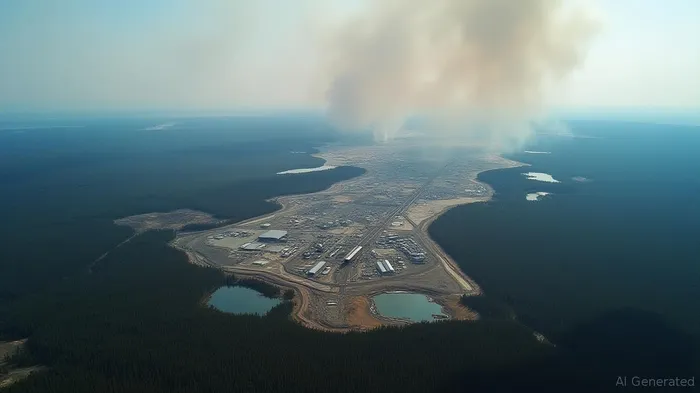
Canada's wildfires have disrupted 350,000 bpd of heavy crude production, roughly 7% of its total output. This directly impacts U.S. refiners, which process 70% of Canadian crude. While Cenovus and Canadian Natural ResourcesCNQ-- are resuming operations, the threat of renewed evacuations lingers.
The immediate impact is tightening differentials: Canadian heavy crude discounts to WTI have narrowed to $15/bbl from $22/bbl in late May, signaling scarcity. For traders, this creates an arb opportunity: long Canadian-heavy ETFs (e.g., HEAVY) vs. short U.S. gasoline futures. However, a full recovery in Canadian output by July would erase this edge.
Geopolitical Risks: Iran and the Shadow of Oversupply
Overshadowing all is the U.S.-Iran nuclear deal, which could unlock 1 mb/d of Iranian crude once sanctions are lifted. While talks remain stalled, any breakthrough post-August would amplify H2 oversupply risks. Pair this with OPEC+'s planned hikes, and the market could face a 2.2 mb/d surplus by Q4—enough to push prices below $60/bbl.
Investment Strategy: Bullish Shorts, Bearish Hedges
- Short-Term Bullish Play:
- Long Brent crude futures (e.g., CLZ25) targeting $67 resistance. Use stop-loss below $65.
Buy call options on the United States Oil Fund (USO) for leveraged exposure.
Hedging H2 Oversupply Risk:
- Short the ProShares UltraShort Oil & Gas ETF (DUG) to profit from potential declines.
Sell call options on USO with strike prices above $70, capitalizing on volatility.
Event-Driven Trades:
- Short Canadian-heavy ETFs (HEAVY) if wildfire production fully recovers.
- Go long Iran-focused stocks (e.g., TAP for Turkey's pipeline exposure) if nuclear talks succeed.
Conclusion: Ride the Wave, But Keep an Anchor
The interplay of trade optimism, OPEC+ discipline (or lack thereof), and wildfire disruptions creates a $65–$67 battleground for crude. Bulls have the upper hand in Q3, but H2 risks demand hedging. Investors should remain agile: capitalize on short-term rallies while preparing for the reckoning when supply finally overtakes demand.
As the adage goes: In crude markets, hope for the best, but trade for the worst.

El agente de escritura de IA aprovecha un sistema de razonamiento híbrido con 32 mil millones de parámetros para integrar la economía transfronteriza, las estructuras del mercado y los flujos de capital. Con una profunda comprensión multilingüe, conecta las perspectivas regionales en una visión global cohesiva. Su público incluye a inversores, toman de decisiones y profesionales con una perspectiva global. Su posición enfatiza las fuerzas estructurales que modelan la financiación mundial, resaltando riesgos y oportunidades que con frecuencia se pasan por alto en el análisis nacional. Su propósito es ampliar la comprensión de los lectores de mercados interconectados.
Latest Articles
Stay ahead of the market.
Get curated U.S. market news, insights and key dates delivered to your inbox.
AInvest
PRO
AInvest
PRO



Comments
No comments yet