
Be Bullish as AI Fundamentals Could Overshadow Any Concerns, Key Takeaways from the Q2 Earnings Recap
The stock market is nearing historic highs as a resilient economy eases tariff concerns and strong earnings highlight the early payoffs from AI, even as inflation clouds the outlook for rate cuts. With the Q2 earnings season almost finished and NvidiaNVDA-- and BroadcomAVGO-- still to report, investors shouldn’t be surprised if more exceptional results emerge. Tech giants continue to ramp up AI investment, with some already moving into early monetization and seeking greater computing capacity. The message is clear: AI is here to stay, with potential applications ranging from nuclear energy to cryptocurrency. Yet the race is increasingly divided — the strongest players may see their valuations stretch further, while laggards risk steep declines. At the same time, emerging fintech innovations are beginning to ripple across the entire system.
Mag 7: Big 4 are the clear winners, while others lag
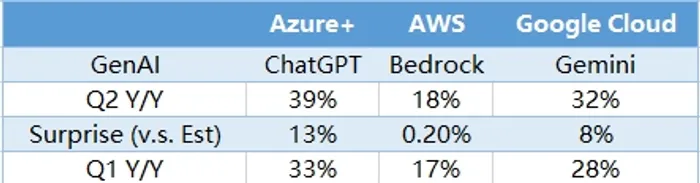
AI is intensifying competition in cloud services as enterprise clients prioritize advanced capabilities and demand greater computing resources. Microsoft’s Azure and GoogleGOOGL-- Cloud both posted accelerated year-over-year growth in Q2 at 39% and 32%, respectively, up from 33 percent and 28 percent in Q1, driven by rising demand for ChatGPT and Gemini. In contrast, AWS, the largest cloud provider, saw growth of 18%, only one percentage point higher than the prior quarter, hindered by the absence of powerful generative AI offerings. Both Azure and Google Cloud exceeded consensus expectations, while AWS merely met them. Technology investors increasingly require upside surprises to justify holding positions, and AmazonAMZN-- has yet to convince the market of its AI leadership. Its core e-commerce business could also face headwinds from potential tariffs under a Trump administration, putting it in a less favorable position.
Meta, despite lacking a competitive generative AI model for now, has integrated AI effectively into its social media platforms, improving recommendation systems and monetization. The company delivered one of the most notable surprises of the season, with EPS beating estimates by 21 percent and revenue exceeding expectations by about 6 percent. Mark Zuckerberg is investing heavily to recruit talent from OpenAI, AppleAAPL--, and others, while committing billions to AI data center infrastructure, signaling a clear ambition to further embed AI in its business model. This integration is already boosting profitability, and a successful future generative AI launch could accelerate growth even more.

Tesla and Apple remain less directly tied to AI. Tesla’s core business is driven by automotive sales, which are now pressured by rising EV competition and reduced incentives. Its valuation depends heavily on Elon Musk’s vision for robotaxis and the Optimus humanoid robot. Although both involve advanced AI training, they are specialized areas with less visibility and potentially greater challenges. Apple is far behind in AI development, lacking sufficient GPU resources and key talent, and has yet to find a path to effectively leverage and monetize AI. Investors may take a more cautious stance toward these two names, even as they attempt to catch up.
Nvidia remains the most prominent winner. Its early monetization of AI continues to drive purchases of GPUs by technology giants, with expectations for increased capital spending. Companies still in heavy investment phases will need Nvidia’s products to compete, sustaining demand for its GPUs over an extended period. The upcoming earnings report is expected to validate Nvidia’s valuation, fueled by the AI boom. The industry as a whole is transitioning from pure investment to early monetization, although it is still too early to call a full inflection pointIPCX--. The global AI race is intensifying, moving from training to more advanced inference and real-world applications.
Microsoft and MetaMETA-- are approaching market capitalization milestones and could soon surpass four trillion and two trillion dollars respectively. Google remains well positioned as investors reassess its potential after earlier threats from OpenAI. Apple could become attractive if it manages a credible turnaround in AI, while Amazon and TeslaRACE-- still need to prove they can truly compete in the space despite substantial effort.
Not every AI-linked company will succeed
Investors are increasingly discerning, rewarding tangible results over mere association with AI. Amazon and IBMIBM-- illustrate this point. IBM shares have fallen 20% from their June peak, narrowing year-to-date gains to 10 percent, as software and cloud revenues failed to meet expectations. More enterprises appear to be choosing advanced AI cloud providers instead. SalesforceCRM-- has tumbled 30% YTD amid slower enterprise spending, likely influenced by emerging AI agents and a challenging macroeconomic backdrop. While the company’s Einstein AI exists, it lacks the capabilities to fully convince customers of its value.
The AI race is unforgiving. More advanced models can easily displace less capable offerings as enterprise clients demand superior adoption, pushing unpopular AI models and mid-tier cloud providers into a weaker position. For example, the OpenAI and OracleORCL-- collaboration caused the latter’s shares to surge 48 percent year-to-date. Still, the strong momentum in AI demonstrates its ability to withstand unfavorable market conditions. Even in a challenging environment, MicrosoftMSFT--, Meta, and Google have delivered robust results and gained market share from competitors. Investors must identify which companies can survive the final stages of the AI race, as dominant players are likely to remain entrenched.
Stablecoins ready to hit the financial system
Beyond AI, cryptocurrency and stablecoins are emerging as another force shaping markets. The banking sector is hovering near record highs on strong loan demand and broad financial recovery, with potential deregulation under Trump adding support. Banks are preparing to integrate stablecoins and other digital assets as fintech moves to the forefront, offering a potential boost to traditional finance. JPMorganJPM--, Bank of AmericaBAC--, and CitigroupC-- are exploring stablecoin initiatives, marking a deeper connection between traditional and digital finance. This could prove significant, as both sectors stand to benefit from greater integration. BitcoinBTC-- and EtherETH-- have surged to record highs, while companies like Peter Thiel–backed BMNR are adopting crypto-treasury strategies, fueling investor enthusiasm. As the United States accelerates crypto adoption, the innovation could create vast opportunities, though the risk of speculative excess remains.
The rise of fintech and stablecoins could also challenge traditional credit card networks such as VisaV-- and MastercardMA--. With the potential for faster, lower-cost transactions, these systems could erode the dominance of established payment players. WalmartWMT-- and Amazon are exploring their own stablecoin projects as alternative payment methods, which could further diminish the influence of credit card companies.
In summary, AI and stablecoins are the two dominant themes emerging from Q2 earnings. Technology companies are already seeing tangible benefits from AI and are likely to deepen their competitive edge, with growth momentum strong enough to withstand macroeconomic headwinds. Meanwhile, stablecoins and cryptocurrency are beginning to reshape the financial system as mainstream institutions adopt them. These two transformative forces of the 21st century are likely to remain central investment themes until a clear inflection point emerges.

Independent investment research powered by a team of market strategists with 20+ years of Wall Street and global macro experience. We uncover high-conviction opportunities across equities, metals, and options through disciplined, data-driven analysis.
Latest Articles
Unlock Market-Moving Insights.
Subscribe to PRO Articles.
Already have an account? Sign in
Unlock Market-Moving Insights.
Subscribe to PRO Articles.
Already have an account? Sign in
Stay ahead of the market.
Get curated U.S. market news, insights and key dates delivered to your inbox.
AInvest
PRO
AInvest
PRO



