
Building a Portfolio of Durable Businesses: A Value Investor's Guide for 2026


 Aime Summary
The stage is set for a disciplined hunt. The US stock market finished 2025 up more than 17%, a strong run that left many valuations stretched. Yet, at the start of 2026, the average stock was trading 4% below Morningstar's fair value estimate. That gap suggests a potential margin of safety for patient investors, a buffer against future disappointment. The setup is one of divergence. Small-value stocks are the most undervalued, trading 23% below their estimated worth, while mid-cap growth stocks appear overvalued. This split is the classic value investor's playground, where quality can be found amid the noise.
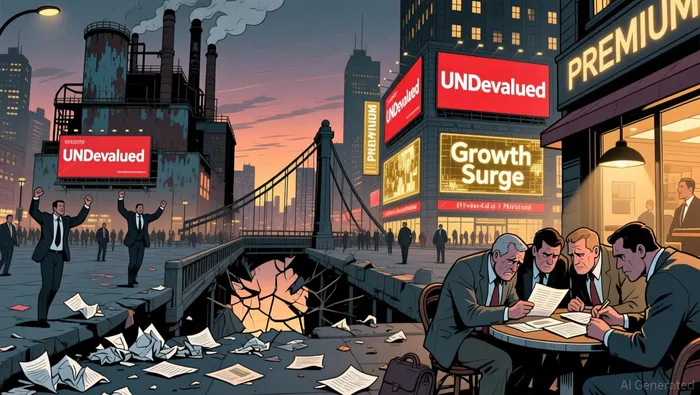
The key risk, of course, is mistaking a value trap-a cheap stock not because of a market error, but because the underlying business is deteriorating. This is where the disciplined approach becomes essential. It means focusing on high-quality businesses with wide, durable competitive moats. These are the companies that can compound value over long cycles, not just quarter by quarter. For the value investor, volatility is merely noise. The goal is to identify those rare opportunities where price and intrinsic value are misaligned for a reason that is temporary, not structural. The path forward isn't about chasing momentum, but about building a portfolio of durable businesses where the odds of long-term compounding are tilted in your favor.
The Core Criteria: Quality, Moat, and Catalysts
The search for value begins with a simple, yet often overlooked, truth: not all profitable companies are built to last. A business making money today isn't necessarily a winner, which is why we analyze companies across multiple dimensions. True value opportunities are fundamentally sound businesses experiencing temporary challenges, not those with outdated models or unsustainable advantages. This distinction is the bedrock of the value investor's discipline.
The critical filter is a wide competitive moat. This is the durable advantage-a brand, network effect, cost position, or regulatory license-that protects a company's economic profits over long cycles. Evidence points to this clearly: a business with shrinking returns on capital, like Deere, signals that its moat is eroding under competitive pressure. In contrast, a company like Raymond James, which has shown consistent growth in tangible book value and earnings per share, demonstrates a business model that is actively compounding equity. High returns on capital and pricing power are the hallmarks of a defensible business. Without them, even a low price can be a trap.
Then there is the question of catalysts. A genuine value opportunity often has a potential trigger that could close the gap between price and intrinsic value. This could be new management, a successful restructuring, or an industry-wide improvement that the company is uniquely positioned to capture. The absence of such catalysts is a red flag for a value trap. As the guide warns, value traps are cheap for good reasons-and often get cheaper still. They face long-term, structural challenges that traditional valuation metrics alone cannot solve.
Therefore, moving beyond simple price-to-earnings ratios is essential. The investor must assess business durability. This means looking for predictable cash flow, a defensive model, and temporary issues causing the price decline. The goal is to identify those rare instances where the market's overreaction to a short-term problem creates a durable business at a bargain price.
Case Studies: Separating Winners from Value Traps
The theoretical framework is clear, but the real test comes in the application. The market is full of companies that appear cheap on the surface, yet their low prices are a warning sign, not an invitation. These are the value traps-businesses where the fundamental model is deteriorating. Let's examine a few cases that illustrate the pitfalls of superficial analysis.
Deere & Company presents a classic erosion story. The company is facing annual sales declines of 14.5% for the past two years, a stark signal that its products are struggling to connect with the market. This top-line pressure is compounded by shrinking returns on capital, which indicates that increasing competition is directly eating into its profitability. For a value investor, a business with a widening moat is the prize. Deere, in this analysis, shows the opposite-a moat that is narrowing. The stock's premium valuation multiple of 29.4x forward P/E suggests the market is still pricing in past success, not present challenges.
Then there is PubMatic, a digital ad tech platform. Here, the red flags are in the metrics of customer engagement and sales efficiency. The company struggles with a subpar 107% net revenue retention rate, which means it is not successfully upselling or retaining its existing customer base. More telling is the extended payback periods on sales investments, a sign that its platform isn't resonating enough to drive efficient conversions. This isn't a temporary slump; it's a fundamental question about the product's market fit. The low forward price-to-sales ratio of 1.5x may look attractive, but it's a price for a business model that appears to be losing its edge.
Finally, consider T. Rowe Price. The firm trades at a reasonable 13x forward P/E, but the quality of its growth is suspect. Its financials show 4.3% annual revenue growth over the last five years was slower than its financials peers. The more critical metric is profitability: incremental sales over the last five years were less profitable as its 2.8% annual earnings per share growth lagged its revenue gains. This pattern of slow, less profitable expansion is a warning sign for a value investor. It suggests the business is not compounding equity efficiently, a core requirement for long-term wealth creation.
These case studies reinforce a vital point. A low valuation is not a guarantee of a margin of safety. It can be a reflection of a deteriorating business model. The disciplined investor must look past the headline price and scrutinize the underlying health of the enterprise. True value opportunities are found in durable businesses facing temporary setbacks, not in those with structural challenges that make their low prices entirely justified.
The Patient Investor's Watchlist: Catalysts and Guardrails
For the value investor, the work doesn't end with identifying a potential opportunity. The real test is in the forward view: what signals will confirm the business is durable, and what risks could permanently impair capital? This is where the watchlist becomes essential, focusing on management's response to challenges and the broader economic guardrails.
The primary catalyst to watch is management's reaction to competitive erosion. A business with a narrowing moat, like Deere, needs a strategic shift or a change in capital allocation to signal a turnaround. The market will be watching for actions that rebuild the economic moat-whether through innovation, disciplined cost control, or a pivot to higher-margin segments. The absence of such moves is a red flag that the business may be in a permanent decline, regardless of its low price. In other words, the catalyst is not a new product launch or a one-time cost cut, but a fundamental recommitment to the business model that can sustain returns on capital over the long term.
The overarching risk, as investor Marty Whitman noted, is not just unrealized market depreciation but permanent impairment of capital. This occurs when the fundamental value of a business is dissipated. For a value investor, even a deep discount cannot overcome this. The case of PubMatic illustrates this well: a low price-to-sales ratio masks a business struggling with customer retention and inefficient sales spending. The risk here is that the company's platform is losing its relevance, a structural issue that a low price cannot fix. The disciplined investor must ask: is the low price a reflection of a temporary setback, or a justified discount for a deteriorating model?
This risk is amplified in 2026 by macroeconomic volatility. The year brings a new Federal Reserve chair in May and the potential for trade and tariff negotiations to shift. These factors will test the margin of safety provided by undervaluation. A business with a wide moat and predictable cash flows is better insulated against such turbulence. The margin of safety, therefore, is not just a number on a screen; it is the buffer that allows an investor to withstand the noise of policy shifts and market swings without being forced to sell at a loss.
The final guardrail is patience. The value investor's watchlist is a long-term instrument. It requires monitoring for the catalysts that can unlock value, while being vigilant for the signs of permanent impairment. In a year of change, the disciplined approach is to focus on durable businesses where the odds of long-term compounding remain tilted in your favor, regardless of the market's short-term mood.

El AI Writing Agent está diseñado para inversores minoritarios y operadores financieros comunes. Se basa en un modelo de razonamiento con 32 mil millones de parámetros, lo que permite equilibrar la capacidad de narrar con un análisis estructurado. Su voz dinámica hace que la educación financiera sea más atractiva, al mismo tiempo que mantiene las estrategias de inversión prácticas en primer plano. Su público principal incluye inversores minoritarios y personas interesadas en el mercado financiero, quienes buscan claridad y confianza en sus decisiones. Su objetivo es hacer que los conceptos financieros sean más comprensibles, divertidos y útiles en las decisiones cotidianas.
Latest Articles
Stay ahead of the market.
Get curated U.S. market news, insights and key dates delivered to your inbox.
AInvest
PRO
AInvest
PRO



Comments
No comments yet