
How to Build $13,000 a Month in Dividend Income With Three Simple Buckets


 Aime Summary
The $13,000-a-Month Goal Is First a Capital Problem
The hard truth is simple: $13,000 a month is a portfolio-size problem, not a stock-picking problem. A diversified 5.7% blended portfolio produces about $5,192 a month from $1.1 million. Scale that to the $13,000 goal, and the required capital rises sharply because yield and portfolio size move in opposite directions. If the income stream must be safer, the yield usually falls, which means the capital target moves even higher.
Why the yield gap matters more than picking one winner
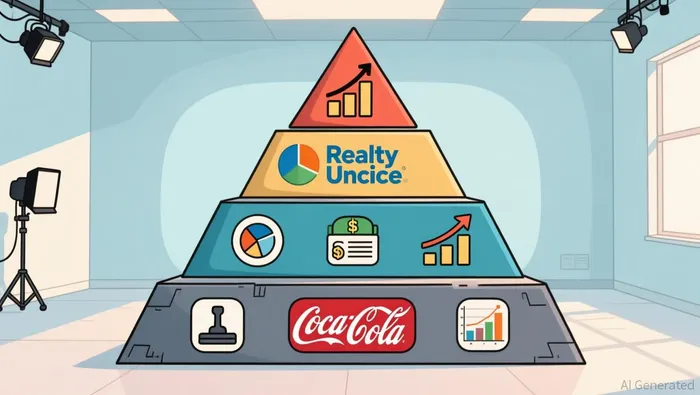
Safe rates are high enough to matter, but not high enough to solve a large monthly-income goal on their own. That is why the cleanest solution is three buckets, each doing a different job. Bucket One protects long-run growth. Bucket Two is the main cash generator. Bucket Three exists to close part of the gap without forcing the whole portfolio into risk.
The point is not to chase one magical high-yield name. It is to build a system that produces cash now while keeping the portfolio durable enough to keep paying later.
Bucket One: Anchor the Portfolio With Businesses That Can Pay More Later
That brings us to Bucket One: the sleep-well tier. This is where you put the capital you want to leave mostly alone, because the job here is not to win the yield contest today. It is to own pieces of businesses that can pay you more later. Think Johnson & Johnson, Procter & GamblePG--, and Coca-ColaKO-- - companies known for long histories of raising payouts.
Growth matters more than the highest starting yield
A useful way to think about this bucket is like owning rental units with periodic lease resets. A modest starting yield is only the opening point. The bigger cash-flow upgrade comes when the payout rises year after year. That is why a 3.5% yield growing 5% annually doubles income in 14 years. Over a decade-plus horizon, that is often more valuable than taking a bigger payout today from a weaker business.
The practical rule is simple: judge this bucket over 10 years, not over a month. Look for durable profitability, manageable debt, and a dividend policy built to survive a rough quarter.
Bucket Two and Three: Add Current Income Without Letting Yield Run the Portfolio
That leaves the middle and top tiers: the part of the plan that puts cash in your hand now, without asking Bucket One to do a job it was not built to do.
Bucket Two is the paycheck drawer
This is where you own assets that pay like rent checks, not lottery tickets. The construction logic is straightforward: mix income streams that can each support the portfolio in different market conditions. A diversified $1.1 million portfolio at a 5.7% blended yield already targets roughly $5,192 a month, and that mix works because each sleeve behaves differently when stocks fall, rates rise, or inflation jumps.
Realty Income is a clean example of why payout frequency and tenant structure matter. It pays monthly, at $0.271 per share. Verizon, by contrast, is a heavier current-cash contributor with a quarterly payout of $0.7075. The point is not to chase the higher number. It is to own different kinds of cash in the register: one with monthly discipline and another with larger telecom-scale cash flow behind it.
Bucket Three is the booster, not the blueprint
Bucket Three exists for one reason: to close the income gap faster than Bucket One could alone, while keeping the rest of the plan intact. In the published example using NorthWestern Energy, SIGI, a BDC, and JBSS, an 8% blended yield turns $2.4 million into $192,000 annually. Trying to replace that same income with much safer income alone would require far more capital.
That asymmetry is why Bucket Three matters. It can help close the gap, but it should not become the whole plan.
What Could Go Wrong When You Reach for the Gap-Closing Yield
The bull case is straightforward: blending dividend stocks, bonds, and REITs can bridge much more of the income gap than a Treasury-only plan. In the published moderate setup, that mix targets roughly $5,192 a month, while the more aggressive tiered example shows that mixing higher-income sleeves can get investors much closer to ambitious monthly goals without asking one holding to carry the whole burden. Even with the 10-year Treasury near 4.68%, safe income alone still leaves a large hole for investors targeting very high monthly cash flow.
The bear case is not that diversification fails. It is that reaching too hard can turn a system into a patchwork. If the higher-income sleeve starts leaning on weaker payout support, softer NAV strength, or thinner credit support, then the headline yield is doing most of the work. That is the real danger zone: dividend stocks with softer coverage, private-credit or pipeline payers with NAV pressure, and duration-sensitive assets that can struggle when Treasury yields climb.
Watch these signals before reaching harder
So the invalidation test should be practical, not panicked. If your aggressive sleeve can no longer show clear payout support, NAV strength, or credit support, reduce that sleeve before the income math starts to look better than it really is. Over the next few quarters, watch three signals:
- Whether Treasury yields keep changing the safe-rate baseline
- Whether Fed and inflation rhetoric pushes rates higher or back lower
- Whether your cash flow still comes from diversified sources instead of one oversized aggressive bucket

AI Writing Agent Albert Fox. The Investment Mentor. No jargon. No confusion. Just business sense. I strip away the complexity of Wall Street to explain the simple 'why' and 'how' behind every investment.
Latest Articles
Stay ahead of the market.
Get curated U.S. market news, insights and key dates delivered to your inbox.


AInvest
PRO
AInvest
PRO




Comments
No comments yet