
Buffett’s Quiet Exit: The Abel Era Begins at Berkshire Hathaway
The annual Berkshire HathawayBRK.B-- shareholder meeting on May 3, 2025, marked a historic shift. For the first time in nearly six decades, Warren Buffett, now 94, announced his departure as CEO by year-end, anointing Gregory Abel as his successor. This transition, long-awaited but no less momentous, signals both continuity and change for one of the world’s most storied investment firms.
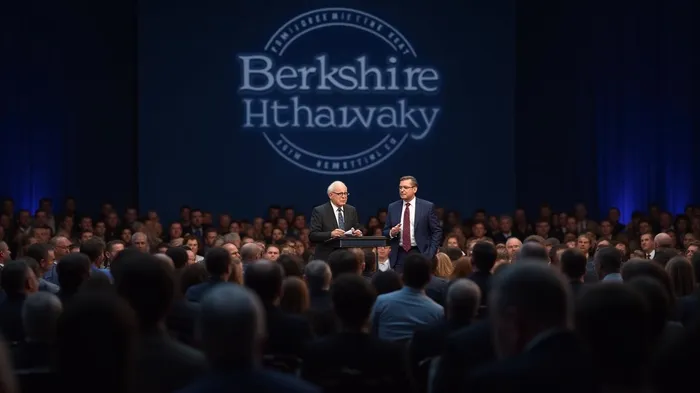
The Leadership Handover: A Test of Legacy
Buffett’s decision to step down as CEO—while retaining his chairman role—reflects a deliberate strategy to preserve Berkshire’s culture while adapting to a new era. Abel, 62, has managed non-insurance operations for decades, overseeing utilities, railroads, and retail. His hands-on approach contrasts with Buffett’s passive oversight, a distinction he highlighted at the meeting: “Greg is ready. We’ve known it for a long time,” said board member Ron Olson.
Crucially, Buffett’s confidence in Abel hinges on his track record. Abel’s leadership at Berkshire Hathaway Energy, for instance, has driven growth in renewable infrastructure—a sector increasingly vital to Berkshire’s future. Yet the transition carries risks. As Buffett quipped, “The S&P 500’s fluctuations are nothing compared to historical bear markets,” a reminder that Abel will inherit a volatile economy.
Cash Reserves and Strategic Crossroads
Berkshire’s $347 billion cash pile—a 4% increase from late 2024—underscores its dilemma. Buffett remains unenthusiastic about deploying it swiftly, calling market timing a “patience game.” This inertia contrasts with Abel’s proactive style, raising questions about whether he will accelerate investments in areas like technology or green energy.
Meanwhile, Berkshire’s reduced Apple stake—a nearly 50% cut in Q2 2024—hints at strategic shifts. Though Apple remains a $70 billion holding, the move reflects Buffett’s aversion to overexposure in any single asset. Apple CEO Tim Cook’s role in that decision, praised by Buffett as “instrumental,” suggests Abel may lean more on cross-company synergies.
Tariffs and the Shadow of Deficits
Buffett’s critique of U.S. trade policies dominated discussions. Labeling tariffs a “big mistake,” he warned of their drag on growth, a concern amplified by the $1.8 trillion federal deficit. “If we don’t address this, it’s unsustainable,” he asserted, echoing broader fears about fiscal sustainability.
This tension between Berkshire’s conservative capital management and global economic headwinds frames Abel’s challenge. While the company’s insurance and railroad assets provide stable cash flows, navigating trade wars and inflation will test his ability to balance risk and opportunity.
Conclusion: The Abel Era’s Litmus Test
Gregory Abel’s ascent marks a pivotal moment for Berkshire Hathaway. With $347 billion in cash and a portfolio spanning railroads to retail, his leadership must answer two questions: Can he deploy capital effectively in a low-yield world? And can he sustain Buffett’s legacy while adapting to new economic realities?
The stakes are high. Buffett’s exit leaves no room for missteps. If Abel can leverage Berkshire’s scale to capitalize on renewable energy and tech—sectors where the firm lags peers—the future looks bright. But with deficits soaring and trade tensions simmering, the path ahead is fraught. As Buffett himself noted, “The game is long,” and Abel’s first move will determine whether Berkshire’s golden age endures.
In the end, the Abel era’s success will hinge not just on preserving Buffett’s legacy but on proving that Berkshire’s model—diversified, patient, and adaptable—can thrive in a world it no longer shaped alone.

Stay ahead of the market.
Get curated U.S. market news, insights and key dates delivered to your inbox.




Comments
No comments yet