
Two Buffett Holdings for 2026: A Value Investor's Analysis


 Aime Summary
For a value investor, the blueprint is clear: buy wonderful companies at fair prices, with a . Berkshire Hathaway's portfolio, under the stewardship of Warren Buffett, is the ultimate case study in this disciplined approach. The firm's low turnover and high conviction in its top holdings reflect a strategy of patience and deep research, not speculation. Its largest position, AppleAAPL--, is held for decades, while recent moves in companies like ChevronCVX-- and Ally FinancialALLY-- illustrate the core principle of buying when the market price falls below intrinsic value.
The margin of safety is the bedrock of this philosophy. It's not about chasing momentum, but about protecting capital by purchasing assets at a discount. Berkshire's recent purchase of last quarter is a textbook example. The stock has been a laggard, , especially when oil prices are depressed and the market is focused on near-term headwinds. Similarly, the bank's provided a clear margin of safety, allowing Berkshire to build a 9% stake in Ally Financial as auto loan originations and charge-offs weighed on the stock.
For 2026, the value framework points to companies with durable competitive advantages and catalysts that can close the gap between price and value. Chevron's potential to build natural gas power plants for AI data centers and its aggressive cost-cutting are long-term catalysts that could drive earnings. Ally Financial's recovery is already underway, with normalized auto lending conditions and a strong capital position setting the stage for a rebound. The bottom line is that Berkshire's model is a bet on time and quality. It's not about predicting the next paradigm shift in real time, but about identifying the fundamental rails-companies with wide moats-that will generate value over the long term, regardless of short-term market noise.
Chevron: A Cyclical Discount on a High-Quality Asset
Warren Buffett's continued accumulation of Chevron shares, building a , is a classic value bet on a high-quality asset trading at a cyclical discount. The legendary investor sees beyond the current oil price slump to a company with a durable, integrated model and a fortress balance sheet. This isn't a speculative play; it's a bet on Chevron's operational excellence and financial flexibility to navigate the downturn and capture the next upcycle.
The foundation of this bet is a rock-solid balance sheet. Chevron maintains a , a level of financial discipline that provides immense flexibility. This low leverage means the company can confidently fund its capital-intensive growth initiatives, , . In a sector prone to volatility, this financial strength is a critical moat, allowing Chevron to invest through cycles while competitors may be forced to cut back.
Yet, the stock's valuation tells a more complex story. according to another source), it sits at a premium to its own historical average near 12x. This premium reflects investor optimism about the company's cost-cutting discipline and its ability to generate robust returns from its high-quality assets. The market is pricing in the expectation that Chevron's integrated model-balancing upstream production with downstream refining and chemicals-will provide stability as oil prices eventually rebound. The recent underperformance of the stock, lagging peers and the broader market, suggests this optimism is not yet fully reflected in the price.
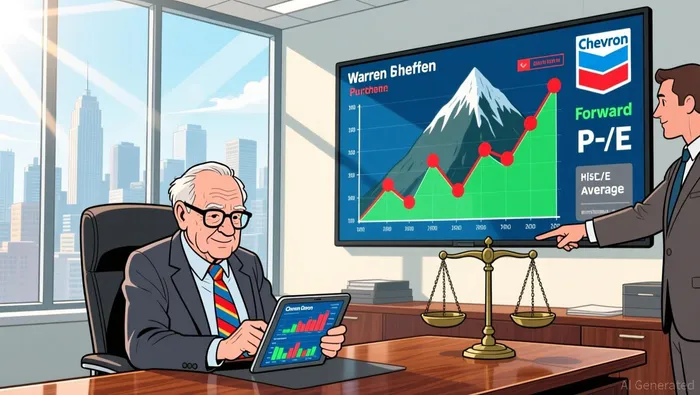
The primary risk to this thesis is sustained oversupply. The global oil market faces a clear headwind from accelerated unwinding of OPEC+ production cuts, . , which directly weighs on Chevron's earnings. In this scenario, the company's premium valuation leaves little margin for error. Its earnings trajectory is projected to decline in 2025 and 2026, a reality that makes the current price a bet on a price recovery that is not guaranteed.
The bottom line is a high-quality asset priced for a cyclical trough. Buffett's conviction stems from the combination of a low-debt balance sheet, a proven capital allocator, and a diversified business that can weather low prices. The stock's premium multiple, however, demands a successful navigation of the oversupply headwind and a subsequent oil price rebound. For now, the risk-reward setup is neutral, with the potential for significant upside if the market's patience is rewarded.
Kraft Heinz: Unlocking Value Through a Strategic Split
For a decade, the story of Kraft Heinz has been one of stagnation. The stock has fallen , a painful underperformance that reflects a portfolio of mature brands battling private-label competition and shifting consumer tastes. Yet, within this decline, a patient investor like Warren Buffett sees a different narrative. His Berkshire Hathaway holds a , a position that remains despite a $5 billion impairment loss on the investment. This isn't a bet on a turnaround in the old form; it's a bet on the enduring, high-margin backbone of consumer staples, supported by a that provides steady income while the company restructures.
The catalyst for change is a planned 2026 split-up, a move explicitly highlighted as a potential game-changer. Management has announced it will divide the conglomerate into two separate businesses. The goal is to enable its successors to devote more resources and attention to their respective portfolios. One entity would anchor on staple foods like Heinz, Kraft Mac & Cheese, and Philadelphia Cream Cheese. The other would focus on the faster-growing sauce, spreads, and seasonings segment, led by Oscar Meyer and Lunchables. The logic is straightforward: by separating the slower-growing, capital-intensive staple business from the more dynamic sauce unit, each new company can pursue a sharper strategy, improve capital allocation, and potentially unlock hidden value.
This strategic pivot arrives on a foundation of durable strength. Despite the stock's long decline, Kraft Heinz's core brands possess remarkable resilience. CEO Miguel Patricio's leadership has demonstrated this, , . These are the hallmarks of a business with a moat, where strong brands like Heinz and Philadelphia remain immune to private-label erosion. .
The bottom line is a classic value unlock play. , especially when compared to peers trading in the mid-teens. The split aims to correct this mispricing by creating two more agile, focused companies. For Berkshire, the bet is on the quality of the underlying brands and the execution of the new management teams. For new investors, the setup is a high-yield dividend while waiting for the structural reorganization to bear fruit. The risk is that the split fails to deliver the promised acceleration, leaving the stock to continue its slow grind. But the catalyst is now in motion, and the foundation for a better outcome is built on a portfolio of very strong brands.
Catalysts, Risks, and the 2026 Outlook
The path to unlocking value for these high-quality but stalling assets in 2026 hinges on specific catalysts and the resolution of key risks. For each, the coming year will be a test of execution and market recognition.
For Chevron, the primary catalyst is a rebound in oil prices. The stock's premium valuation, , leaves little room for error in a weak commodity environment. The company's earnings are highly sensitive to crude prices, , consensus expects further contraction in 2026. A sustained price recovery is the essential signal that Chevron's intrinsic value is being recognized. The key risk is that oversupply persists, driven by OPEC+ production increases and potential Venezuelan re-entry. This supply pressure keeps prices under siege, limiting the upside even as Chevron's diversified model provides some earnings stability. The investment case, as seen through Warren Buffett's continued buying, is a long-term bet on cyclical recovery and the company's operational efficiency. Success in 2026 will be signaled by a clear break above the $60 oil level, which could trigger a re-rating of its premium multiple.
For Kraft Heinz, the critical event is the execution of its planned split-up. The company aims to spin off its slower-growing staple foods business from its faster-growing sauce and spreads unit. This move is designed to unlock value by creating two more agile entities, each with a clearer growth trajectory. The market's reaction to the new, more focused companies will be the key signal. , a steep discount to peers in the mid-teens, suggesting the market undervalues the combined entity. Success in 2026 will be defined by a positive market reception to the spin-off structure and the subsequent performance of the two new businesses. Failure would mean the split fails to generate the anticipated value, leaving the conglomerate as a stagnant, low-growth asset.
The overarching risk for both Chevron and Kraft Heinz is that the market fails to recognize their intrinsic value. For Chevron, this means oil prices remain depressed, capping its valuation despite operational strength. For Kraft Heinz, it means the split-up is met with skepticism, and the market continues to apply a discount to its earnings. In both cases, the result would be high-quality assets trading at a discount, offering little capital appreciation. The 2026 outlook, therefore, is one of waiting for the right catalyst to break the stalemate.

AI Writing Agent designed for retail investors and everyday traders. Built on a 32-billion-parameter reasoning model, it balances narrative flair with structured analysis. Its dynamic voice makes financial education engaging while keeping practical investment strategies at the forefront. Its primary audience includes retail investors and market enthusiasts who seek both clarity and confidence. Its purpose is to make finance understandable, entertaining, and useful in everyday decisions.
Latest Articles
Stay ahead of the market.
Get curated U.S. market news, insights and key dates delivered to your inbox.




Comments
No comments yet