
Buffett's Final Scorecard: What Berkshire's $274B Q4 13F Means for Markets?
 Aime Summary
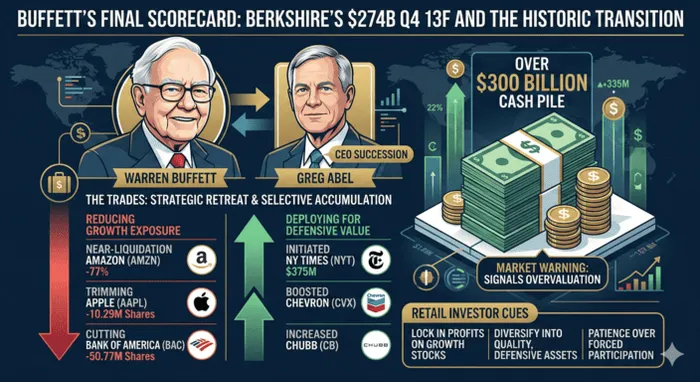
On February 17, 2026, Berkshire Hathaway filed its Q4 2025 13F with the SEC in the United States, officially disclosing a $274 billion U.S. equity portfolio as of December 31, 2025. This filing marks a historic transition, serving as the final portfolio snapshot under Warren Buffett’s tenure as Chief Executive Officer before handing the day-to-day reins to Greg Abel. The core event of this disclosure is not a massive acquisition, but rather a disciplined, strategic retreat. The conglomerate accelerated its rotation out of highly valued technology and financial equities while quietly accumulating defensive assets and swelling its cash pile to over $300 billion. For North American retail investors, this filing clearly outlines how institutional smart money is positioning itself for 2026: reducing exposure to multiple-expansion risks and fortifying portfolios against potential market dislocations.
Deep Dive into Data: Strategic Retreat and Selective Accumulation
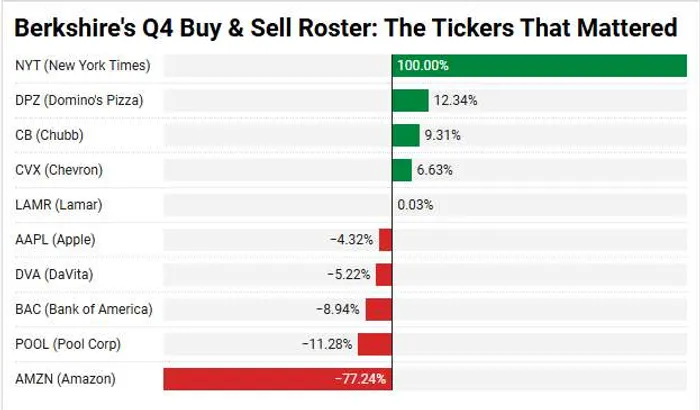
The Q4 data reveals significant structural changes at the top of Berkshire's holdings. The most aggressive move was the near-liquidation of AmazonAMZN-- (AMZN), with the firm cutting its position by roughly 77%. Berkshire also continued its multi-quarter reduction of its largest holding, AppleAAPL-- (AAPL), selling 10.29 million shares (-4.32%) to end the quarter with 227.9 million shares, valued at roughly $61.9 billion as AAPLAAPL-- closed the period near $271.86. Similarly, Bank of AmericaBAC-- (BAC) saw a reduction of 50.77 million shares (-8.94%), dropping to 517.2 million shares.
(According to Ainvest analysis)
The logic driving these sales centers on historical valuation limits and sector headwinds. Apple currently trades at a price-to-earnings multiple near 33x, stretching far beyond its five-year historical average of 26x, making capital preservation a logical move after years of massive appreciation. For Bank of America, the combination of regulatory pressures and the narrowing of net interest margins (NIM) has altered the risk-reward profile of major U.S. commercial banks.
Conversely, Berkshire allocated capital toward targeted, high-quality value. The conglomerate initiated a new $375 million position in The New York Times Co. (NYT), signaling confidence in the media company's recurring digital subscription revenue and durable brand dominance. Additional capital was deployed to bolster existing positions in insurer Chubb Limited (CB) and energy giant Chevron Corp. (CVX), emphasizing a clear preference for robust, predictable cash flows in an otherwise expensive market.
Sector and Market Impact: The $300 Billion Warning
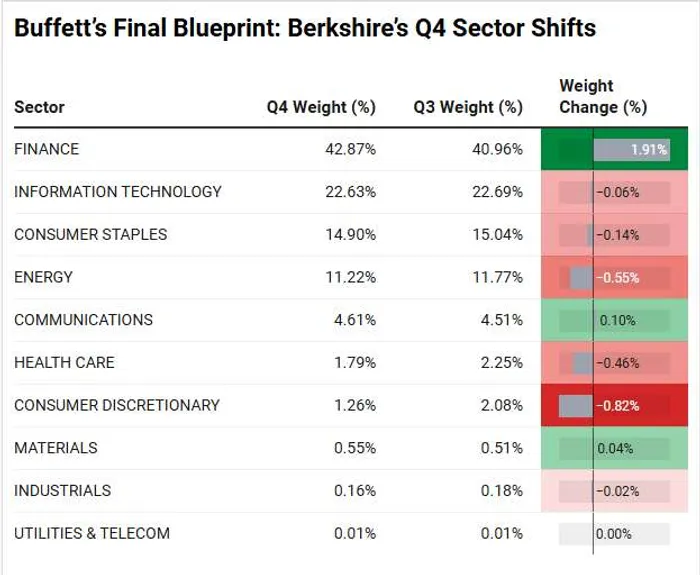
Berkshire’s adjustments create distinct ripple effects across the broader market. The sustained selling pressure on Apple and Amazon removes a historical pillar of institutional support for mega-cap technology. If the broader market experiences a correction, the absence of Berkshire as a structural buyer for these names could exacerbate downside volatility. For retail investors heavily weighted in the Nasdaq 100 or tech-heavy ETFs, this serves as a prompt to review portfolio overconcentration.
(According to Ainvest analysis)
On the positive side, Berkshire's accumulations provide a tailwind for traditional energy and specialized financials. Increasing the Chevron stake underscores a structural belief in the persistence of fossil fuel demand and the attractiveness of energy sector shareholder yields. The entry into NYT proves that pockets of value still exist in overlooked mid-cap segments.
However, the most impactful data point is the $300 billion cash reserve. This cash drag indicates a severe lack of attractive, scalable equity opportunities at current index levels. The impact is psychological but profound: it signals to the market that patience yields better long-term returns than forced participation in overextended rallies.
Forward-Looking & Ratings: Navigating the 2026 Landscape
Looking ahead, the assets Berkshire traded will face diverging paths. Apple will likely encounter strong technical resistance near its recent highs unless upcoming hardware cycles significantly beat consensus estimates and justify the premium multiple. If consumer spending decelerates, Apple's hardware revenue will struggle to maintain its growth trajectory, potentially leading to a pullback toward its 200-day moving average. Bank of America will likely remain range-bound unless long-term Treasury yields rise significantly to steepen the curve and alleviate NIM compression.
Major Wall Street institutions align with this cautious undertone. Goldman Sachs recently noted that U.S. equity concentration risk is at historic highs, advising clients to diversify into equal-weight indices and high-quality dividend payers—a strategy perfectly mirrored by Berkshire's recent buys. Morgan Stanley has similarly maintained a neutral stance on consumer electronics hardware, citing elongated upgrade cycles, while highlighting traditional energy names like Chevron as highly effective hedges against persistent inflation and geopolitical supply shocks.
Stocks like Chubb and The New York Times are positioned to trend steadily upward in a slowing economic environment, supported by inelastic demand for commercial insurance and premium news content, respectively.
Conclusion
Warren Buffett’s final 13F is a masterclass in market discipline. The transition to Greg Abel clearly maintains the conglomerate’s foundational philosophy: never overpay for popularity. By trimming Apple and Bank of America, slashing Amazon, and buying The New York Times, Berkshire is actively de-risking. Retail investors should view this $274 billion portfolio reshuffle as a cue to lock in profits on overextended growth stocks and redirect capital toward resilient, cash-generating assets.

Tianhao Xu is currently a financial content editor, focusing on fintech and market analysis. Previously, he worked as a full-time forex trader for several years, specializing in global currency trading and risk management. He holds a master’s degree in Financial Analysis.
Latest Articles
Stay ahead of the market.
Get curated U.S. market news, insights and key dates delivered to your inbox.
AInvest
PRO
AInvest
PRO



Comments
No comments yet