
Buffett's Final Act: Berkshire's Leadership Shift and the $348 Billion Question
The annual Berkshire HathawayBRK.B-- shareholder meeting on May 6, 2025, marked a historic pivot: Warren Buffett, the 94-year-old “Oracle of Omaha,” announced his retirement as CEO by year-end. The news sent BRK-B shares plummeting 5% to $512—a stark contrast to the stock’s 13% year-to-date gain—and set the stage for an era defined by uncertainty and strategic reinvention.
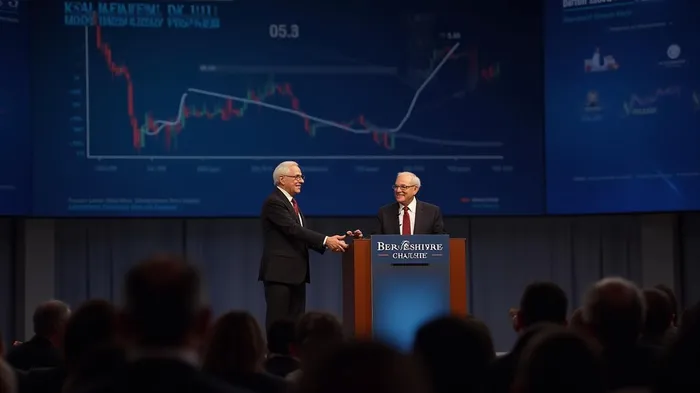
The Numbers Behind the Drop
Berkshire’s first-quarter 2025 results, released earlier in May, laid the groundwork for investor anxiety. Operating earnings fell 14% to $9.64 billion, missing analyst expectations, while insurance underwriting profits collapsed 48.6% due to Southern California wildfires. Foreign exchange losses added insult to injury, with a $713 million hit from a weaker dollar.
But the real story lies in Buffett’s cash hoard. The company’s cash reserves hit a staggering $348 billion, a record high, reflecting Buffett’s reluctance to deploy capital in an overvalued market. The S&P 500’s CAPE ratio—a valuation metric—had already hit 33.1 by April 30, a level historically associated with lackluster returns. Buffett’s decade-long net selling of $174 billion in stocks underscores his skepticism.
The Transition: From Buffett to Abel
Greg Abel, the 62-year-old former utility executive tapped to succeed Buffett, faces a dual challenge: managing Berkshire’s sprawling empire and deploying its $348 billion war chest. Abel’s priorities are clear: leverage the cash pile as a “buffer against volatility,” as he stated, while maintaining Buffett’s core principles of long-term value investing.
Yet Abel’s vision diverges in key areas. While Buffett has dismissed cryptocurrencies as “rat poison squared,” Abel has remained neutral, leaving room for modern portfolio experimentation. This flexibility could be critical as Berkshire navigates a post-Buffett world.
The CEO transition’s immediate impact was stark. BRK-B’s 5% drop on May 6 contrasted with its YTD outperformance of the S&P 500, which fell 4% over the same period. Investors, however, are split: some see the cash reserves as a competitive advantage, while others worry about Abel’s ability to replicate Buffett’s 19.9% annualized returns, which delivered a 5,502,284% total return over 60 years.
The Elephant in the Room: Tariffs and Trade
Berkshire’s Q1 report highlighted another existential threat: trade policy. President Trump’s tariffs loomed large, with the company warning of potential impacts on BNSF rail logistics, Geico’s auto insurance, and its retail operations. The uncertainty underscores a broader risk—global supply chains are now a double-edged sword for Berkshire, whose businesses span industries from energy to finance.
Conclusion: A New Era, But Old Rules?
Berkshire Hathaway’s future hinges on two constants: cash and continuity. Abel’s pledge to preserve the company’s independence and cash reserves aligns with Buffett’s legacy, even as markets brace for change. With $348 billion in dry powder and a track record of outperforming the S&P 500 during high-CAPE environments, investors may find solace in Berkshire’s resilience.
Yet the numbers tell a cautionary tale. The S&P 500’s average three-year return of 23% following CAPE ratios above 30—excluding dividends—suggests patience is key. For shareholders, the question isn’t whether Buffett’s era is ending, but whether Abel can turn cash into growth in a market that’s already priced for perfection.
In the end, Berkshire’s value will be measured not just by its cash reserves, but by its ability to navigate a world where the “Oracle” is no longer at the helm.

Stay ahead of the market.
Get curated U.S. market news, insights and key dates delivered to your inbox.




Comments
No comments yet