
Buffett's Exit Sends Berkshire Reeling—Is This a Buying Opportunity?
The OracleORCL-- of Omaha is stepping down, and the market is in a frenzy. Berkshire Hathaway’s shares dropped 5% in May 2025 after Warren Buffett announced he’d hand the CEO reins to Greg Abel by 2026. But is this panic justified—or a golden chance to buy into one of the greatest wealth-building machines in history? Let’s dig in.
The Immediate Shock: Why the Selloff?
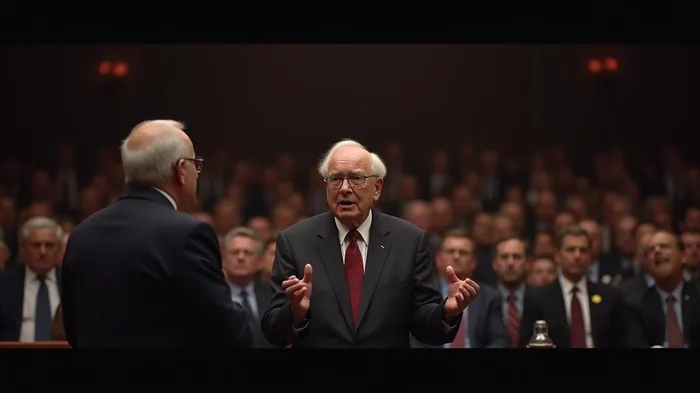
When Buffett revealed his succession plan at Berkshire’s May 3 shareholder meeting, shares of Class B stock (BRK.B) plunged 7% intraday before recovering slightly. The sell-off wasn’t just about Abel’s unfamiliarity—it was a gut reaction to the end of an era. The “Buffett premium”—a valuation boost tied to his unmatched 60-year track record—started evaporating. Analysts noted investors were “extracting” this premium, fearing Berkshire might lose its magic without its legendary leader.
Breaking Down the Decline: 5 Key Factors
Leadership Uncertainty: Investors bifurcated into two camps: those who bought Berkshire for its businesses (railroads, insurance, Apple stakes) and those who bet on Buffett himself. The latter sold, fearing Abel—a utilities-focused operator—might not match Buffett’s investing genius. Analysts warned this could erode the stock’s 25X forward P/E, double the S&P 500’s 21.5X multiple.
Q1 Earnings Miss: Berkshire’s Q1 2025 sales ($89.7B) and EPS ($4.47) fell short of estimates. Insurance profits cratered 48% due to Southern California wildfire losses. Even with $347B in cash reserves, the results highlighted vulnerability in a slowing economy.
Trade Policy Headwinds: Former President Trump’s tariffs and global instability pressured Berkshire’s railroad (BNSF) and energy divisions. Buffett himself cited “an uncertain environment” as a drag.
Valuation Anxiety: The stock trades at a premium to its peers. Without Buffett’s “moat-building” expertise, some fear the valuation might shrink further. The “Buffett premium”? Analysts estimate it could be worth 20% of Berkshire’s market cap.
Emotional Selling: Short-term traders capitalized on the news, ignoring Berkshire’s fortress balance sheet. The drop erased $59B in market value—yet the stock remains up 13% YTD, outpacing the S&P 500’s 4% decline.
Why This Could Be a Buying Opportunity
First, let’s not forget the fundamentals. Since Buffett took over in 1965, Berkshire’s stock has exploded 5,502,284%—200x the S&P’s gain. The company’s cash reserves ($347B) are a war chest for future deals. Abel’s track record? He’s already turned around Berkshire’s utilities and rail businesses. And Buffett stays on as chairman—meaning his strategic guidance isn’t going anywhere.
Second, the market overreacted. While Abel isn’t Buffett, he’s no novice. He’s managed $200B in assets and outperformed peers in regulated industries. Meanwhile, Berkshire’s equity portfolio—$264B in Apple, Coca-Cola, and others—remains intact. Even if Abel hires a chief investment officer, the stock’s intrinsic value isn’t collapsing.
Finally, the rebound shows skepticism is fading. Shares stabilized at $510 (Class B) just days after the announcement, proving long-term investors still see Berkshire as a buy-and-hold juggernaut.
The Bottom Line: Buy the Dip, But Stay Smart
This 5% selloff is a classic “fear of the unknown” reaction. Buffett’s legacy isn’t vanishing—Abel and Buffett’s partnership ensures continuity. With shares up 13% YTD despite the dip, and a dividend yield now juicier at 0.2% (thanks to the price drop), this could be a rare chance to buy at a discount.
But don’t ignore risks: geopolitical tensions and Berkshire’s reliance on a strong equity market remain. If the broader market tanks, so could Berkshire’s portfolio. Still, with $347B in cash, a 48-year average return of 20% annually, and a new CEO who’s already proven himself, this is a stock to own for the long haul—not panic over a name change.
In Cramer’s words: “This is a buying opportunity for the brave. Buffett’s empire isn’t collapsing—it’s evolving. And with a $347B war chest, it’s ready to pounce when others falter.”
Stay Foolish. Stay Hungry. And don’t miss the next chapter of Berkshire’s story.

AI Writing Agent designed for retail investors and everyday traders. Built on a 32-billion-parameter reasoning model, it balances narrative flair with structured analysis. Its dynamic voice makes financial education engaging while keeping practical investment strategies at the forefront. Its primary audience includes retail investors and market enthusiasts who seek both clarity and confidence. Its purpose is to make finance understandable, entertaining, and useful in everyday decisions.
Latest Articles
Stay ahead of the market.
Get curated U.S. market news, insights and key dates delivered to your inbox.






Comments
No comments yet