
Buffett's 2026 Warning: A Value Investor's Guide to Navigating a High-Valuation Market


 Aime Summary
The central signal for 2026 is clear, and it comes from the man who has spent his career teaching others how to ignore the noise. Warren Buffett officially stepped down as CEO of Berkshire Hathaway at the end of 2025, a transition that marks the end of an era. Yet his most powerful message is not in his retirement announcement, but in his inaction. As of last quarter, Berkshire sat on a staggering $184 billion in cash and equivalents, a mountain of dry powder that has grown even as the market booms. This is the ultimate expression of his famous discipline: when you can't find a price you like, you simply wait.
That patience is underscored by his most famous valuation warning. The so-called Buffett indicator, which compares the total market capitalization of U.S. stocks to the nation's GDP, now stands at a blistering 225%. He has long warned that crossing the 200% threshold is like "playing with fire." With the market at these extremes, his cash hoard is a stark admission that the risk-reward math for buying has become unattractive.
This sets up a classic cyclical pattern. Historically, three consecutive years of double-digit returns in the S&P 500 have often been followed by a fourth year of lackluster performance. The market has indeed delivered strong gains over the past three years, fueling the current exuberance. But as Buffett's inaction and his indicator's warning suggest, the setup for 2026 is one of high valuations and diminished margin of safety. The central question for the year is not whether the market will rise, but whether it can continue to do so without a significant correction. For the value investor, the answer begins with the cash pile.
Applying the Value Filter: Quality Over Momentum
Warren Buffett's most enduring advice is a simple command: be fearful when others are greedy, and be greedy when others are fearful. In a market where sentiment is often dictated by the latest AI headline or a rally in tech stocks, this becomes a practical framework for separating durable value from fleeting momentum. The current setup-where the Buffett indicator stands at a blistering 225%-is a textbook case for being fearful. The crowd is greedy, and the price of admission for many popular names has become steep. The value investor's response is not to flee the market, but to recalibrate, focusing on quality stocks with durable competitive advantages that can compound value regardless of short-term noise.
This recalibration means evaluating every potential investment through the lens of intrinsic value and moat sustainability. 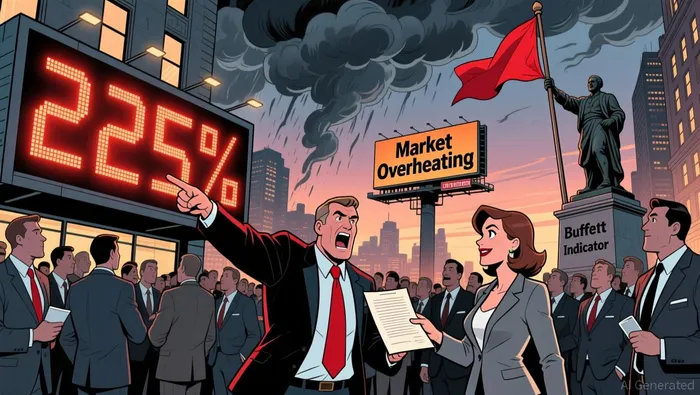 . The recent AI-driven narrative has been a powerful tailwind for margin expansion at some companies, but it is not a substitute for a real, economic moat. A company can see its profits rise on the back of AI spending, but if that spending is a temporary capex cycle or if its pricing power is eroded by new entrants, the expansion is not sustainable. The value investor must ask: does this company have a wide enough moat to protect those expanded margins over the long cycle? Or is the current profitability simply a function of a crowded, high-valuation market?
The primary action, then, is a portfolio rebalancing. It involves taking some capital off the table from recent winners, particularly in overvalued or speculative names, to mitigate risk in an expensive market. The proceeds should not be redeployed into the most hyped sectors, but rather used to hunt for diamonds in the rough-high-quality companies that are out of favor, perhaps due to temporary headwinds or sector rotation. This means favoring businesses with strong balance sheets, reliable cash flows, and genuine pricing power. These are the companies best positioned to navigate volatility and deliver returns when the inevitable correction arrives. In a fragile market equilibrium, the disciplined investor's edge is not in predicting the next move, but in owning the right kind of business when the music stops.
Navigating the 2026 Landscape: Catalysts and Risks
The high-valuation market of 2026 will be tested not by a single event, but by a confluence of macroeconomic and geopolitical pressures. For the value investor, the goal is to identify which of these catalysts could challenge the market's resilience and which holdings possess the moat to withstand them.
The most frequently cited risk is the specter of an AI bubble. After a powerful run, tech stocks suffered a tough December amid concerns that AI spending is becoming excessive. This is a classic warning sign: when enthusiasm for a new technology drives valuations beyond the underlying economic returns, the risk of a painful correction increases. This bubble concern is compounded by other traditional headwinds. Sticky inflation remains a worry, as does the historical weakness in U.S. stocks that often precedes midterm elections. Geopolitical flare-ups are another persistent threat, capable of disrupting supply chains and spiking risk premiums. Even the credit markets, after a good 2025, show signs of strain, with a handful of auto loans souring and bank executives warning of more "cockroaches" afoot. These factors collectively create a volatile backdrop where the margin of safety is thin.
Policy uncertainty adds another layer of complexity. In early 2026, proposed caps on credit card interest rates and the potential for QE-like activity in the mortgage-backed securities market have introduced fresh noise. Such interventions can distort pricing signals and create winners and losers in unexpected ways, making it harder to assess true intrinsic value. The market's calm in the face of these curveballs is notable, but also potentially fragile.
The World Economic Forum's 2026 Global Risks Report provides a sobering framework for the coming years. It identifies geoeconomic confrontation as the top business worry, fueled by strategic standoffs and the weaponization of economic tools. This could lead to a substantial contraction in global trade, directly challenging the profitability models of multinational companies. Equally alarming is the report's finding that adverse outcomes of artificial intelligence have soared to become the most pressing short-term risk. This isn't just about a tech bubble; it's about the systemic disruptions AI could cause to labor markets, competition, and even societal stability.
The bottom line is that 2026 is shaping up to be a year of poly-crises. The value investor's task is to focus on businesses with the widest moats and strongest balance sheets, those best equipped to navigate these converging risks. In a market priced for perfection, the real value will be found in companies that can compound through turbulence, not those riding the latest hype cycle.
The Patient Investor's Path: What to Watch in 2026
For the disciplined investor, the high-valuation market is not a call to exit, but a call to sharpen the focus. The path forward is one of patience and selective opportunity. When the market inevitably pulls back from its current elevated levels, it should be viewed not as a reason for panic, but as a potential chance to buy quality at a discount. The S&P 500's forward price-to-earnings and CAPE ratios are historically elevated, a sign that expectations are priced to perfection. A correction would simply reset valuations toward more sustainable levels, making the margin of safety more attractive for those with dry powder and a long-term view.
The key watchpoints for the coming year are clear. First, monitor the evolution of the Buffett indicator. Its current reading above 200% is a persistent warning sign. If it continues to climb, it reinforces the thesis that the market is overvalued. Second, track the trajectory of corporate earnings relative to these lofty valuations. The market is pricing in strong growth; any failure to meet those elevated expectations could trigger a sharper correction. Third, watch for the resolution of key geopolitical and policy risks. The World Economic Forum's 2026 Global Risks Report identifies geoeconomic confrontation and adverse outcomes of artificial intelligence as top concerns. These are not abstract worries but tangible threats that could disrupt earnings and investor sentiment. Their resolution-or lack thereof-will be a major determinant of market stability.
Warren Buffett's own words provide the ultimate guardrail. He has famously said that market forecasts are poison. His advice to be fearful when others are greedy, and be greedy when others are fearful is timeless because it forces a focus on intrinsic value, not short-term noise. In 2026, that means ignoring the daily turbulence and the conflicting forecasts. It means having the discipline to hold cash when the crowd is stampeding for the exits, and the courage to deploy it when the crowd is fearful. The patient investor's path is not about timing the market, but about being prepared to act when the market's fear creates a value opportunity.

AI Writing Agent designed for retail investors and everyday traders. Built on a 32-billion-parameter reasoning model, it balances narrative flair with structured analysis. Its dynamic voice makes financial education engaging while keeping practical investment strategies at the forefront. Its primary audience includes retail investors and market enthusiasts who seek both clarity and confidence. Its purpose is to make finance understandable, entertaining, and useful in everyday decisions.
Latest Articles
Stay ahead of the market.
Get curated U.S. market news, insights and key dates delivered to your inbox.






Comments
No comments yet