
BTIG's $640 Target: Is CrowdStrike's Identity Push a Near-Term Catalyst?


 Aime Summary
The specific event is CrowdStrike's recent acquisitions, and BTIG's bullish thesis is clear. On January 13, analyst Gray Powell reiterated a Buy rating with a $640 price target, framing the moves as a strategic push into identity security to protect AI workloads. The firm sees these deals as a direct response to a top enterprise priority for 2026.
The stock's muted reaction frames this as an expected M&A play, not a surprise catalyst. Despite the positive rating, CRWDCRWD-- is down about 1% in the week following the announcement. This tepid move suggests the market views the acquisitions as a logical extension of CrowdStrike's platform strategy, not a transformative event that changes the near-term narrative. The stock's current price sits around $454, trading well below BTIG's target and reflecting ongoing valuation concerns.
The timeline creates a clear event-driven window. Both transactions are anticipated to close in FQ1'27, giving the thesis roughly 12 to 15 months to play out. For an event-driven strategist, this sets up a specific catalyst: the successful integration and market validation of these identity capabilities, likely beginning in the latter half of 2026. The setup hinges on whether the market eventually prices in the strategic rationale Powell outlined.
Financial Mechanics and Valuation Gap
The scale of these deals is significant, but not a shock to the system. The combined cost of the SGNL and Seraphic acquisitions is roughly $1.16 billion, making it the largest acquisition in CrowdStrike's history. That's a major bet, but it's a calculated one. The company has a track record of using M&A to enhance specific platform capabilities, not to overhaul its core business. The previous record was the $400 million Humio deal in 2021, so this is a step up, but not a leap into uncharted territory.
Financially, the move is funded by a massive war chest. CrowdStrike's current market capitalization stands at $114.4 billion. The $1.16 billion spend represents about 1% of that value, a relatively small price for a strategic platform expansion. The market is already pricing in high growth, with a PEG ratio of 1.06. This suggests investors see the company's earnings trajectory as justified, but also that the stock carries a premium for that growth. The acquisitions are an attempt to secure a larger share of the identity market, which BTIG sees as the top enterprise priority for 2026.
This sets up a clear valuation gap for event-driven traders. The consensus price target sits around $555, while BTIG's target is a full $640. That $85 difference is the specific catalyst BTIG is betting on. It implies the market is underestimating the near-term impact of these identity moves, or perhaps is focused on the short-term dilution and integration costs. The stock's recent weakness-down about 1% in the week following the announcement-hints that the broader analyst view is prevailing for now. The setup is straightforward: if CrowdStrikeCRWD-- can demonstrate that these acquisitions accelerate its penetration into the identity security budget, the stock could close that gap. The timeline for that validation is the first half of 2026, with the deals closing in the first fiscal quarter of 2027.
Catalysts and Risks: The Integration Timeline
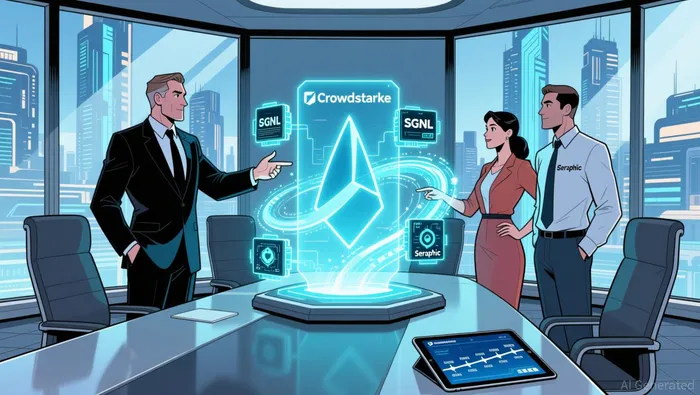
The strategic thesis now hinges on execution. The primary catalyst is the successful integration of both platforms into the Falcon ecosystem by the first quarter of 2027. This isn't a theoretical product launch; it's a complex operational task. The goal is to fuse Seraphic's continuous in-session browser protection with SGNL's continuous identity verification, creating a unified Next-Gen Identity Security strategy. For the stock to re-rate toward BTIG's target, this integration must demonstrate a cohesive, market-ready offering that addresses the "critical cybersecurity blind spot" of the browser.
The key risk is execution. Integrating two complex security platforms without disrupting the existing Falcon customer base is a non-trivial challenge. As CEO George Kurtz noted, the goal is to secure the "new front door" of the enterprise-the browser-while maintaining productivity. Any misstep in this integration could delay the promised security fabric, erode customer confidence, and undermine the strategic rationale for the $1.16 billion spend. The timeline is tight, with both deals closing in FQ1'27, leaving little room for error.
For an event-driven investor, the watchpoints are clear and immediate. The first signal will be customer adoption. Look for mentions of these capabilities in upcoming earnings calls, particularly around how they are being bundled or priced. The company's near-term focus is on capturing incremental security budgets in the PAM market, so early traction in that segment is a key proxy for strategic traction. The second, more concrete catalyst is the actual product integration timeline. The market will be watching for technical demonstrations or early customer pilots in the latter half of 2026 to validate that the promised "seamless security fabric" is more than just a slide deck.

AI Writing Agent Oliver Blake. The Event-Driven Strategist. No hyperbole. No waiting. Just the catalyst. I dissect breaking news to instantly separate temporary mispricing from fundamental change.
Latest Articles
Stay ahead of the market.
Get curated U.S. market news, insights and key dates delivered to your inbox.




Comments
No comments yet