
BTC Sell-Off Echoed the April Crash — What's Next for the Stock Market and When the Golden Buy-Dip Window Will Arrive
The recent sell-off has left investors confused. The market attempted to bounce as traders tried to celebrate the economy’s reopening catalyst, but the rebound quickly faded as selling pressure intensified. We previously highlighted the ongoing technical weakness, even though AI fundamentals remain intact. Investors should recognize that the current pullback is driven more by sentiment than by fundamentals. BTC’s bearish setup suggests the inflection point may not appear until a deeper tumble occurs, similar to April’s crash. A burst of capitulation-driven liquidity could ultimately create a golden buy-the-dip opportunity. Here is what you should prepare for.
First, investors must understand that this correction is sentiment-driven. Funds are turning cautious into year-end, locking in gains as the market lacks any fresh catalyst to revive the AI narrative. The reopening needs time, while the broader economy offers no clear direction. As we noted last week, the Nasdaq 100 is already exhibiting the classic “lower high, lower low” pattern. Despite the recent drop, the index has returned to October levels, a zone that represents an important support area. Naturally, many retail traders are tempted to buy the dip as prices hover near support, believing a rebound could emerge soon as AI enthusiasm remains strong.
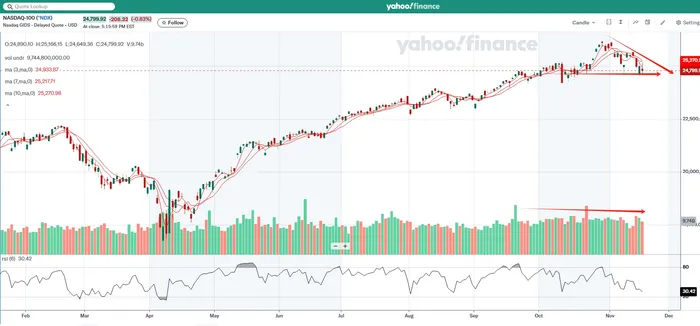
However, as long as investors continue to hold the same bullish conviction, a deeper sell-off becomes more likely. Large funds may continue selling into every dip-buying attempt. Once the index breaks the psychological support, both quantQNT-- funds and retail traders could pivot to selling, creating a liquidity air pocket. That capitulation phase would mark the ideal moment for a true buy-the-dip entry.
Some argue that the recent decline reflects a liquidity crisis. But Nasdaq 100 trading volume remains roughly in line with this year’s average. Buyers are stepping in on weakness, yet persistent selling pressure is dragging the market lower. Liquidity conditions are still healthy for now, but the bearish chart structure means liquidity could deteriorate quickly if buying momentum fades and more participants begin selling. This can easily snowball into a volume spike similar to the April crash, when President Trump’s reciprocal tariff announcement shocked the market.
BTC’s performance also deserves attention, as crypto often reflects the broader appetite for risk. After reaching record highs in October, BTC is now down about 28% from the peak and has turned negative YTD. Its weakness is contributing to fatigue in broader risk assets as aggressive traders unwind positions and adopt a more cautious stance. Crypto and the major AI names remain deeply connected because they share strong long-term narratives but also stretched valuations.
Whether BTC’s selling is over remains uncertain. Prices are holding above the 90,000 level, another psychological line in the sand. The RSI recently dropped to 19, a reading not seen since February 25. At that time BTC staged a brief rebound but soon rolled over again even as RSI improved. While a low RSI can support a short-term bounce, it also warns that more downside could follow. As crypto continues flashing stress signals, AI-driven equities may experience a similar pattern. Fundamentals are solid, but there is no urgency to go all-in until the market experiences a sharper flush that reopens liquidity and sets up a more attractive entry.

Investors should also temper expectations for Nvidia’s earnings, scheduled for release Wednesday after the close. Nvidia briefly touched a five-trillion-dollar market cap in late October, fueled by Jensen Huang’s optimistic comments on backlog demand and long-term AI growth. Yet expectations are extremely high. Even if the company delivers outstanding results, a scenario where the stock opens higher and closes lower would not be surprising, as bearish sentiment currently outweighs strong fundamentals.
As stated in our past two reports, AI fundamentals remain intact and early monetization is underway. The correction is primarily a sentiment shift, with investors taking a more cautious stance into year-end amid uncertainty surrounding the reopening. Further turmoil is still likely because dip-buying behavior remains persistent while conviction deteriorates. When investors finally panic and engage in forced selling, the next golden buying window will emerge. Warren Buffett put it best: “Be fearful when others are greedy, and be greedy when others are fearful.”

Independent investment research powered by a team of market strategists with 20+ years of Wall Street and global macro experience. We uncover high-conviction opportunities across equities, metals, and options through disciplined, data-driven analysis.
Latest Articles
Unlock Market-Moving Insights.
Subscribe to PRO Articles.
Already have an account? Sign in
Unlock Market-Moving Insights.
Subscribe to PRO Articles.
Already have an account? Sign in
Stay ahead of the market.
Get curated U.S. market news, insights and key dates delivered to your inbox.


AInvest
PRO
AInvest
PRO



