
BTC Perpetual Futures Long/Short Ratios: A Contrarian Indicator for Crypto Traders


 Aime Summary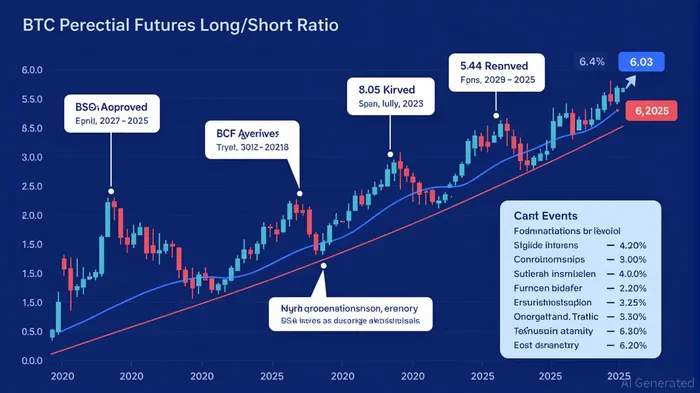
The BTC perpetual futures long/short ratio has emerged as a critical tool for crypto traders seeking to identify market imbalances and anticipate reversals. By analyzing real-time positioning data across exchanges like Binance, Bybit, and Gate.io, investors can gauge whether the market is overbought or oversold. Recent data reveals a marginal bearish bias, with short positions accounting for 50.66% of global perpetual futures positions as of late August 2025, compared to 49.34% longs [1]. This slight tilt is amplified on platforms like Bybit (52.29% short) and Binance (50.87% short), while Gate.io remains marginally bullish (51.03% long) [1]. Such divergences underscore the importance of cross-exchange analysis to avoid skewed interpretations.
Historical patterns validate the ratio’s contrarian utility. For instance, in Q1 2025, the ratio spiked to an extreme bullish level of 6.03, signaling overbought conditions. This was followed by a 20% price correction and $2.2 billion in liquidations as short-sellers re-entered the market [2]. Conversely, a ratio of 0.44 in July 2023—a bearish extreme—precipitated a 20% rebound as short-covering drove prices higher [2]. These examples illustrate how extreme ratios often precede reversals, acting as a barometer for crowd psychology.
The current market environment, however, lacks such extremes. While the ratio remains slightly bearish, it has not reached levels historically associated with sharp reversals. For example, the global ratio in early August 2025 stood at 49.47% long and 50.53% short [3], a marginal deviation from equilibrium. This suggests cautious positioning rather than panic selling or euphoric buying. Traders should monitor whether the ratio approaches thresholds like 0.7 (bearish) or 4.0 (bullish), which have historically signaled turning points [2].
Exchange-specific dynamics add nuance. Bybit’s 52.52% short bias in early August 2025 [3] contrasts with Gate.io’s 51.06% long tilt [3], reflecting regional trading preferences. Aggregating data across platforms mitigates the risk of overreliance on single-exchange metrics, which can distort broader market sentiment. For instance, Binance’s 49.17% long position in August 2025 [3] indicates a more neutral stance compared to Bybit’s pronounced bearishness.
To effectively use the long/short ratio, traders must combine it with complementary tools. Funding rates, on-chain metrics, and macroeconomic indicators like ETF inflows provide context. For example, the post-ETF approval rally in early 2024 skewed the ratio heavily bullish, but subsequent corrections were triggered by surging funding rates and short-covering [3]. Similarly, Bitcoin’s volatility has declined to levels below Netflix’s (46% vs. 53%), enhancing the ratio’s predictive power when paired with metrics like the Derivative Market Power (DMP) index [2].
In conclusion, the BTC perpetual futures long/short ratio is a potent contrarian indicator, but its value lies in identifying extremes rather than minor deviations. While current data suggests a cautious bearish bias, traders should remain vigilant for shifts toward overbought or oversold conditions. By integrating this metric with technical analysis and macroeconomic insights, investors can navigate Bitcoin’s volatility with greater precision.
**Source:[1] BitcoinBTC-- News Today: Market Sentiment Splits: Shorts Edge [https://www.ainvest.com/news/bitcoin-news-today-market-sentiment-splits-shorts-edge-longs-btc-futures-war-2508/][2] Navigating Sentiment Shifts in the Post-ETF Era - BTC [https://www.ainvest.com/news/btc-perpetual-futures-long-short-ratios-navigating-sentiment-shifts-post-etf-era-2508/][3] Unveiling Crucial BTC Perpetual Futures Long-Short Ratios [https://coinstats.app/news/d0e42e61b99169456896df4196214232dbe1894c70fe07cf759f6517c44f8a58_Unveiling-Crucial-BTC-Perpetual-Futures-LongShort-Ratios-What-They-Mean-for-Traders/]

Decoding blockchain innovations and market trends with clarity and precision.
Latest Articles
Stay ahead of the market.
Get curated U.S. market news, insights and key dates delivered to your inbox.


AInvest
PRO
AInvest
PRO



Comments
No comments yet