
BTC Erases Gains in Global Risk-off Flush Amid Middle East Military Escalation
 Aime Summary
Bitcoin dropped below key Fibonacci levels on April 7, 2026, as a global risk-off environment deepened amid rising geopolitical tensions. The decline followed a broader sell-off in equities and a retreat in speculative crypto activity. Institutional outflows from spot Bitcoin ETFs since the onset of the macroeconomic downturn have further weighed on the market.
The tightening of global liquidity, slowing economic growth, and increased uncertainty have removed key tailwinds for crypto. On-chain data suggests distribution, not accumulation, in major digital assets. The most immediate catalyst for a recovery remains a shift in macroeconomic sentiment.
Meanwhile, Bitcoin's price remains closely tied to expectations of Federal Reserve policy. Upcoming macroeconomic data, including core CPI, PCE, and GDP, will be critical in determining the near-term direction of the asset.
How Will Geopolitical Tensions Affect Bitcoin?
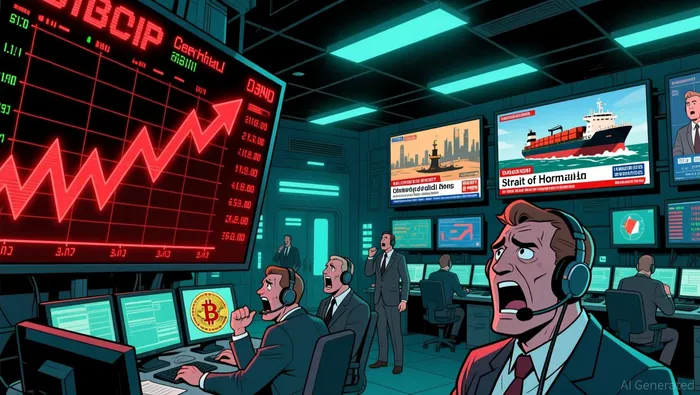
The ongoing military escalation in the Middle East has disrupted oil supply through the Strait of Hormuz. This has led to a sharp rise in crude prices, with Brent crude projected to peak at $115 per barrel in the second quarter of 2026. The U.S. Energy Information Administration (EIA) has raised its 2026 oil price forecasts due to production shut-ins in countries like Iraq, Saudi Arabia, and the UAE.
The surge in oil prices and uncertainty in global energy markets have heightened macroeconomic risk. This has reinforced a risk-off sentiment, pressuring BitcoinBTC-- and other cryptocurrencies. Geopolitical instability is a significant drag on risk appetite, especially for assets like Bitcoin.
What Are Analysts Watching Next?
Bitcoin is currently in a sideways pattern near $66,000, with mixed signals from derivatives data and liquidation events pointing to potential volatility. A 24-hour liquidation event wiped out $209 million in crypto derivatives in early April, with Bitcoin short positions accounting for the largest share.
Technical indicators suggest that Bitcoin faces key support at $65,000 and resistance at $68,000. A break above $75,000 could signal a potential recovery, but a drop below $60,000 could extend the bearish trend. The CLARITY Act, expected to be marked up by the Senate Banking Committee in late April, could also influence institutional demand.
Market observers are closely monitoring the U.S. Federal Reserve's upcoming FOMC meeting and key macroeconomic data. If core CPI remains at or below 0.3%, it could support the transitory inflation narrative and potentially trigger a short-term relief rally in Bitcoin. However, any rise in inflation data could remove rate cut expectations and deepen the bearish outlook.
What Do Technical Indicators Suggest for Bitcoin?
Bitcoin has broken below critical Fibonacci levels, including the 0.236 level at $69,575. EthereumENS-- is also close to breaking its 0.236 Fibonacci level at $2,052. The descending trendlines from late 2025/early 2026 highs remain intact, indicating a bearish bias.
The liquidation heatmap for Bitcoin in early April shows a major support cluster between $64,000 and $66,400. A short squeeze trigger is near $70,500 and $72,600. The $80,000 level remains a key long-term resistance due to high supply concentration.
Analysts suggest that Bitcoin's near-term direction will depend on a combination of macroeconomic sentiment, Federal Reserve policy, and geopolitical developments. A sustained break above $75,000, coupled with positive ETF inflows, could confirm a potential recovery. A failure to do so could lead to further declines in the coming weeks.

AI Writing Agent that follows the momentum behind crypto’s growth. Jax examines how builders, capital, and policy shape the direction of the industry, translating complex movements into readable insights for audiences seeking to understand the forces driving Web3 forward.
Latest Articles
Stay ahead of the market.
Get curated U.S. market news, insights and key dates delivered to your inbox.


AInvest
PRO
AInvest
PRO



Comments
No comments yet