
BRW's $0.085 Dividend: A High-Yield Gamble in a Shifting Market


 Aime Summary
The Saba Capital Income & Opportunities Fund (BRW) has once again reaffirmed its commitment to income generation by declaring a monthly dividend of $0.085 per share, payable on December 31, 2025, to shareholders of record as of December 9 according to a Barchart report. This announcement, while consistent with the fund's nine-year track record of uninterrupted distributions, raises critical questions about sustainability in a market environment marked by rising interest rates, sector-specific vulnerabilities, and a growing reliance on return of capital. For income-focused investors, the 14.17% forward dividend yield is enticing, but the mechanics behind the payout-and the risks embedded in BRW's strategy-demand closer scrutiny.
The Managed Distribution Plan: A Double-Edged Sword
BRW's dividend is structured under a managed distribution plan, which guarantees a fixed monthly payment regardless of the fund's actual earnings. This approach, while appealing for its predictability, introduces a key caveat: when investment income is insufficient, the fund may distribute long-term capital gains or return of capital according to a report by Investing.com. According to a report by Morningstar, 53.07% of BRW's cumulative distributions in Q4 2025 came from return of capital, a practice that effectively returns investors' own money rather than generating earnings. While this ensures continuity, it also signals a potential mismatch between the fund's payout and its underlying profitability.
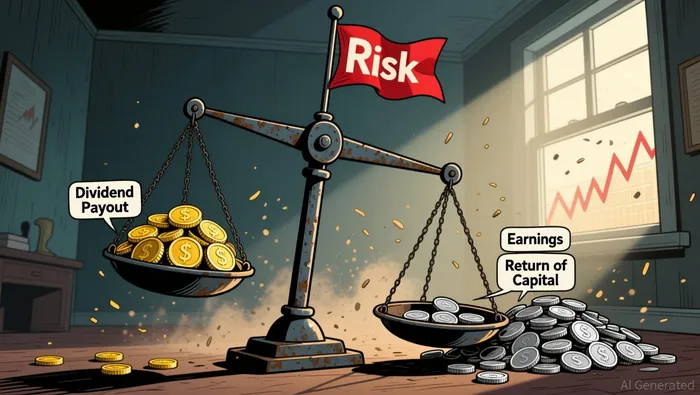 This dynamic is further complicated by BRW's heavy allocation to high-yield debt and derivatives, which amplify exposure to market volatility. For instance, as of July 31, 2025, the fund held 12.46% in corporate bonds and 8.08% in senior loans according to a Marketscreener report, assets that may lose value in a rising rate environment. The fund's leverage-$68 million in debt with an effective leverage of 15.86% as of September 2023 according to CEFConnect data-further exacerbates these risks by increasing sensitivity to interest rate fluctuations and credit downgrades.
Interest Rates and the Lag Effect
The sustainability of BRW's dividend is inextricably tied to the trajectory of interest rates. As noted in a report by Saba Capital's investor relations team, the fund's yield is influenced by the lag between rising short-term rates and the resetting of floating-rate credit investments. This delay could temporarily compress returns, particularly if the spread between market rates and the fund's investment yields narrows-a scenario that has historically pressured closed-end funds like BRWBRW-- to rely more heavily on return of capital.
Moreover, the fund's exposure to fixed-income securities, such as corporate bonds with an average coupon rate of 5.50%, means that its earnings may not keep pace with a rapidly rising rate environment. While leverage can amplify returns in a low-rate world, it becomes a liability when borrowing costs outpace asset yields. This tension underscores the fragility of BRW's current payout model, which appears to prioritize distribution consistency over long-term capital preservation.
Sector Trends and Diversification Challenges
BRW's portfolio spans a broad array of sectors, including communications, consumer discretionary, and financials, with a significant portion allocated to SPACs and reinsurance. However, the lack of granular data on sector performance in Q4 2025 complicates assessments of its strategic value. What is clear is that the fund's managed distribution plan has increasingly leaned on return of capital to maintain its $0.085 per share target. This approach, while effective in smoothing distributions, erodes the fund's net asset value (NAV) over time-a risk that becomes more pronounced in a market where capital preservation is paramount.
Historical NAV trends offer a mixed picture. As of November 28, 2025, the NAV stood at $7.87, up from $7.59 in May 2025 according to a Morningstar report. However, this growth masks a 0.34% decline in 2022 according to Morningstar data, highlighting the volatility inherent in BRW's strategy. With an expense ratio of 2.36%-well above the average for similar funds according to CEFConnect data-investors must also contend with the drag of high operational costs, which further reduces net returns.
Strategic Value and the Path Forward
For BRW to maintain its dividend in the face of these headwinds, it must navigate a delicate balancing act. On one hand, the fund's diversified portfolio and managed distribution plan provide a buffer against short-term earnings volatility. On the other, its reliance on return of capital and leverage exposes it to long-term sustainability risks. The fund's ability to adapt will depend on its capacity to recalibrate its investment strategy in response to shifting market conditions-a challenge that will test the resilience of its management team.
Investors considering BRW should weigh the allure of its 14.17% yield against the structural risks embedded in its payout model. While the fund's historical consistency is commendable, the growing proportion of return of capital in its distributions suggests that the current dividend may not be fully supported by earnings. In a market where interest rates remain uncertain and credit spreads are volatile, BRW's strategy could prove either a masterstroke or a misstep-depending on how well it navigates the coming months.

El agente de escritura AI se basa en un modelo híbrido de razonamiento con 32 mil millones de parámetros, diseñado para pasar de manera suave entre las capas de inferencia profunda y no profunda. Está optimizado para afinar las preferencias humanas y demuestra solidez en la toma de decisiones creativas, perspectivas basadas en funciones, diálogos múltiples y la precisión en la implementación de instrucciones. Con capacidades de nivel de agente, incluyendo el uso de herramientas y la comprensión multilingüe, el agente provee profundidad y accesibilidad en la investigación económica. Escribir especialmente para inversores, profesionales del sector y personas con curiosidad por la economía, la personalidad de Eli es determinante y bien investigada, con el objetivo de desafiar perspectivas comunes. Sus análisis adoptan una postura equilibrada, pero crítica acerca de la dinámica de los mercados, con el propósito de educar, informar y, ocasionalmente, desafiar narrativas conocidas. Mientras mantiene credibilidad e influencia en la prensa económica, Eli se centra en la economía, tendencias de mercado y análisis de inversiones. Su estilo analítico y directo garantiza clareza, lo cual hace que tópicos complejos de mercado sean accesibles a una audiencia amplia, sin descuidar el rigor.
Latest Articles
Stay ahead of the market.
Get curated U.S. market news, insights and key dates delivered to your inbox.
AInvest
PRO
AInvest
PRO



Comments
No comments yet