
The Brooklyn Revival: Barclays Center as a Catalyst for NYC's Post-Pandemic Real Estate Boom
New York City's post-pandemic economic rebound has been uneven, but in Brooklyn, the BarclaysBCS-- Center stands out as a linchpin of revitalization. Built in 2012 as a hub for sports, music, and entertainment, the arena has evolved into a mixed-use asset with strategic advantages few properties can match. For investors, its adaptive reuse value—combining live events, retail, and residential potential—positions it as a rare bet on Brooklyn's rising economic clout. Let's dissect its financials, location, and growth trajectory.
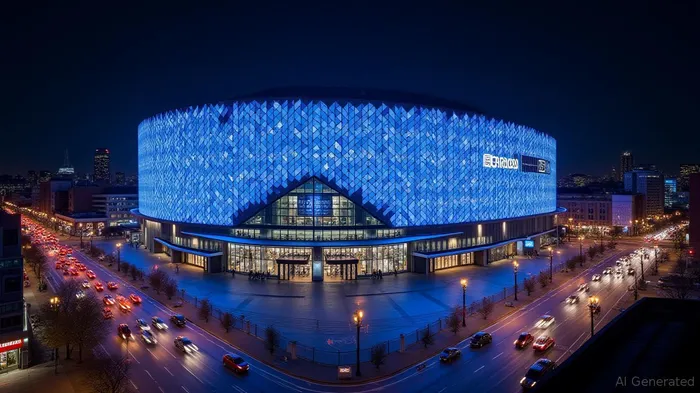
Location: Brooklyn's Crown Jewel for Mixed-Use Development
The Barclays Center's prime location in the Brooklyn borough—adjacent to Atlantic Terminal, one of NYC's busiest transit hubs—is its greatest asset. Unlike venues in less accessible areas, Barclays sits at the intersection of three subway lines and near major highways, making it a magnet for both local residents and tourists. This accessibility fuels foot traffic for nearby retailers, restaurants, and offices, creating a symbiotic ecosystem.
The arena's mixed-use design further amplifies its value. The surrounding Atlantic Yards development includes 3,000+ residential units, 400,000 sq ft of retail space, and the Barclays itself. This density ensures steady demand for events, while the arena's underused rooftops and adjacent lots offer untapped potential for expansion.
Adaptive Reuse: A Venue That Does More Than Host Games
Barclays' versatility is its secret weapon. Since its opening, it has hosted NBA games (Brooklyn Nets), WNBA games (New York Liberty), concerts (BTS, Taylor Swift), and even esports tournaments. This diversity keeps the calendar full and revenue streams flowing.
While ticket sales remain below 2019's $14.4 million peak, they've surged 70% since 2021, hitting $113.8 million in FY 2023. Concert revenue, which dropped to $28.7K in 2020, rebounded to $57.4M in 2024's second quarter. This recovery underscores the venue's ability to pivot—a trait critical in a post-pandemic world.
Financials: Progress, but Challenges Remain
Barclays' net operating income (NOI) climbed to $16.1M in FY 2023, up from $14.1M in 2022. Yet its $21.1M annual interest payments still outpace this figure, resulting in a $5.1M loss. Non-cash charges like depreciation (now $19.9M annually) further inflate losses, but they also provide tax shields.
The arena's debt structure is a double-edged sword. Its $1.2B in construction bonds, backed by PILOT payments (tax substitutes), require $38.5M annually. By 2026, interest costs will rise by $5.5M, squeezing margins. However, deferred revenue hit $46.5M in 2023—a 61% jump—suggesting strong demand for future events.
Strategic Advantages and Risks
Strengths:
1. Brooklyn's Growth: The borough's population is rising, with tech and creative industries clustering near Barclays. This fuels demand for both residential spaces and entertainment.
2. Naming Rights Renewal: Barclays' sponsorship expires in 2032. Renegotiating at higher rates (the current deal is below-market) could add $10M+ annually.
3. Owner Backing: Billionaire Joe Tsai's $18M FY 2023 injection ensures liquidity, though his equity stake (now $138M vs. $329M in 2020) signals caution.
Weaknesses:
1. Team Performance: The Nets' playoff struggles could reduce marquee game revenue.
2. PILOT Pressure: Rising debt servicing costs require occupancy rates to stay near 90%—a tight bar.
Investment Takeaway: A Long-Term Play with Upside
Barclays Center isn't a quick-profit investment. Its recovery hinges on sustained post-pandemic demand and Brooklyn's continued growth. However, its mixed-use model and strategic location make it a rare “anchor asset” in a revitalizing neighborhood.
For investors:
- Buy the dip: If occupancy dips below 85%, consider it a buying opportunity.
- Monitor deferred revenue: A $50M+ deferred balance signals confidence in future bookings.
- Watch PILOT renegotiations: If Barclays renews its naming rights at higher terms, it could unlock $100M+ in equity value over the deal's lifespan.
Brooklyn's vacancy rates are now 4.5%, down from 8% in 2020—a testament to its rising appeal. Barclays, as its crown jewel, stands to benefit disproportionately.
Final Analysis
Barclays Center is a microcosm of NYC's comeback: resilient, adaptable, and undervalued. While its financials aren't yet perfect, its location, mixed-use potential, and Brooklyn's upward trajectory make it a compelling real estate bet for patient investors. As the arena evolves into a 24/7 destination, its true value—like Brooklyn itself—is only just beginning to surface.
Invest with eyes on 2030 and beyond.

Stay ahead of the market.
Get curated U.S. market news, insights and key dates delivered to your inbox.
AInvest
PRO
AInvest
PRO



Comments
No comments yet