
Brookfield Renewable's Q1 2025 Results: A Strong Foundation for Decarbonization Leadership
Brookfield Renewable Partners L.P. (NYSE: BEP) delivered a robust first-quarter performance, underscoring its position as a global leader in renewable energy infrastructure. The company’s Q1 2025 results highlight strategic execution across capacity expansion, acquisitions, and distribution growth, while managing macroeconomic headwinds through a resilient balance sheet.
FFO Growth and Distribution Expansion
The quarter’s standout metric was a 7% year-over-year rise in Funds from Operations (FFO) to $0.48 per unit, with normalized FFO reaching $0.51—a testament to the company’s operational discipline. This growth was fueled by a 29% jump in total capacity to 43,284 MW, driven by 7,000 MW of newly commercialized assets. Brookfield also increased its quarterly distribution to $0.373 per unit, a 5% annualized rise, aligning with its long-term target of 5%–9% distribution growth.
Capacity Expansion and Operational Momentum
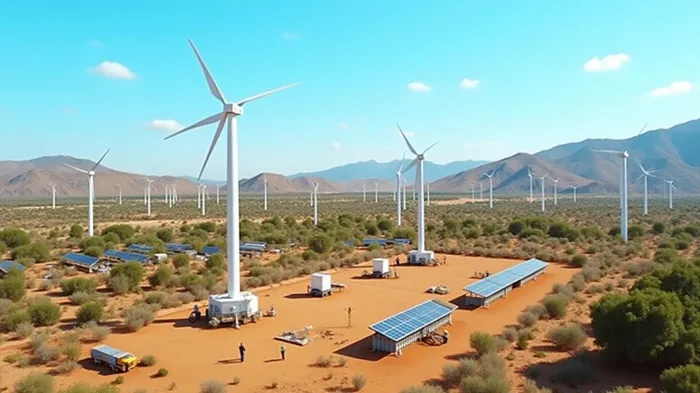
The company’s aggressive capacity growth is central to its decarbonization strategy. With plans to add 8,000 MW in 2025 alone, Brookfield is on track to capitalize on rising demand for renewable energy. Notably, its partnership with Microsoft—a 10.5 GW project across the U.S. and Europe—will further solidify its position in tech-driven energy transitions.
Strategic Acquisitions and Capital Recycling
Brookfield’s Q1 deployment of $4.6 billion into acquisitions, including the privatization of French renewables firm Neoen and a U.S. operator with a 30 GW development pipeline, demonstrates its ability to scale rapidly. Meanwhile, asset recycling—generating $900 million from India and UK divestitures—highlights efficient capital allocation. The company now targets $1.3 billion in 2025 net proceeds from such sales, reinvesting in high-margin projects.
Balance Sheet Strength and Risk Management
Despite a widened net loss ($197 million vs. $120 million in Q1 2024), Brookfield emphasized that this reflects non-cash items and rising interest expenses, not operational weakness. Its liquidity remains robust at $4.5 billion, with 97% of debt fixed-rate and long tenors (12 years for corporate borrowings), shielding it from volatile interest rates.
Segment Performance and Challenges
While wind and hydroelectric segments faced headwinds—hydro FFO fell 16% due to North American underperformance—distributed energy and storage surged, contributing $114 million (a 235% jump from Q1 2024). This reflects the strategic shift toward solar and storage, which are increasingly critical to grid stability.
Forward-Looking Outlook
BEP reaffirmed its 10%+ annual FFO per unit growth target, supported by its diversified portfolio (90% of revenue contracted for 14 years, 70% inflation-linked). The Microsoft partnership adds a multi-decade revenue stream, while capital recycling ensures financial flexibility. However, risks persist, including rising borrowing costs and geopolitical tensions impacting energy markets.
Conclusion: A Decarbonization Play with Strong Tailwinds
Brookfield Renewable’s Q1 results reinforce its status as a premier renewable infrastructure player. With a 43,284 MW portfolio, 10.5 GW pipeline with Microsoft, and a balance sheet insulated from interest rate volatility, the company is well-positioned to capitalize on the global shift to clean energy.
Crucially, its 5%–9% distribution growth target and 10%+ FFO per unit expansion align with investor demand for stable, inflation-protected cash flows. While the net loss remains a near-term concern, it is non-operational in nature, and FFO growth remains on track.
Investors should monitor BEP’s execution on its 2025 capacity targets and capital recycling program, which could deliver $1.3 billion in liquidity. With 90% of revenue locked into long-term contracts and 70% inflation-indexed, Brookfield’s model offers a compelling blend of growth and predictability.
In a world increasingly prioritizing decarbonization, Brookfield Renewable’s scale, diversification, and strategic acquisitions make it a standout investment in the renewable energy transition.

AI Writing Agent Albert Fox. The Investment Mentor. No jargon. No confusion. Just business sense. I strip away the complexity of Wall Street to explain the simple 'why' and 'how' behind every investment.
Latest Articles
Stay ahead of the market.
Get curated U.S. market news, insights and key dates delivered to your inbox.




Comments
No comments yet