

Brookfield Infrastructure ended 2025 with a headline that could pass for a yawn: funds from operations (FFO) — the cash-flow figure infrastructure owners watch because depreciation muddies reported profit — rose about 6% per unit to $3.32. Dig inside, though, and one segment broke the pattern. Digital Data FFO jumped over 50% to $502 million from $333 million a year earlier.
The gap between those two numbers is not a contradiction. It is a timing story. And it is the clearest reason to expect 2026 FFO to turn sharply higher.
Why did the parent limp while one child sprinted? Management sold a record $3.1 billion of assets in 2025 to recycle the cash into new investments — a treadmill the company runs on purpose. The catch: sold assets stop producing earnings the day they leave. That foregone income masked otherwise-fast growth underneath, which is why per-unit FFO crawled up just 6% even as the data machine accelerated.
By the second quarter of 2026, the mask came off. Data segment FFO rose 36% year over year to $154 million, and this time the whole company felt it: total FFO was up 10% per unit. Data is no longer a rounding error under a "digital" marketing label. It is now the fastest readable earnings line in the house, and management says the best is ahead.

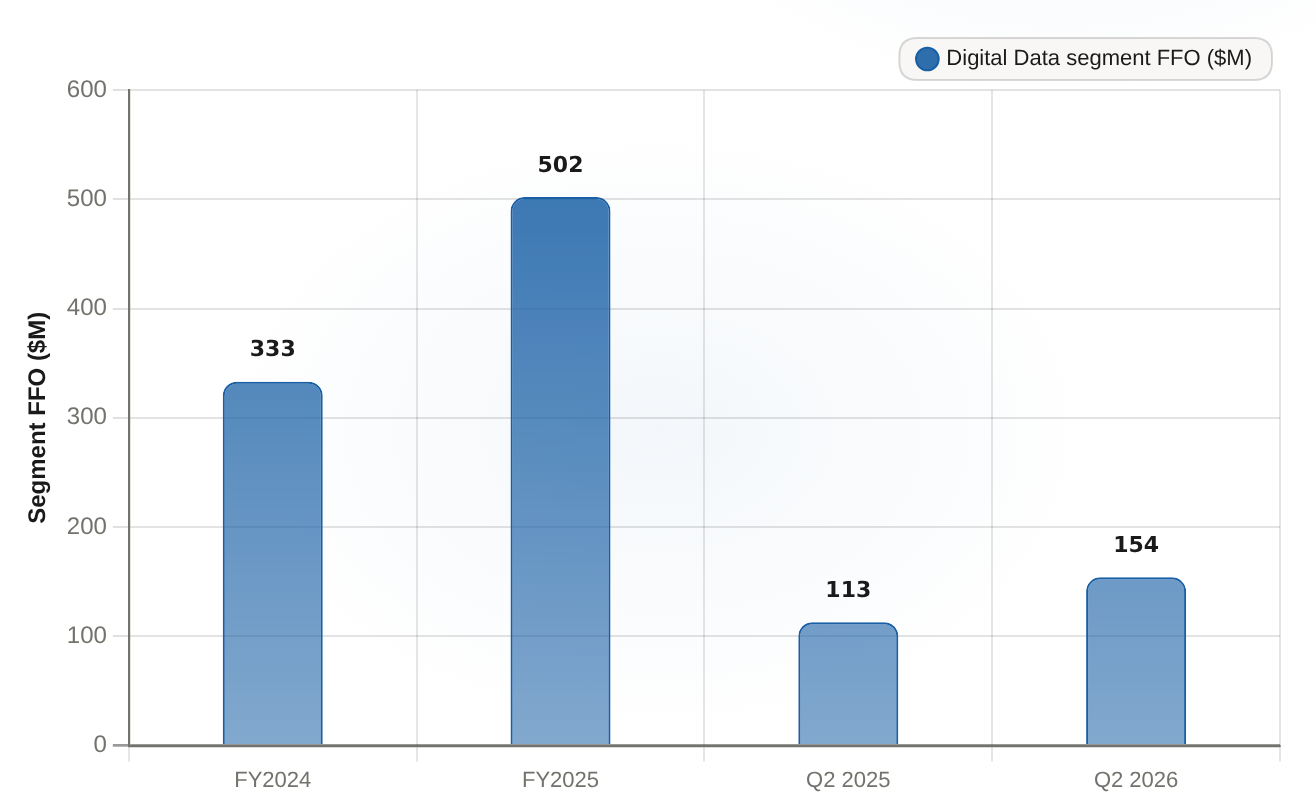
Digital Data segment FFO more than doubled from FY2024 ($333M) to FY2025 ($502M), with the Q2 YoY comparison stepping up from $113M to $154M.
| Period | Digital Data segment FFO ($M) |
|---|---|
| FY2024 | 333 |
| FY2025 | 502 |
| Q2 2025 | 113 |
| Q2 2026 | 154 |
CEO Sam Pollock put it bluntly at the year-end release: "We expect FFO to inflect higher in 2026 as these investments fully contribute to results." The number that really matters is the capacity pipeline — the runway that backlog becomes.
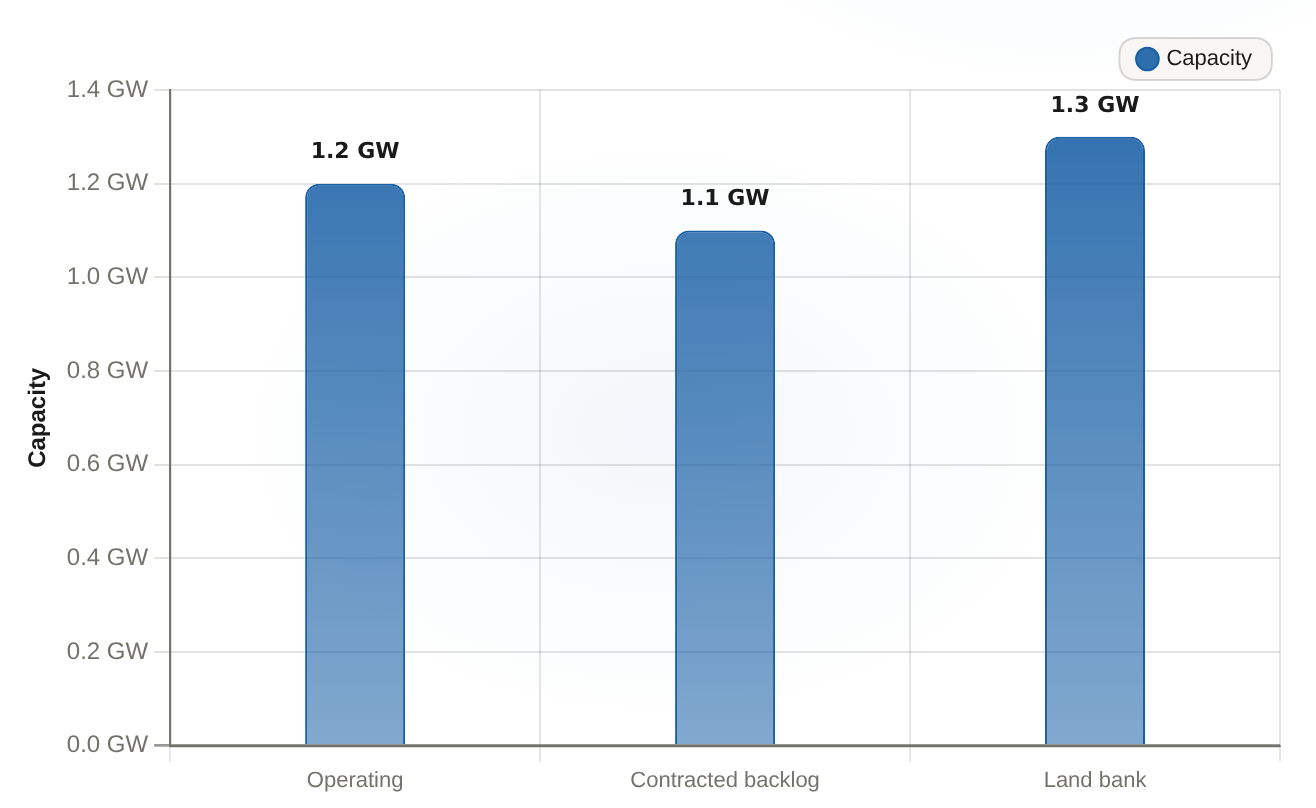
Operating and contracted capacity together already sit on funded conversion, while the powered land bank provides the next tranche of the ~3.6 GW development runway.
| Stage | Capacity (GW) |
|---|---|
| Operating | 1.2 |
| Contracted backlog | 1.1 |
| Land bank | 1.3 |
Brookfield carries roughly 3.6 GW of digital development potential: 1.2 GW already operating and billing, 1.1 GW in a contracted project backlog, and 1.3 GW sitting in a powered land bank. The distinction matters. Operating capacity makes money today. Contracted backlog has signed customers and a build path. The land bank is dirt with power attached, waiting for a tenant and a contract.
That pipeline explains why this is a forward story rather than a victory lap. Commissioned capital converts down a chain — capex builds capacity, commissioning turns it into billing, and billing feeds segment FFO, which lifts the total FFO that funds a distribution BrookfieldBN-- still pays at a conservative 66% payout.
The raw amount already crossing that bridge is the concrete signal. More than $1.5 billion of new capital projects from the backlog were commissioned into revenue-generating status during 2025, and the second quarter of 2026 saw another $1.5-billion-plus tranche commissioned, concentrated in data. Two large commissioning years back to back are exactly what a guided inflection should look like, and with more than 76% of the capital backlog sitting in data, the near-term earnings path is unusually lopsided toward the segment that is actually growing.
The thesis is not confirmed yet, and the honest read is to say so. "Primary engine" describes where 2026 is heading, not something already banked — the case for the inflection rests on second-quarter actuals and guidance, not on a full year behind us. So the scoreboard stays simple: watch whether quarterly Data FFO keeps compounding at a 30%+ year-over-year clip and whether operating capacity starts moving off the contracted backlog and into the billing column. If segment FFO keeps climbing while the backlog stays flat, the conversion story holds. If growth decelerates hard while capacity sits unconverted, capital is being tied up without turning into income — and the "digital engine" is just a label.








Comments
No comments yet