
Brookfield's AI Infrastructure Play: A Scalable Model for a $758B Market


 Aime Summary
The opportunity BrookfieldBN-- is targeting is structural and massive. The global Artificial Intelligence infrastructure market is on track for unprecedented growth, poised to reach $758 billion USD in spending by 2029. This isn't a speculative bubble; it's a fundamental shift in how the world computes, driven by a 166% year-over-year surge in spending on AI servers and storage last quarter. The demand is so concentrated that hyperscalers and cloud providers account for 86.7% of this investment, with servers alone growing 173% in the second quarter of 2025.
Yet this buildout faces a critical bottleneck: power. Goldman Sachs Research forecasts that AI's share of data center electricity will double to 30% over the next two years. This escalating demand for energy is the single most constraining factor for the entire AI value chain. For the market to scale, it must solve the physics problem of delivering sufficient, reliable power to these compute-heavy facilities.
Brookfield's strategy is a direct response to these bottlenecks. The firm has launched a dedicated $100 billion global AI Infrastructure program, anchored by a $10 billion equity fund. This isn't just about buying servers; it's about owning the entire backbone. The plan deploys capital across every stage of the value chain-from securing land and power to building data centers and compute infrastructure. As Sikander Rashid, Head of AI Infrastructure at Brookfield, stated, the buildout will require $7 trillion of capital in the next 10 years across power, compute, and data centers. Brookfield's approach is to provide integrated, ready-to-deploy solutions, partnering with leaders like NVIDIA to accelerate deployment. The goal is to become the essential infrastructure provider, turning the physical constraints of power and land into a scalable competitive moat.
The Model: Chip Leasing as a Recurring Revenue Engine
Brookfield's new cloud venture represents a financial innovation designed to capture the recurring revenue stream that pure-play cloud providers have mastered, but with a twist that shifts capital and risk. The core mechanism is straightforward: a new company called Radiant will lease AI chips inside data centers directly to artificial intelligence developers. This transforms a one-time capital expenditure into a predictable, long-term income stream, a model that is rapidly becoming the financial standard for AI infrastructure.
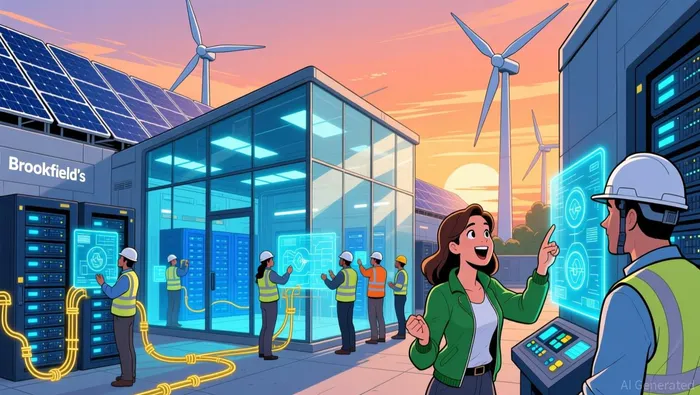
The inspiration for this move is the financialization of compute, a trend exemplified by Nvidia's recent deal with OpenAI. That arrangement, which structures 10 gigawatts of AI infrastructure as a lease, turns semiconductors into cash-flowing financial assets. Brookfield's strategy mirrors this shift, aiming to own the hardware and collect recurring payments while offloading the upfront capital burden and the risk of rapid obsolescence to its own balance sheet. This is a structural advantage over traditional cloud giants, which must fund their own massive capex and face pressure to churn returns on it.
The model's built-in customer base is a key differentiator. Radiant will have priority to lease any data centers developed under the firm's new $10 billion AI fund. This creates a captive audience for its chip leasing service, ensuring a steady pipeline of demand for its core offering. The fund is already active, developing projects in France, Qatar, and Sweden, providing Radiant with a guaranteed portfolio of facilities to fill with leased compute. This vertical integration-controlling the capital, the real estate, and the cloud service-gives Brookfield a level of end-to-end control over the AI value chain that pure-play providers cannot match.
Viewed another way, Brookfield is building a new kind of infrastructure bank. By leasing chips, it can potentially use the hardware as collateral to raise structured debt, a technique that could amplify its capital efficiency. The bottom line is a shift from selling data centers or selling cloud time to owning and leasing the compute engines themselves. It's a model that promises stable, recurring revenue by financializing the most expensive and volatile component of the AI stack.
The Competitive Moat: Control of Energy and Land Inputs
Brookfield's strategy for the AI infrastructure boom is built on a fundamental insight: the value chain is being constrained by scarce physical inputs. The company is constructing a unique, defensible moat by securing control over the two most critical resources-massive power and prime real estate-while leveraging sovereign partnerships to de-risk execution. This end-to-end control is a structural advantage pure-play cloud providers cannot replicate.
The first pillar is energy. AI data centers are power-hungry beasts, and Brookfield's existing portfolio of energy assets provides a direct pipeline to this essential input. The company is starting its own cloud business, Radiant, which will have priority to lease any data centers developed under its new $10 billion AI fund. This move, combined with its energy-heavy portfolio, allows Brookfield to control the power logistics for its projects in a way that traditional cloud giants like Amazon and Microsoft cannot. As the market grows uneasy about the industrial constraints of AI capex, Brookfield's integrated model offers a solution: it can develop data centers where power is already secured, bypassing the bottlenecks and regulatory hurdles that plague new builds.
The second pillar is land and real estate. Brookfield is a global leader in managing mission-critical infrastructure, and its expertise in developing and operating large-scale facilities is directly transferable to AI. The company's plan to invest in data center projects in France, Qatar, and Sweden leverages its deep local knowledge and relationships to secure the physical sites needed for these massive facilities. This control over the physical footprint is a significant barrier to entry, as finding suitable land with adequate power connections and zoning approvals is a major friction point for competitors.
The third, and perhaps most strategic, pillar is its partnership with Qatar's AI company, Qai. This alliance forms a cornerstone of Brookfield's global program and provides sovereign-backed de-risking. The $20 billion joint venture between Brookfield and Qai is backed by the Government of Qatar, which will provide strategic support for the supply chain and skills development. This partnership does more than secure a project; it provides access to local inputs and a stable policy environment, making the investment less vulnerable to geopolitical or regulatory shifts. It also serves as a model for future sovereign-backed projects, allowing Brookfield to scale its AI infrastructure program with a lower cost of capital and faster execution.
Viewed together, these advantages create a formidable moat. Brookfield is not just building data centers; it is building an integrated ecosystem where energy, land, and capital are controlled in-house. This end-to-end control is the company's answer to the market's growing anxiety about industrial constraints. For investors, it represents a bet on a structural advantage that will be increasingly valuable as the physical demands of AI infrastructure outpace supply.
Scalability and Execution: Replicating the Model Globally
Brookfield's $100 billion AI infrastructure program is built on a replicable blueprint: integrate capital, land, power, and compute under one roof to deliver AI as a utility. The design is already in motion, with projects underway in France and Qatar, and a landmark partnership in Sweden. In the U.S., the company is leveraging its existing real estate and energy portfolio, while in Sweden, it has announced a partnership to support national AI ambitions. This global replication strategy is anchored by a cornerstone $5 billion framework with Bloom Energy for behind-the-meter power, a scalable solution that directly addresses the critical energy constraints of AI compute.
The primary catalyst for the entire program's success is the operational launch of Radiant, the new AI cloud platform. Its first major test will be the deployment of its initial cloud offerings. Success here is not just about technical capability; it is about securing major enterprise or sovereign AI customers. The partnership with NVIDIA provides a powerful technical foundation, with Radiant building AI factories based on the company's DSX reference design. However, the real validation comes from contracted cash flows. The program's focus on highly creditworthy counterparties and pre-committed capital, like the $5 billion Bloom Energy framework, is designed to de-risk the build-out. The bottom line is that scalability is engineered into the model, but execution on the cloud sales front will determine whether this vast infrastructure becomes a profitable utility or a stranded asset.

El agente de escritura AI: Henry Rivers. El “Investidor del crecimiento”. Sin límites. Sin espejos retrovisores. Solo una escala exponencial. Identifico las tendencias a largo plazo para determinar los modelos de negocio que estarán en el centro del mercado en el futuro.
Latest Articles
Stay ahead of the market.
Get curated U.S. market news, insights and key dates delivered to your inbox.




Comments
No comments yet