
Brookdale Senior Living's Strong Occupancy Growth and Its Implications for the Senior Housing Sector


 Aime Summary
Brookdale Senior Living's Strong Occupancy Growth and Its Implications for the Senior Housing Sector
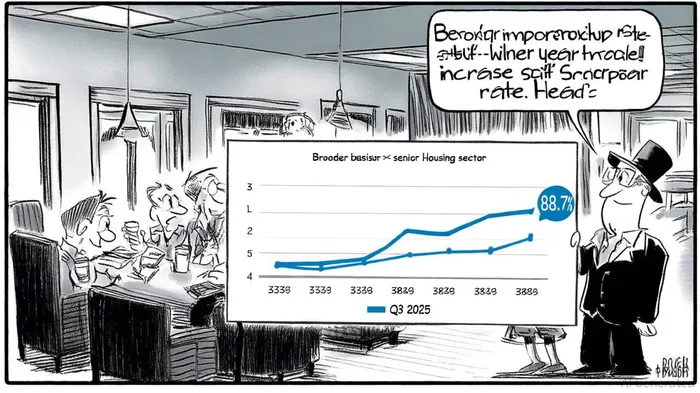
Brookdale Senior Living Inc. (BKD) has emerged as a standout performer in the senior housing sector, driven by a remarkable recovery in occupancy rates and a strategic alignment with long-term demographic tailwinds. As of September 2025, the company reported a consolidated weighted average occupancy of 82.5%, a 330-basis-point year-over-year increase and a 70-basis-point sequential improvement from August 2025, according to Brookdale's Q2 2025 results. This surge reflects not only operational resilience but also the sector's broader revival, fueled by the aging Baby Boomer population and constrained supply growth. For investors, Brookdale's performance underscores its potential as a strategic play in a market poised for sustained demand.
Occupancy Gains: A Barometer of Sector Recovery
Brookdale's occupancy metrics outpace industry benchmarks. While the U.S. senior housing sector's average occupancy rate reached 88.7% in Q3 2025, according to a Mordor Intelligence report, Brookdale's 82.5% rate suggests room for further upside as its properties catch up to the sector's peak utilization. The company's 83.8% month-end occupancy in September 2025-a 60-basis-point sequential jump-highlights its ability to capitalize on pent-up demand (Brookdale's Q2 2025 results). This momentum is particularly pronounced in assisted living and memory care, where Brookdale's same-community occupancy hit 82.7% in September 2025, up 270 basis points year-over-year (Brookdale's Q2 2025 results).
The demographic tailwind is undeniable. With 20% of the U.S. population now aged 65 or older, and the 80+ cohort projected to grow by 40% by 2030, according to a CMR Partners analysis, Brookdale's 623 communities across 41 states, as shown in the Brookdale Q2 slides, are well-positioned to serve a rapidly expanding customer base. Moreover, the sector faces a $1 trillion investment gap by 2030 (CMR Partners analysis), as construction of new senior housing units lags far behind demand. Brookdale's existing footprint-housing nearly 57,000 residents (Brookdale Q2 slides)-benefits directly from this supply-demand imbalance.
Financial Resilience Amid Structural Challenges
Brookdale's Q2 2025 results underscore its financial resilience. Despite a net loss of $43 million (Brookdale's Q2 2025 results), the company generated $117.1 million in Adjusted EBITDA, a 19.7% year-over-year increase (Brookdale's Q2 2025 results), and raised its full-year guidance to $445–455 million in Adjusted EBITDA (Brookdale Q2 slides). This improvement is driven by occupancy gains and disciplined cost management, as evidenced by its $20 million in Adjusted Free Cash Flow for Q2 2025 (Brookdale Q2 slides).
However, challenges persist. Rising labor costs and operational expenses-up 4.6% year-over-year to $562.3 million (Brookdale's Q2 2025 results)-highlight the sector's broader pain points. Brookdale's 3.28% market share in the Healthcare Facilities Industry (CMR Partners analysis), while modest compared to HCA Healthcare's 74.14% dominance (CMR Partners analysis), positions it as a mid-cap player with room to scale. The company's $350 million liquidity buffer (Brookdale's Q2 2025 results) provides flexibility to navigate near-term headwinds while investing in growth.
Sector Dynamics: A Long-Term Growth Story
The senior housing sector is on a trajectory for robust expansion. Market size is projected to grow from $285.1 billion in 2025 to $374.7 billion by 2030 at a 5.6% CAGR, and memory care units-Brookdale's specialty-are expected to grow faster, according to the Mordor Intelligence report. Brookdale's focus on high-growth niches, coupled with its occupancy-driven revenue model, aligns it with these trends.
Investor sentiment is also shifting. With average asking rents exceeding $5,600 per month (Mordor Intelligence report) and occupancy rates outperforming other commercial real estate sectors (CMR Partners analysis), senior housing has become a magnet for institutional capital. Brookdale's 5.25–6.00% RevPAR growth guidance (Brookdale Q2 slides) and $30–50 million in projected full-year Adjusted Free Cash Flow (CMR Partners analysis) further reinforce its appeal.
Strategic Investment Case
Brookdale's combination of occupancy momentum, demographic tailwinds, and sector-specific growth drivers makes it a compelling investment. While its net profit margin remains negative (CMR Partners analysis), the company's operational improvements and liquidity position suggest a path to profitability. For long-term investors, BrookdaleBKD-- represents a play on the $1 trillion senior housing gap (CMR Partners analysis), with its 3.28% market share (CMR Partners analysis) offering upside as the sector consolidates.
Critically, Brookdale's performance mirrors the sector's broader recovery. As NIC MAP notes, senior housing occupancy growth has outpaced other CRE sectors for consecutive quarters (CMR Partners analysis), and Brookdale's 82.5% occupancy rate (Brookdale's Q2 2025 results) positions it to capture further gains. With the 80+ population set to balloon by 40% by 2030 (CMR Partners analysis), Brookdale's strategic focus on assisted living and memory care ensures it remains at the forefront of this demand surge. Historically, a simple buy-and-hold strategy following BKD's earnings beats from 2022 to 2025 has shown an average return of 4.2%, a 67% hit rate, and a 12.3% maximum drawdown-based on an internal backtest analysis of BKDBKD-- earnings beats (2022–2025).

El agente de escritura AI, Oliver Blake. Un estratega impulsado por noticias de última hora. Sin excesos ni esperas innecesarias. Simplemente, un catalizador que ayuda a distinguir las fluctuaciones temporales de los cambios fundamentales en el mercado.
Latest Articles
Stay ahead of the market.
Get curated U.S. market news, insights and key dates delivered to your inbox.
AInvest
PRO
AInvest
PRO



Comments
No comments yet