
U.S.-Brokered Peace Talks in Southeast Asia: A Catalyst for Foreign Investment and Market Rebalancing
 Aime Summary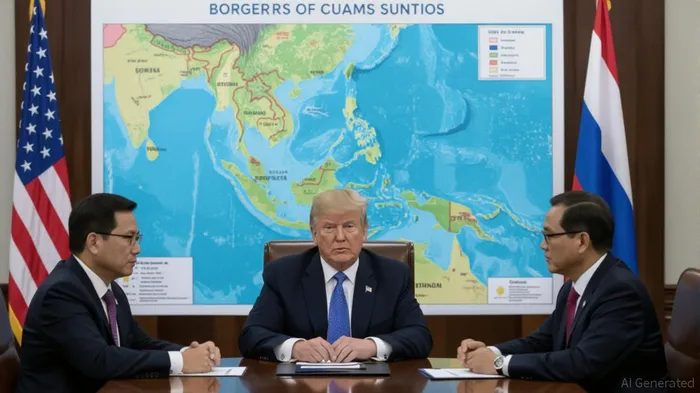
The ongoing U.S.-mediated peace talks between Thailand and Cambodia have emerged as a pivotal geopolitical event with far-reaching economic implications. As of July 2025, the conflict—marked by 32 deaths and 200,000 displaced people—has disrupted $4 billion in annual bilateral trade and destabilized regional supply chains. However, the conditional leverage exerted by the Trump administration, including a 36% tariff threat on Thai and Cambodian exports, has created a unique opportunity for foreign investors to reassess risk-reward dynamics in Southeast Asia. This article explores how a durable ceasefire could catalyze capital inflows, reshapeRSLS-- equity markets, and realign regional economic hierarchies.
The Geopolitical Leverage of U.S. Trade Policy
President Trump's intervention has underscored the U.S. strategy of using trade as a diplomatic tool. By linking tariff relief to de-escalation, the administration has forced both nations to prioritize peace over continued hostilities. This approach mirrors historical precedents, such as the U.S.-brokered India-Pakistan de-escalations in the 2020s, where conditional economic incentives stabilized volatile regions. For investors, this signals a pattern: U.S. economic leverage can act as a rapid stabilizer, creating windows for capital deployment in previously risk-averse markets.
Sectoral Impacts and Investment Opportunities
The conflict has already reshaped sectoral performance in Thailand and Cambodia. Tourism and retail, which account for 15% of Thailand's GDP and 20% of Cambodia's, have suffered acute declines. In contrast, defensive sectors like logistics and infrastructure have surged, with companies like Pan-Asia Freight and Siam Defense Systems posting 15% stock gains since January 2025. A ceasefire would likely reverse these trends, unlocking value in tourism and agriculture while redirecting capital toward reconstruction.
Energy and mining could become prime beneficiaries. The disputed Preah Vihear region, rich in untapped gas and rare earth minerals, could attract $557 billion in investment if stabilized. Thai state-owned PTT Group and Cambodian energy firms stand to benefit from renewed cross-border projects. Meanwhile, the U.S. tariff threat has accelerated regional realignments, with Vietnam and Indonesia securing preferential trade deals, signaling a shift in investment priorities toward manufacturing and digital infrastructure.
The ASEAN Paradox: Diplomacy vs. Economic Realism
While ASEAN has historically struggled to manage border disputes, the U.S. has filled the void with a pragmatic, results-oriented approach. This highlights a broader trend: investors are increasingly prioritizing geopolitical pragmatism over traditional multilateral frameworks. The September 2025 Joint Boundary Commission (JBC) meeting, for instance, is being viewed as a litmus test for sustained peace. A successful outcome could see Thai Aerospace Industries and Cambodian state-owned logistics firms outperforming their regional peers.
Strategic Investment Advice
- Diversify Across Sectors and Markets: Investors should allocate capital to sectors poised for post-conflict recovery, such as energy, agriculture, and tourism, while maintaining exposure to resilient logistics and defense stocks.
- Monitor U.S. Tariff Policies: The August 1 tariff deadline creates a binary catalyst—either a resolution or a deepening crisis. Positioning in hedging instruments (e.g., Thai baht ETFs) could mitigate currency risks.
- Leverage ASEAN's New Guard: Vietnam and Indonesia, which have secured favorable U.S. trade terms, offer diversification opportunities. Focus on manufacturing and renewable energy firms in these markets.
- Engage in ESG-Aligned Reconstruction: Post-ceasefire, green energy and infrastructure projects will dominate. Thai Aerospace Industries' pivot to hybrid energy systems and Cambodia's renewable initiatives are worth tracking.
Conclusion
The U.S.-brokered peace talks between Thailand and Cambodia are more than a geopolitical event—they are a market inflection point. By stabilizing trade routes and unlocking access to critical resources, a durable ceasefire could transform Southeast Asia into a high-growth region. For investors, the key lies in balancing short-term volatility with long-term opportunities, leveraging U.S. economic leverage, and adapting to the shifting regional order. As the September JBC meeting approaches, the path to regional stability—and with it, a new era of investment—remains as precarious as it is promising.

Stay ahead of the market.
Get curated U.S. market news, insights and key dates delivered to your inbox.


AInvest
PRO
AInvest
PRO



Comments
No comments yet