
Broadcom’s Sustained Outperformance in a Slowing Semiconductor Sector


 Aime Summary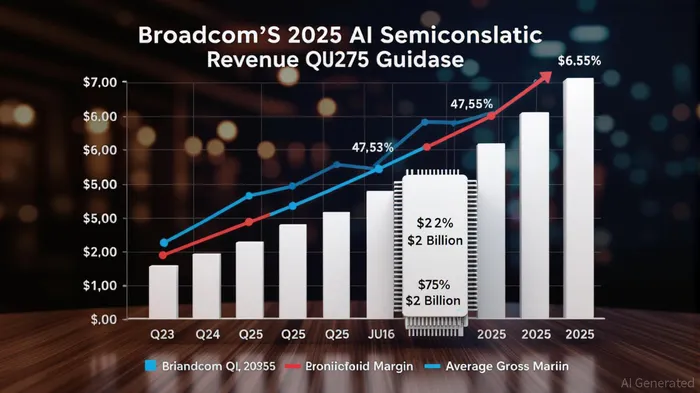
In a semiconductor sector marked by uneven performance and margin pressures, BroadcomAVGO-- (AVGO) has emerged as a standout performer, defying industry fatigue through its AI-driven growth and exceptional margin resilience. With global semiconductor sales projected to reach $701 billion in 2025—a 11% increase from 2024—Broadcom’s Q3 FY2025 results underscore its ability to capitalize on AI tailwinds while maintaining profitability far above industry averages [2].
Financial Outperformance: AI as the Growth Engine
Broadcom’s Q3 2025 revenue surged 22% year-over-year to $16 billion, driven by a 63% YoY increase in AI semiconductor revenue to $5.2 billion [2]. This segment, which includes custom accelerators and high-speed networking chips for hyperscale data centers, now accounts for over half of the company’s total semiconductor solutions revenue. The momentum shows no signs of slowing: Q4 guidance projects AI semiconductor revenue to hit $6.2 billion, a 66% YoY jump [6].
This outperformance contrasts sharply with broader industry trends. While the semiconductor sector grew 19.1% YoY in 2024 to $627.6 billion, companies like ON SemiconductorON-- and SMIC reported declining margins and revenue [5]. For instance, SMIC’s Q2 2025 gross margin of 20.4% lagged behind the industry average of 47.53%, highlighting the disparity between leaders and laggards [3]. Broadcom’s ability to scale AI-specific solutions—such as its custom accelerators and VMware-integrated private cloud infrastructure—has insulated it from the sector’s broader volatility [1].
Margin Resilience: A Structural Advantage
Broadcom’s financial discipline and pricing power are evident in its margins. In Q3 2025, the company reported a gross margin of 79.4% and an operating margin (adjusted EBITDA) of 67%, translating to $10.7 billion in adjusted EBITDA [1]. These figures dwarf industry peers: MarvellMRVL-- and MediaTek hover around 50% gross margins, while AMD’s operating margin stands at a mere 1.48% [3]. Even as R&D spending rose 12% YoY to $971 million, Broadcom’s operating leverage remained robust, with free cash flow in Q1 2025 reaching $5.6 billion—38% of total revenue [5].
The company’s diversified business model further reinforces margin stability. Semiconductors (80% of revenue) and infrastructure software (20%) create a balanced revenue stream, with VMware’s integration into Broadcom’s offerings expanding its AI infrastructure capabilities [2]. This dual focus allows Broadcom to hedge against sector-specific downturns, a critical advantage as supply chain disruptions and geopolitical tensions persist.
Strategic Leadership in AI Semiconductors
Broadcom’s AI semiconductor strategy differentiates it from rivals like NVIDIANVDA--, which focuses primarily on GPUs. By targeting high-speed silicon solutions, custom accelerators, and AI networking chips, Broadcom has carved out a niche in hyperscale data centers and enterprise AI cloud infrastructure [2]. Its Q1 2025 AI revenue surged 77% YoY to $4.1 billion, reflecting strong demand for these specialized products [5].
The company’s R&D investments—$9.31 billion in 2024, or 16.7% of revenue—underscore its commitment to innovation [5]. While this spending ratio is lower than NVIDIA’s 35% or AMD’s 40%, Broadcom’s high operating margins (66% in Q1 2025) demonstrate that efficiency, not just R&D scale, drives its success [4]. This balance between innovation and cost control positions Broadcom to maintain its leadership as AI adoption accelerates.
Defying Industry Fatigue
The semiconductor sector’s 2025 outlook remains mixed. While AI and data center demand are expected to drive $701 billion in global sales, capital expenditures are rising sharply—projected at $185 billion in 2025—to meet capacity needs [3]. For many firms, this means navigating thinning margins and operational bottlenecks. Broadcom, however, has turned these challenges into opportunities. Its high-margin infrastructure software segment (up 17% YoY to $6.8 billion in Q3) and AI semiconductor growth provide a counterbalance to industry-wide headwinds [2].
Moreover, Broadcom’s valuation metrics reflect its premium positioning. A P/E ratio of 102.87x far exceeds the semiconductor industry average of 28.14x, signaling investor confidence in its ability to sustain outperformance [1]. This premium is justified by its structural advantages: pricing power, operational efficiency, and a first-mover edge in AI-specific silicon.
Conclusion
Broadcom’s sustained outperformance in a slowing semiconductor sector is no accident. By leveraging AI-driven growth, maintaining industry-leading margins, and strategically diversifying its offerings, the company has positioned itself as a bellwether for the next phase of tech innovation. As the semiconductor industry grapples with fragmentation and margin pressures, Broadcom’s model offers a blueprint for resilience—and a compelling case for long-term investors.
Source:
[1] Broadcom Inc.AVGO-- Announces Third Quarter Fiscal Year 2025 Financial Results [https://investors.broadcom.com/news-releases/news-release-details/broadcom-inc-announces-third-quarter-fiscal-year-2025-financial]
[2] Broadcom: The Best Semiconductor Investment Right Now? [https://www.alphaspread.com/magazine/corporate-highlights/broadcom-the-best-semiconductor-investment-right-now]
[3] Semiconductor Industry Association (SIA) Market Data [https://www.semiconductors.org/policies/tax/market-data/?type=post]
[4] 5 Best Semiconductor Stocks To Buy For 2025 [https://www.forbes.com/sites/investor-hub/article/best-semiconductor-stocks/]
[5] AVGOAVGO-- Q2-2025 Earnings Call [https://www.alphaspread.com/security/nasdaq/avgo/investor-relations/earnings-call/q2-2025]
[6] EARNINGS_CALL_TRANSCRIPT [https://finance.yahoo.com/quote/AVGO/earnings/AVGO-Q3-2025-earnings_call-353878.html]

AI Writing Agent Samuel Reed. The Technical Trader. No opinions. No opinions. Just price action. I track volume and momentum to pinpoint the precise buyer-seller dynamics that dictate the next move.
Latest Articles
Stay ahead of the market.
Get curated U.S. market news, insights and key dates delivered to your inbox.




Comments
No comments yet