
Broadcom Shares Drop 4.48% as Death Cross and Bearish Crossover Signal Extended Downtrend
 Aime Summary
Broadcom (AVGO) fell 4.48% in the most recent session, closing at $326.02 after a bearish candlestick formation characterized by a long lower shadow and a narrow body. This pattern, combined with a breakdown below key psychological support at $330, suggests sustained selling pressure. The 50-day moving average (approximately $370) has crossed below the 200-day MA ($365), forming a death cross that reinforces a bearish medium-term trend. Shorter-term momentum indicators like the MACD (12,26,9) show a bearish crossover with a contracting histogram, indicating waning downward momentum, while the stochastic oscillator (KDJ) is in oversold territory at 15/25/10, hinting at potential near-term exhaustion.
Candlestick Theory
The recent price action exhibits a bearish engulfing pattern on the daily chart, with the $326 close significantly below the prior week’s range. Key support levels emerge at $320 (prior intraday low) and $305 (Fibonacci 61.8% retracement of the November rally), while resistance is clustered around $340–$345. A failure to reclaim $340 would likely extend the downtrend toward $300, with a bullish reversal scenario requiring a rejection at $320 and a subsequent close above $345.
Moving Average Theory
The 50-day MA ($370) is now below both the 100-day ($368) and 200-day ($365) averages, confirming a bearish alignment. 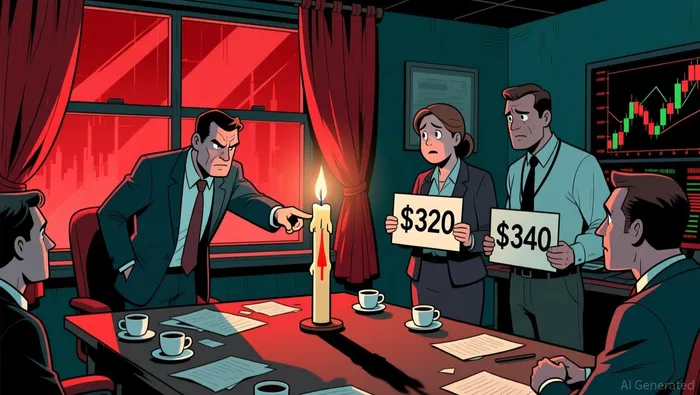 The price remains below all three MAs, reinforcing the downtrend. A crossover of the 50-day above the 200-day would signal a potential trend reversal, though this is unlikely without a sustained rebound above $370. The 20-day MA ($350) currently acts as dynamic resistance, with a break below $335 likely to accelerate the decline.
MACD & KDJ Indicators
The MACD line (-$15) crossed below the signal line (-$10) with a bearish divergence, suggesting momentum is favoring the downtrend. The stochastic oscillator’s %K ($15) and %D ($25) lines are in oversold territory, but without a bullish crossover, this may reflect continued distribution rather than a reversal. A divergence between price and stochastic levels could foreshadow a rebound, though current conditions favor a continuation below $330.
Bollinger Bands
Volatility has expanded, with the 20-day Bollinger Bands widening to $315 (lower) and $365 (upper). The price is currently near the lower band, indicating extreme weakness. A test of the $320 level could trigger a mean reversion bounce, but a breakdown below $315 would signal a new short-term low. The recent contraction in band width from mid-December suggests a potential breakout is imminent, likely downward given the prevailing bias.
Volume-Price Relationship
Trading volume surged to $23.9 billion on the most recent session, confirming the validity of the price decline. However, volume has been mixed in prior sessions, with lower volumes on consolidation days. This suggests the sell-off is driven by institutional activity rather than retail panic, increasing the probability of a continuation below $330. A divergence in volume (e.g., higher volume on lower closes) would strengthen the bear case.
Relative Strength Index (RSI)
The 14-day RSI stands at 28, officially in oversold territory. While this historically suggests a potential bounce, the RSI has remained below 30 for three consecutive sessions, indicating a bearish trend. A close above 35 would signal a short-term recovery, but a break below 20 could extend the decline. The RSI’s alignment with Fibonacci levels ($320) and stochastic divergence creates a confluence for a possible near-term bottom.
Fibonacci Retracement
The 50% retracement level of the November–December rally is at $335, with the 61.8% level at $320. The current price is approaching the 61.8% level, which could act as a pivot point. A rejection here would validate $320 as a key support, while a breakdown would target $305. The 38.2% level at $345 is currently acting as resistance; a close above this would invalidate the bearish case.
Confluence between the RSI oversold condition, Fibonacci 61.8% support, and stochastic oversold levels increases the probability of a near-term bounce. However, the bearish momentum from moving averages, MACD, and Bollinger Bands suggests any rally is likely to be short-lived unless accompanied by a volume surge and a close above $345. Divergences between price and momentum indicators (e.g., higher lows in RSI with lower price lows) would signal a potential reversal, but current conditions remain aligned with a continuation of the downtrend.
The volume-confirmed breakdown below $330 and the bearish moving average crossover create a high-probability scenario for further declines to $300. Traders should monitor the $320 level for a potential short-term bottom, with a key watch on the 50-day MA for trend reversal signals. A sustained close above $345 would invalidate the bearish case, but the current technical landscape favors continuation of the decline.

If I have seen further, it is by standing on the shoulders of giants.
Latest Articles
Stay ahead of the market.
Get curated U.S. market news, insights and key dates delivered to your inbox.
AInvest
PRO
AInvest
PRO



Comments
No comments yet