
Broadcom's OpenAI Deal: Assessing the Infrastructure Bet in the AI S-Curve


 Aime Summary
This deal is not just a chip purchase; it is a high-stakes bet on the next phase of the AI infrastructure S-curve. OpenAI is moving from being a customer to a builder, designing its own accelerators to embed its frontier model expertise directly into hardware. This vertical integration is the strategic pivot point, aiming to unlock exponential efficiency gains as the industry shifts from proprietary, full-stack solutions toward open architectures.
The scale of the commitment frames the ambition. OpenAI has committed to deploying 10 gigawatts of custom AI accelerators, with BroadcomAVGO-- responsible for the initial deployment starting in the second half of 2026 and completing by the end of 2029. To contextualize, that's equivalent to the output of ten nuclear reactors. This is part of a broader industry trend where hyperscalers like Meta, Google, and Microsoft are building custom AI chips to reduce dependency on NvidiaNVDA-- and secure their supply lines. OpenAI's move is the logical next step for a company racing to fuel applications like ChatGPT and Sora.
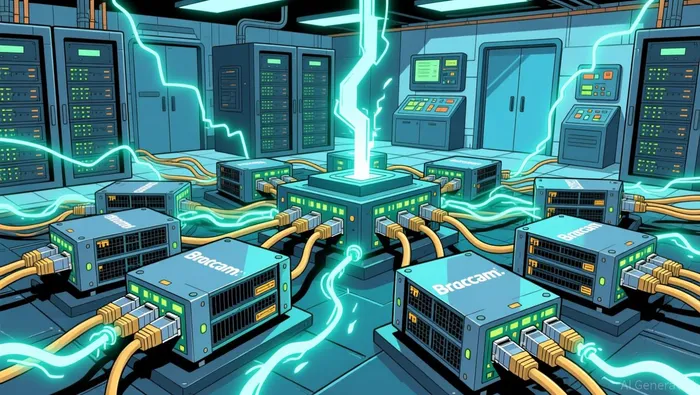
The critical, and perhaps more disruptive, element is the networking choice. The collaboration specifies that the racks will be scaled entirely with Ethernet and other connectivity solutions from Broadcom. This signals a decisive shift away from Nvidia's InfiniBand dominance. The decision reflects a maturing market where Ethernet, powered by new standards like RoCE and advanced silicon, can now deliver equivalent performance for AI training workloads at a fraction of the cost. Meta's validation of RoCE for its Llama 3 cluster is a key precedent. For OpenAI, this open networking backbone promises greater flexibility, avoids vendor lock-in, and sets a potential industry standard.
The bottom line is that this partnership represents a paradigm shift. It's a bet on the convergence of custom silicon and open networking as the next exponential curve in AI compute. By controlling both the accelerator and the fabric, OpenAI aims to optimize for its specific workloads, driving down the cost per AI operation. This is the infrastructure layer for the next generation of intelligence, and the companies that master it will define the economics of the AI era.
The Financial Engine: Broadcom's AI Revenue Trajectory
Broadcom is executing a high-stakes bet on the next phase of the AI infrastructure S-curve, where custom silicon and open networking will drive exponential efficiency gains. The financial engine for this bet is its AI semiconductor business, which is growing at a rate that transforms its entire portfolio. In the latest quarter, AI semiconductor revenue grew 74% year-over-year. More critically, the company forecasts that this segment will double again in the ongoing quarter. This isn't just growth; it's the acceleration of an exponential curve.
This momentum is anchored by massive, long-term customer commitments. The OpenAI deal is a key component of a staggering $73 billion total order backlog. Within that, AI networking segment orders alone exceed $10 billion. This visibility provides a multi-year runway, moving the business from speculative hype to contracted reality. The scale of these orders underscores a paradigm shift: hyperscalers are no longer just buying GPUs; they are investing in custom, high-efficiency solutions from partners like Broadcom to optimize their AI compute stacks.
The result is a fundamental transformation of Broadcom's revenue mix. For the upcoming first quarter of fiscal 2026, the company forecasts $8.2 billion in AI semiconductor revenue. With a total revenue forecast of $19.1 billion, this means AI semiconductor revenue is expected to make up 42.9% of total revenue. This is the pivot point. A business that generated $12.2 billion in AI revenue for all of fiscal 2024 is now on track to see that segment nearly double its contribution to the top line in just one quarter. This shift is the core of the investment thesis: Broadcom is not just participating in the AI boom; it is building the fundamental rails for the next generation of compute efficiency.
The bottom line is that Broadcom's financial engine is now powered by this AI trajectory. The exponential growth in AI revenue, backed by a record order backlog, is rapidly reshaping the company's profile. It is moving from a diversified infrastructure company to a dominant player in the custom silicon and networking layers of the AI stack. For investors, the question is whether this S-curve acceleration can continue to compound returns, or if the stock's recent run has already priced in the entire journey. The evidence shows the journey is just beginning.
The Execution Challenge: Power, Scale, and Competition
The exponential growth thesis for AI infrastructure is a high-stakes bet on the next phase of the technological S-curve. The core promise is clear: custom silicon and open networking will drive massive efficiency gains, reshaping data centers. Yet this bet faces a hard physical constraint and intense competitive execution pressure. The entire buildout is hitting a wall of power demand that could derail the timeline.
The scale of the coming strain is staggering. Data center power demand in the US is projected to grow from 61.8 GW in 2025 to 134.4 GW in 2030. This isn't just a forecast; it's a fundamental limit on the speed of deployment. While utilities like American Electric Power are planning massive capital increases to meet this demand, the process is fraught with regulatory friction and grid limitations. In Ohio, for instance, a new data center tariff is already "culling duplicative or speculative requests", signaling that not every project can proceed at the same pace. For a company like Broadcom, whose success hinges on multi-year deployments, this power constraint introduces a critical uncertainty. The timeline for scaling its custom AI accelerators is now intertwined with the availability of grid power, a variable outside its direct control.
Execution risk is equally acute on the competitive front. Broadcom's recent diversification is real, with new orders from Anthropic and a fifth custom-chip customer. Yet its most significant near-term catalyst remains a multi-year partnership with OpenAI to deploy 10 gigawatts of custom accelerators, with the first racks targeted for the second half of 2026 and completion by the end of 2029. This is a single, large-scale deployment. Its success is pivotal for validating the custom silicon model and securing future orders. The company must execute flawlessly over this three-year window, navigating the complexities of co-developing with a major AI innovator.
Furthermore, Broadcom is entering a crowded field. While custom AI chips (ASICs) are gaining share, Nvidia's GPUs remain dominant for training. The company must compete not only with Nvidia's relentless innovation but also with other chipmakers like AMD and Marvell. The industry is moving toward heterogeneous computing, where Nvidia GPUs are often paired with custom accelerators. This reality means Broadcom's chips must deliver a compelling cost-performance advantage to justify integration into a system that still relies heavily on Nvidia's core technology. The collaboration with OpenAI is a strategic move to build a more open, Ethernet-based networking backbone, potentially reducing reliance on Nvidia's proprietary stack. But this shift is still in its early stages, and the dominance of Nvidia's full-stack solution for many enterprises remains a formidable barrier.
The bottom line is that the AI infrastructure S-curve is steep, but the path is narrow. Broadcom's thesis depends on executing a massive, multi-year deployment for a single customer while navigating a power-constrained buildout and intense competition. The company is betting that its custom silicon and networking strategy will capture a growing share of the market. The coming years will test whether it can turn this vision into a reliable, exponential revenue stream.
Catalysts and Watchpoints: The Next Phase of the S-Curve
The partnership between OpenAI and Broadcom is a high-stakes bet on the next phase of the AI infrastructure S-curve. This is not just another chip deal; it is a strategic pivot toward custom silicon and open networking that could drive exponential efficiency gains. The first major catalyst is the deployment of the first OpenAI-designed accelerator racks, targeted for the second half of 2026. This initial rollout will be a critical test of the co-development model, proving whether embedding AI expertise directly into hardware can unlock the promised performance and cost advantages.
Investors should monitor Broadcom's AI revenue guidance and execution against its $8.2 billion Q1 2026 forecast to gauge the deal's contribution. This figure represents a doubling from the prior year and would make AI semiconductor revenue a dominant 43% of total sales. The company's recent track record shows AI chip revenue grew 74% year-over-year last quarter, but the market will scrutinize whether the OpenAI partnership accelerates this growth into the next exponential phase. Any deviation from this aggressive forecast would signal execution risk in scaling a new, complex product line.
The long-term scenario depends on whether this partnership sets a precedent for other hyperscalers to adopt similar custom, Ethernet-based architectures. The collaboration combines custom silicon and open networking, a model that could reduce reliance on traditional GPU-centric stacks. If successful, it validates a new paradigm where AI leaders design their own accelerators, while partners like Broadcom provide the foundational, standards-based networking fabric. This could reshape the entire AI infrastructure stack, favoring companies that control both the compute and connectivity layers.
For Broadcom, this is the ultimate validation of its strategy. The company is not just selling chips; it is building the rails for the next generation of AI clusters. The success of the OpenAI deal will determine if Broadcom can join the ranks of the pure-play AI infrastructure leaders, moving beyond its current position as a critical enabler. The path is clear, but the execution is everything.

Eli escribe con una personalidad directa y bien investigada, enfocada en desafiar concienzudamente las perspectivas habituales. Su análisis aborda de forma equilibrada pero crítica las dinámicas del mercado, con la finalidad de educar, informar y, a veces, turbinar las narrativas habituales. Mientras mantiene la credibilidad y el poder de influencia en la prensa económica, Eli se centra en el mundo de la economía, los patrones del mercado y las analíticas de inversiones. Su estilo analítico y directo garantizan la claridad, lo que permite que incluso los temas complejos del mercado sean comprensibles para un público amplio, sin sacrificar el rigor.
Latest Articles
Stay ahead of the market.
Get curated U.S. market news, insights and key dates delivered to your inbox.




Comments
No comments yet