

For the better part of a year, the rating game has been simple: BroadcomAVGO-- carries a premium multiple, and the debate is whether investors are overpaying for AI growth. Somewhere in that debate, the reset already happened. Shares trade near $369, roughly 25% below their June 2026 all-time high around $495, and the forward multiple has come down from about 44x in mid-January to about 32x on this fiscal year's consensus. More importantly, this is not an estimate-collapse story — Wall Street kept raising the bottom line on the way down. A bear case built on a "stretched 40x+" multiple is arguing against a valuation that no longer exists.
The live question into the September 2 report after the close is not whether Broadcom is "overpriced" in the abstract. It is whether 32x fits an AI semiconductor ramp that management guides up over 200% — and what the print does to next year's number.
Walk the de-rating back and it looks like a market that already did its work. In mid-January, one bull note called the premium roughly 44x forward earnings. By late April, a Broadcom-versus-Nvidia valuation piece had it around 31x forward earnings — research vintages on different fiscal-year bases, but pointing the same direction. The stock meanwhile fell from a June 2026 all-time high near $495 to the current price, while the estimates underneath it climbed. Consensus called for a 67% increase in Broadcom's earnings in fiscal 2026 to $11.36 per share, and by August the following fiscal year's consensus had risen to about $19.55. Price down roughly a quarter, denominator larger. That is a re-rating, not an estimate collapse.
Do not trust a single line in a data screen to see this. The market-data feed behind some quote pages prints Broadcom's forward P/E at roughly 90x (per Ainvest data) — a figure on an incomparable basis that contradicts every consensus-derived multiple actually in use. The honest way to read the stock is to do the division. At the current price of $368.79, dividing by the $11.36 fiscal 2026 consensus gives about 32x; dividing by the $19.55 fiscal 2027 consensus gives about 19x. The gap between those two numbers is the entire investment case: the market is being paid purely to believe next year's forecast.
None of this makes Broadcom cheap in the abstract, and the caveat matters. The premium depends on the yardstick. Per Ainvest market data, on trailing GAAP earnings and on enterprise value to EBITDA — two valuation measures that account for last year's profits and debt — Broadcom still trades far above Nvidia: roughly 60x versus about 27x on trailing GAAP, and about 43x versus roughly 26x on EV/EBITDA. The modest premium only appears on the forward non-GAAP basis that valuation spreadsheets actually use. So the honest framing is not "Broadcom is cheap." It is that ~32x buys a roughly 6-to-8 turn premium over Nvidia in exchange for a bigger guided step-up in AI growth.

Under the multiple sits a fundamental ramp that is no longer hypothetical. Non-GAAP earnings per share ran from $1.58 to $2.44 across the past five fiscal quarters while total revenue went from $15.0 billion to $22.2 billion — the fiscal Q2 top line up 48% year over year. Inside that quarter, AI semiconductor revenue more than doubled to $10.8 billion, and management guided the same line to grow over 200 percent year-over-year to $16 billion in Q3.
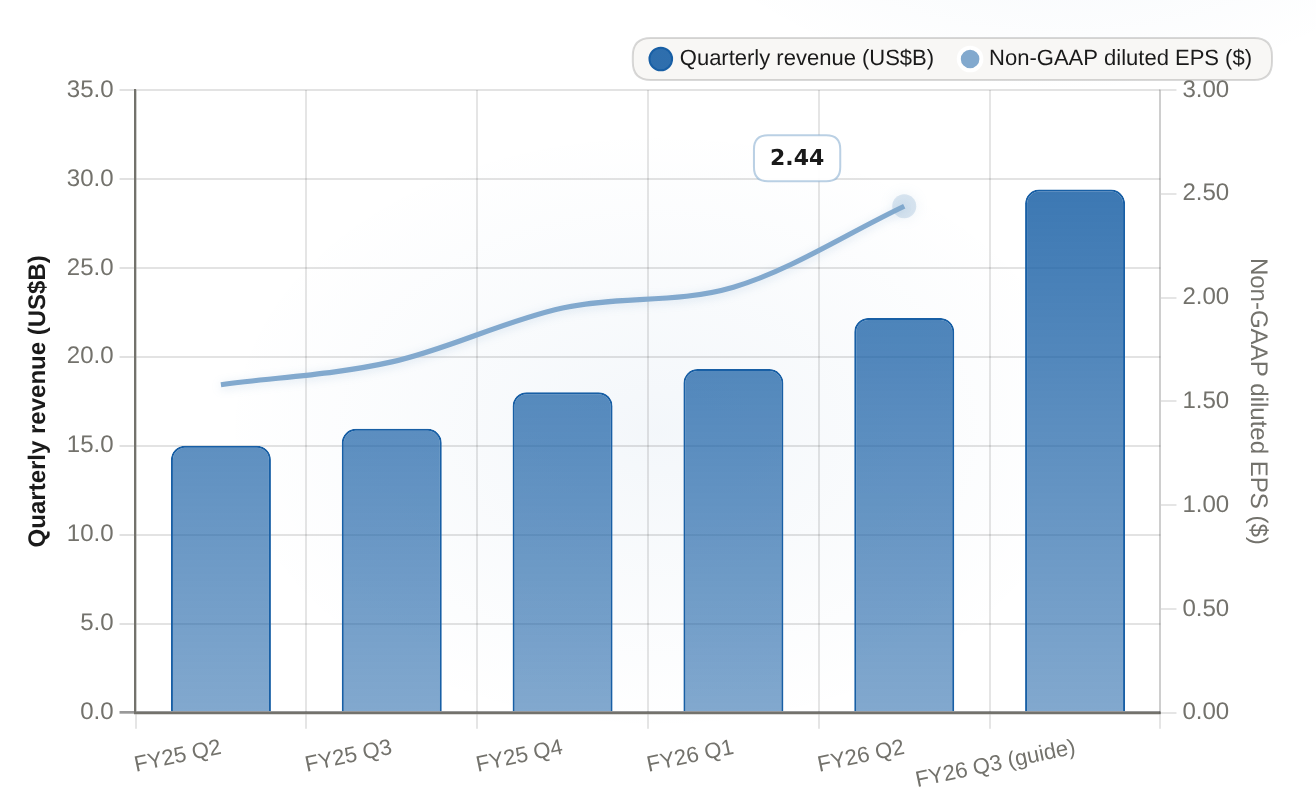
Revenue accelerates from $15.0B to $22.2B across five actual quarters, guidance steps up to $29.4B for Q3 FY26, and non-GAAP diluted EPS climbs from $1.58 to $2.44.
| Period | Quarterly revenue (US$B) | Non-GAAP diluted EPS ($) |
|---|---|---|
| FY25 Q2 | 15.004 | 1.58 |
| FY25 Q3 | 15.952 | 1.69 |
| FY25 Q4 | 18.015 | 1.95 |
| FY26 Q1 | 19.311 | 2.05 |
| FY26 Q2 | 22.187 | 2.44 |
| FY26 Q3 (guide) | 29.4 | N/A |
Set that guided pace against Nvidia's just-reported quarter, where total revenue rose 106% year over year. To be precise, Broadcom's guide is a segment line and Nvidia's is a company total — but on the comparison investors actually trade, Broadcom is offering the faster forward growth, and that is the justification for paying anything above Nvidia's roughly 24x forward multiple. For as long as the gap in growth pace stays this wide, the premium has a leg to stand on.
Here is the catch. The multiple has little expansion left to give, because it already reset. At about 19x on the fiscal 2027 consensus, the market needs the step-up from $11.36 to $19.55 — roughly 72% of EPS growth in a single year — to convert on schedule. That depends on the multi-year AI revenue target (sources disagree on whether the "in excess of $100 billion" figure applies to fiscal 2026 or 2027) becoming real EPS, with software holding up alongside. The two-sided math from the current price runs on one earnings base, fiscal 2026: re-expand toward the January territory of 40x and the same $11.36 is roughly $454, up about 23%; compress toward a peer-like 25x and it is roughly $284, down about 23%. If next year's EPS instead lands short, something has to give — keep the multiple and the price falls, or swallow a lower multiple. The envelope pivots on one thing: what the September 2 report does to the fiscal 2027 estimate.
Which is why the print is not really a beat-the-quarter test. Management already guided Q3 revenue to about $29.4 billion, above the roughly $28.5 billion consensus that existed when the guide came out — the market moved the goalposts months ago, so the printed quarter has little surprise left in it. The June reaction is the precedent to remember. Broadcom beat adjusted EPS at $2.44 versus the $2.40 estimate and still got hit for roughly 15% the next trading day, because the full-year AI target was not raised. The market was pricing in upgrades, not affirmations. The earnings-call language — whether the multi-year AI target moves higher, and what the implied fiscal 2027 cadence does to the $19.55 consensus — is the actual event.
The demand sitting behind that estimate is financed, for now. The four biggest cloud operators — Amazon, Alphabet, Microsoft, Meta — put up $166 billion in combined capex in the June quarter, up 87% year over year. That is the order book under the $16 billion AI guide and the reason consensus can keep climbing. The signal that breaks the current read is quiet and specific: if Broadcom's own forward language points to fiscal 2027 EPS drifting away from consensus, 32x flips from fair-on-compounding-growth to expensive-on-slowing-estimates. Watch the Q4 AI guide, not the Q3 beat. The multiple has already done its work. EPS has to carry the rest.








Comments
No comments yet