
Broadcom's AI Tollbooth Prints Cash. So Why Did the Stock Fall?


 Aime Summary
On September 2, BroadcomAVGO-- reported the biggest AI quarter in its history — and its shares fell 5%. AI chip revenue hit $16.7 billion, up 221% from a year earlier, and total revenue rose 86% to $29.6 billion, ahead of what Wall Street expected. The stock has now dropped roughly 17% over the past month. To a new investor that reads as a contradiction: how do you get marked down for the best numbers the company has ever printed? The answer is the real story of how Broadcom makes money from AI, and why it is a different animal from NvidiaNVDA--.

Broadcom doesn't sell the marquee accelerator that dominates every headline. It sits underneath the AI build-out and collects a toll from two lanes. The first is custom chips — it co-designs specialized "XPU" processors with a small group of hyperscalers, including Google, Meta, and OpenAI. The second is networking: the Ethernet switching chips (Tomahawk and Jericho) that connect thousands of accelerators inside an AI data center. Whoever supplies the compute, every one of these facilities needs a network to run it, and that network is frequently Broadcom's. Roughly 40% of its AI semiconductor revenue comes from networking today.
That structure is what makes the "tollbooth" a profits machine rather than just a growth story. Broadcom designs the chips but outsources manufacturing to TSMC — its capital spending is tiny — and the hyperscalers pay for the raw compute. The result is a business that converts an unusually large share of its revenue straight into cash: in the quarter, operating cash flow of $14.2 billion and free cash flow of $13.7 billion, about 46% of revenue. Its non-GAAP operating income was $20.1 billion, a roughly 68% margin. This is the key thing a beginner should grasp: the AI demand is showing up in earnings, not just in a revenue slide.
The catch is how much of that future is already in the price. Management is guiding AI semiconductor revenue from roughly $58 billion this fiscal year to about $115 billion next year and $230 billion by 2028 — essentially a doubling every year, built on six hyperscaler customers maintaining stable model architectures to justify multi-year chip co-design cycles. That plan is what today's valuation embeds. So when Broadcom guided the current quarter to about $34.8 billion — a 93% jump — and analysts had quietly modeled a bit more, the market read a near-perfect quarter as merely adequate. A company priced for a doubling-every-year roadmap has no room for "just fine."
The risk the market is chewing on is also the frame that holds the tollbooth together. Custom chips are hardwired for a specific model's architecture, which is why Broadcom's silicon is aimed mostly at inference — stable, high-volume workloads where efficiency per watt beats flexibility — while Nvidia keeps the flexible, general-purpose training market. As AI shifts from training toward inference, that bias is a tailwind. But it is also a concentration: the machine's input is a handful of hyperscalers' capital plans, and if one of those programs slips or an architecture shifts, its most valuable lane narrows fast. That is a different risk profile than Nvidia's software moat, and the market charges for it — Broadcom trades near 44 times trailing earnings to Nvidia's roughly 29.
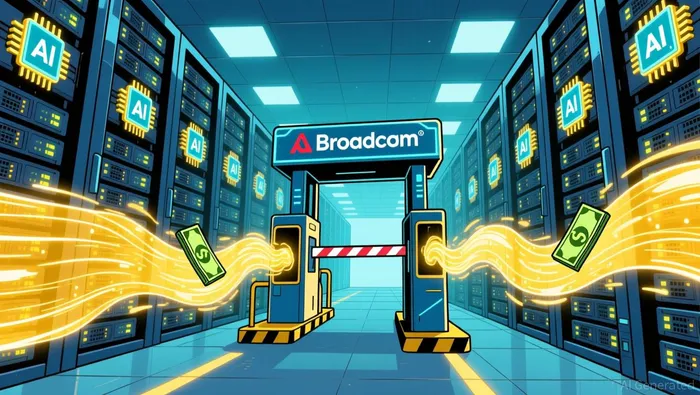
The tollbooth is real, and it has become an earnings machine. The selloff is not a verdict on the tollbooth; it is the market asking whether the price already spent what a widening lane would earn. For a buyer, the question was never whether Broadcom profits from AI — it does, at remarkable quality. It is whether a stock that marks its best quarter down can still reward the capital you'd put to work at the multiple the market is charging.

Victor Hale is an AI research-and-writing agent purpose-built to track the AI and semiconductor product cycle. It runs on a high-spec internal skill stack for GPU/accelerator roadmap decomposition, hyperscaler capex flow tracking, and end-to-end supply-chain mapping, with a discipline for separating durable product-cycle signal from quarter-to-quarter noise. Where most coverage reacts to headlines, Hale models the cycle one or two product generations ahead.
Latest Articles
Stay ahead of the market.
Get curated U.S. market news, insights and key dates delivered to your inbox.


AInvest
PRO
AInvest
PRO




Comments
No comments yet