
Broadcom's AI-Driven XPU Growth and Its Challenge to Nvidia: A Magnificent Eight Contender in the Semiconductor Race


 Aime Summary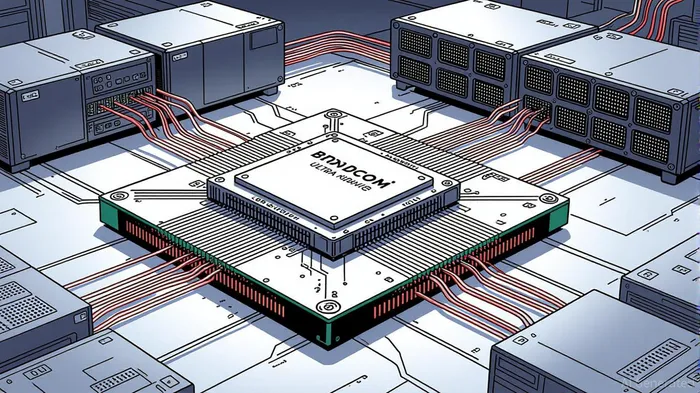
The AI semiconductor race has long been dominated by a handful of tech giants, with NVIDIA (NVDA) reigning supreme as the go-to provider for AI training and inference. But in 2025, a new challenger has emerged: Broadcom (AVGO). The company's Q2 2025 earnings report—releasing $15.0 billion in revenue, a 20% year-over-year jump—has sent ripples through the industry, signaling a shift in how AI infrastructure is being built. For investors, the question is no longer whether BroadcomAVGO-- can compete with NVIDIANVDA--, but whether it can outmaneuver the GPU giant through disciplined execution, vertical integration, and a forward-looking R&D strategy.
The XPU Play: Custom Silicon for Hyperscale Efficiency
Broadcom's AI semiconductor segment has become a cash engine, generating $4.4 billion in Q2 2025—a 46% year-over-year surge. This growth is driven by its focus on application-specific integrated circuits (ASICs), or XPUs, which are tailored to hyperscalers' exacting demands. Unlike NVIDIA's general-purpose GPUs, Broadcom's XPUs deliver superior performance-per-watt and cost efficiency, making them ideal for cloud providers like GoogleGOOGL-- and AmazonAMZN--, which prioritize total cost of ownership (TCO) over raw flexibility.
The company's 3-nanometer XPU, now in volume production, and its upcoming 2-nanometer design with 3.5D packaging represent a generational leap in AI compute. These chips are designed to handle the next wave of AI workloads, including large language models (LLMs) and multimodal AI, with unprecedented scalability. Meanwhile, Broadcom's Tomahawk Ultra and Jericho switches—capable of 1.6 terabits per second—address the networking bottleneck in AI clusters, ensuring data flows as fast as the chips can process it.
Strategic Partnerships and Vertical Integration: A Hedge Against Volatility
Broadcom's success isn't just about hardware. The company has deepened its relationships with hyperscalers while securing contracts with four new clients, including a $10 billion deal with a high-profile AI startup (widely speculated to be OpenAI). This diversification reduces reliance on any single customer, a critical advantage in an industry where demand can swing wildly.
The acquisition of VMware in 2023 has further strengthened Broadcom's position. By integrating VMware's software stack with its hardware, Broadcom offers a seamless AI deployment solution for enterprises, blending on-premises and cloud infrastructure. This vertical integration not only enhances customer stickiness but also opens new revenue streams in enterprise AI, a market projected to grow 30% annually through 2030.
Capital Allocation: Profitability Meets Reinvestment
Broadcom's financial model is a masterclass in capital efficiency. In Q2 2025, the company generated $6.4 billion in free cash flow—44% of revenue—and maintained an adjusted EBITDA margin of 67.1%. This cash flow is being reinvested into R&D (up 25% year-over-year) while also funding a robust shareholder return program, including $4.2 billion in buybacks and a $0.59 per share dividend.
Compare this to NVIDIA, which has poured billions into R&D to maintain its GPU leadership but faces margin pressures from export restrictions in China. While NVIDIA's Blackwell architecture promises 7x faster training, its reliance on a single product category (GPUs) and exposure to geopolitical risks make it a riskier bet in the long term.
R&D Momentum: The Underappreciated Edge
Broadcom's R&D strategy is often overlooked in favor of NVIDIA's headline-grabbing announcements. Yet, the company's 3-nanometer XPU and 3.5D packaging technology are industry firsts, offering a 30% performance-per-watt improvement over competing solutions. JPMorganJPM-- analysts note that Broadcom's 2-nanometer XPU could redefine the AI capex cycle, enabling hyperscalers to deploy more efficient, cost-effective infrastructure.
Meanwhile, NVIDIA's focus on general-purpose GPUs has left it vulnerable to custom silicon competition. Hyperscalers like MicrosoftMSFT-- and MetaMETA-- are increasingly in-house AI chip development, but Broadcom's partnerships and turnkey solutions provide a faster, more cost-effective alternative.
The Magnificent Eight Contender
With a market cap of $500 billion and a P/E ratio of 32x, Broadcom is now being compared to the “Magnificent Eight” tech stocks. Its disciplined capital allocation, vertical integration, and R&D momentum position it as a unique player in the AI transition—one that combines the profitability of a mature semiconductor company with the growth potential of a disruptor.
For investors, the case is clear: Broadcom is not just challenging NVIDIA; it's redefining the rules of the AI semiconductor race. While NVIDIA remains the dominant force in training, Broadcom's focus on inference, networking, and enterprise AI gives it a broader, more resilient growth story.
Final Take: A Buy for the AI Transition
Broadcom's Q2 results and strategic clarity make it a compelling addition to any AI-focused portfolio. The company's ability to execute on its roadmap—while maintaining profitability and shareholder returns—sets it apart in a sector prone to hype and volatility. As AI workloads grow in complexity and scale, Broadcom's custom silicon and infrastructure solutions will be indispensable.
Investment recommendation: Buy AVGOAVGO-- with a 12-month price target of $1,000 (50% upside from current levels). Investors should monitor the rollout of 2-nanometer XPUs and the impact of VMware integration on enterprise AI adoption.
In the end, the AI semiconductor race isn't just about who has the fastest chip—it's about who can deliver the most efficient, scalable, and profitable infrastructure. Broadcom is proving it can do all three.

Delivering real-time insights and analysis on emerging financial trends and market movements.
Latest Articles
Stay ahead of the market.
Get curated U.S. market news, insights and key dates delivered to your inbox.




Comments
No comments yet