
Broadcom's AI-Driven Transformation: Has the "Poor Man's Nvidia" Evolved into a Standalone AI Chip Leader?
 Aime Summary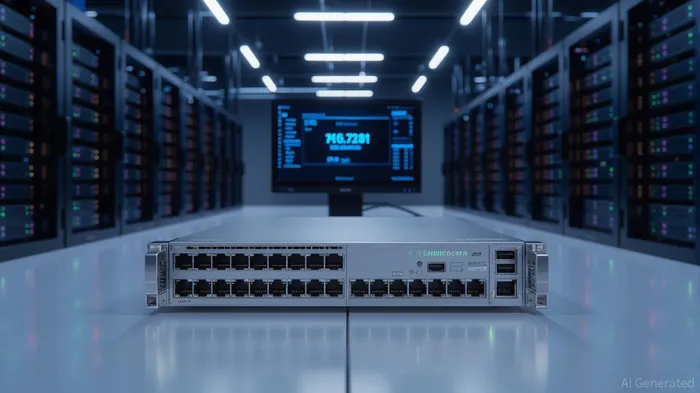
In the race to power the next era of artificial intelligence, BroadcomAVGO-- has quietly rewritten its narrative. Once dubbed the “poor man's Nvidia” for its role as a complementary player in the AI ecosystem, the chipmaker has emerged as a standalone force in 2025. With a 70% market share in custom AI application-specific integrated circuits (ASICs), a 46% year-over-year surge in AI-related revenue to $4.4 billion, and a strategic pivot toward inference workloads, Broadcom is no longer just a supporting actor in the AI revolution—it's a lead.
The Shift from Complement to Competitor
Broadcom's transformation hinges on its mastery of application-specific integrated circuits (ASICs), which are tailored for AI inference tasks. Unlike general-purpose GPUs, these custom chips offer 75% lower costs and 50% greater energy efficiency per watt, making them ideal for hyperscalers prioritizing deployment over training. The company's Tomahawk 6 switch, with its 102.4 terabits per second throughput and 3.5D XDSiP packaging, has become a linchpin for AI clusters, enabling faster data transfer and reduced latency.
This focus on inference aligns with a critical industry trend: while training workloads remain dominated by Nvidia's Blackwell architecture, inference—where demand is projected to outpace training by a 2:1 margin—has become the new frontier. Broadcom's custom accelerators (XPUs) are already deployed by Google, AmazonAMZN--, and MetaMETA--, with three of its largest customers planning to deploy over 1 million units by 2027.
Financial Fortitude and Strategic Leverage
Broadcom's financials underscore its newfound independence. In Q2 2025, the company reported $4.4 billion in AI-related revenue, driven by a 17% growth in its Semiconductor Solutions segment ($8.4 billion) and a 25% surge in Infrastructure Software (now 44% of total revenue). The 2023 acquisition of VMware has proven pivotal, creating a flywheel effect where AI hardware fuels demand for VMware's enterprise AI cloud platforms. This synergy has bolstered Broadcom's EBITDA margin to 67%, with $10.001 billion in adjusted EBITDA and $6.411 billion in free cash flow.
Meanwhile, Nvidia's dominance in data center GPUs (92% market share) remains unchallenged for training tasks. However, Broadcom's cost and efficiency advantages in inference—and its expanding partnerships with OpenAI, AppleAAPL--, and Oracle—position it to capture a disproportionate share of the $120 billion AI chip market in 2025.
The VMware Ecosystem: A Differentiator
The VMware acquisition has added a critical layer to Broadcom's AI strategy. By integrating AI-powered cloud management into its Infrastructure Software segment, the company now offers end-to-end solutions for enterprises seeking secure, on-premise AI deployments. This has proven particularly valuable in a world where data privacy and edge computing are gaining urgency. VMware's Cloud Foundation platform, now bolstered by Broadcom's AI networking solutions, is a key driver of the 44% revenue contribution from software—a stark contrast to Nvidia's hardware-centric model.
Risks and Realities
Nvidia's CUDA ecosystem and Blackwell architecture remain formidable, particularly for training large language models. Broadcom's focus on inference, while lucrative, may not fully offset the long-term demand for training-centric GPUs. Additionally, geopolitical risks—such as U.S.-China trade tensions—could impact Broadcom's supply chain, though its “friendshoring” partnerships with U.S. and EU manufacturers mitigate this.
That said, Broadcom's 67% EBITDA margin and $7 billion shareholder return program offer a compelling value proposition. With Q3 2025 guidance projecting AI semiconductor revenue of $5.1 billion, the company is on track to sustain its 10-quarter growth streak.
Investment Thesis: A Standalone Bet
For investors, the question is no longer whether Broadcom can outperform NvidiaNVDA-- in all areas—but whether its niche in inference and networking justifies a standalone bet. The answer lies in its ability to monetize the $55 billion custom chip market, which is expected to grow at 32% annually through 2030. Broadcom's 70% market share in this segment, combined with its VMware-driven software ecosystem, creates a moat that rivals like AMDAMD-- and Intel struggle to match.
Broadcom's stock has appreciated 45% year-to-date, outpacing Nvidia's 9% gain, despite a higher forward P/E ratio (33 vs. Nvidia's 30). This premium reflects investor confidence in its diversification and margins. With AI inference demand set to explode and the company's guidance pointing to $5.1 billion in AI semiconductor revenue for Q3 2025, now is the time to view Broadcom not as a “poor man's Nvidia,” but as a standalone leader in the AI stack.
For those seeking exposure to the AI revolution beyond the GPU giants, Broadcom offers a compelling, high-margin alternative. The “poor man's” label may soon be a relic of the past.

Delivering real-time insights and analysis on emerging financial trends and market movements.
Latest Articles
Stay ahead of the market.
Get curated U.S. market news, insights and key dates delivered to your inbox.




Comments
No comments yet