
Broadcom's AI Dominance: Is AVGO the Next Semiconductor Giant?
 Aime Summary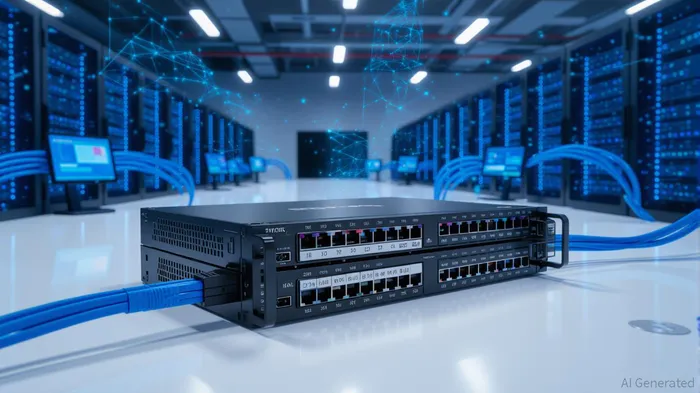
The global AI semiconductor race has entered a new phase, with BroadcomAVGO-- (AVGO) emerging as a formidable contender. While NVIDIANVDA-- (NVDA) and AMDAMD-- (AMD) dominate headlines, Broadcom's strategic ecosystem design, aggressive M&A, and 90% market share in cloud data center Ethernet switches position it as a hidden powerhouse. For investors, the question is no longer whether AI will reshape the semiconductor industry but whether Broadcom can consolidate its leadership—and whether AVGOAVGO-- is a must-buy ahead of its September 4, 2025 earnings report.
Strategic Ecosystem Design: From Chips to Software Flywheel
Broadcom's dominance in AI infrastructure stems from its ability to integrate hardware, software, and strategic partnerships into a cohesive ecosystem. The acquisition of VMware in 2023 was a masterstroke, bridging the gapGAP-- between Broadcom's silicon expertise and enterprise software needs. VMware's virtualization capabilities now enable secure, on-premise AI deployments, addressing a critical demand in hybrid cloud environments. This integration has transformed Broadcom from a chipmaker into a full-stack infrastructure provider, with its Infrastructure Software segment contributing 44% of Q2 FY2025 revenue.
The company's custom ASICs, or XPUs, further cement its leadership. These application-specific chips outperform GPUs in cost, speed, and energy efficiency, making them ideal for hyperscalers like Google, MetaMETA--, and MicrosoftMSFT--. For instance, Broadcom's co-development of Google's TPU v5/v6 and Meta's MTIA underscores its role as a key enabler of AI inference and training. Meanwhile, its Tomahawk 6 switch, with 102.4 terabits per second throughput, addresses the growing bottleneck of data movement in AI clusters, driving 170% year-over-year revenue growth in Q2.
Market Leadership: 90% Share in Networking, 70% in Custom AI Chips
Broadcom's market share in cloud data center Ethernet switches—90%—is a testament to its dominance in networking. This leadership is underpinned by its proprietary Scale Up Ethernet (SUE) architecture, which scales seamlessly with AI workloads. In contrast, NVIDIA's CUDA ecosystem, while dominant in AI training, faces challenges in inference workloads, where Broadcom's XPUs offer 2–3x faster performance and 30% lower power consumption.
The company's 70% market share in custom AI chips further differentiates it. Hyperscalers are increasingly adopting Broadcom's ASICs for edge computing and on-premise deployments, where energy efficiency and cost are paramount. With three major customers planning to deploy up to one million chip clusters by 2027, Broadcom's addressable market could reach $60–90 billion. This is not just growth—it is a structural shift in how AI infrastructure is built.
Competitive Positioning: Navigating the NVIDIA-AMD Duopoly
NVIDIA remains the undisputed leader in AI training, with Q2 FY2025 data center revenue of $39.1 billion. However, its growth rate has slowed, and the law of large numbers now constrains its ability to maintain 69% year-over-year gains. AMD, meanwhile, is making inroads in inference workloads and open interconnect standards via the UALink consortium. Yet, Broadcom's 3.5D XDSiP technology—reducing latency and power consumption—gives it a distinct edge in next-generation AI accelerators.
Broadcom's ecosystem strategy also insulates it from proprietary risks. By focusing on open Ethernet-based solutions and standards, it appeals to hyperscalers seeking interoperability. This contrasts with NVIDIA's NVLink, which locks customers into its ecosystem. As AI workloads shift from training to inference, Broadcom's cost-effective XPUs and networking solutions are poised to capture a larger share of the market.
Financial Strength and Earnings Catalysts
Broadcom's financial discipline is another pillar of its success. In Q2 FY2025, it generated $6.4 billion in free cash flow, with R&D spending at 16.71% of revenue. This enables sustained innovation while returning capital to shareholders via a $4.2 billion stock buyback and a $0.59 per share dividend. Analysts project Q3 FY2025 AI revenue of $5.1 billion—a 60% year-over-year increase—and total revenue of $15.8 billion.
The upcoming earnings report on September 4, 2025, is a critical catalyst. With a 31-analyst consensus of “Strong Buy” and an expected EPS of $1.66 (up 34% YoY), the market is pricing in continued outperformance. Investors should watch for guidance on 2026 AI revenue targets, which could exceed $30 billion.
Investment Outlook: A Must-Buy Before Earnings?
Broadcom's ecosystem strategy, market share, and financial strength make it a compelling long-term play. While its 45x forward P/E is a premium to NVIDIA's 42x, the valuation reflects its unique position in AI networking and custom silicon. For investors seeking exposure to the AI boom, AVGO offers a dual-engine model: high-margin semiconductors and a growing software platform.
However, risks remain. Supply chain vulnerabilities and geopolitical tensions could disrupt production, though Broadcom's “friendshoring” partnerships with U.S. and EU manufacturers mitigate this. Additionally, R&D costs are high, but the company's cash flow ensures sustainability.
Conclusion: Broadcom is not just a semiconductor company—it is an infrastructure architect. Its ecosystem design, 90% market share in networking, and 70% lead in custom AI chips position it to outperform peers as AI demand accelerates. With earnings on the horizon and a clear growth trajectory, AVGO is a must-buy for investors willing to bet on the next phase of the AI revolution.

Delivering real-time insights and analysis on emerging financial trends and market movements.
Latest Articles
Stay ahead of the market.
Get curated U.S. market news, insights and key dates delivered to your inbox.




Comments
No comments yet