
Broadcom's AI Ambitions Ignite: A $10 Billion Bet and a Challenge to Nvidia's Dominance


In the high-stakes arena of semiconductor innovation, Broadcom Inc.AVGO-- is carving out a bolder path. The company's latest earnings report, released amid swirling doubts about the AI boom's sustainability, delivered a mix of solid beats and forward-looking optimism that sent shares climbing in after-hours trading.
CEO Hock Tan, a master dealmaker who's transformed BroadcomAVGO-- into a tech behemoth through relentless acquisitions, didn't just meet Wall Street's gaze—he stared it down with projections of accelerating AI revenue growth. As NvidiaNVDA-- grapples with its own forecast jitters, Broadcom's narrative shifts from beneficiary to potential disruptor, fueled by custom chips and a mysterious new customer wielding $10 billion in orders.
Earnings Highlights: Beating Expectations Across the Board
Broadcom's fiscal third quarter, ending August 3, painted a picture of resilient growth in a sector prone to volatility. Revenue climbed 22% year-over-year to $15.96 billion, surpassing analysts' consensus estimate of $15.83 billion. Adjusted earnings per share hit $1.69, edging out the expected $1.65. This performance flipped the script from a year ago, when the company posted a net loss of $1.88 billion—or 40 cents per share—largely due to a one-time $4.5 billion tax provision tied to repatriating intellectual property to the U.S. This time around, net income soared to $4.14 billion, or 85 cents per share, underscoring a return to profitability.
Breaking it down by segments, the semiconductor solutions business—encompassing chips for everything from iPhones to data centers—surged 57% to $9.17 billion. Meanwhile, the infrastructure software arm, bolstered by the VMware acquisition, grew 43% to $6.79 billion. These figures reflect Broadcom's diversified portfolio, which spans connectivity components for AppleAAPL-- devices, virtualization software for networks, and increasingly, the plumbing of AI infrastructure.
Looking ahead, Broadcom guided for fourth-quarter revenue of about $17.4 billion, topping the average analyst projection of $17.02 billion. While some estimates had ventured as high as $18 billion, the forecast still signals confidence in sustained demand, particularly as tech giants pour billions into AI buildouts.
The AI Revenue Boom: From Steady to Stratospheric

At the heart of Broadcom's story is its AI segment, which is emerging as a powerhouse. Third-quarter AI semiconductor sales reached $5.2 billion, a 63% jump from the prior year and ahead of the company's own $5.1 billion prediction, as well as analysts' $5.11 billion estimate. This category includes custom-designed accelerators—dubbed XPUs—and networking gear essential for linking clusters of graphics processors in AI data centers.
Tan has been methodically upgrading Broadcom's offerings to handle the data deluge from AI models, positioning the company as a critical enabler in the ecosystem. For the fourth quarter, AI revenue is expected to climb further to $6.2 billion, well above the $5.82 billion Wall Street had anticipated. This trajectory isn't just about riding the AI wave; it's about engineering it. Broadcom's chips and networking solutions are tailored for customers building and operating massive AI systems, where efficiency and speed can make or break billion-dollar investments.
The Mystery Customer: A $10 Billion Catalyst for 2026
What truly electrified investors was Tan's revelation during the earnings call: a new, unnamed customer has committed $10 billion in production orders for custom AI chips. This "qualified customer" brings immediate and substantial demand, prompting Broadcom to revise its fiscal 2026 AI outlook upward "significantly." Previously, Tan had pegged 2026 growth at a respectable 50% to 60%, mirroring the current year's pace. Now, with this deal in hand, he described the acceleration as "fairly material," hinting at shipments ramping up strongly from the start of 2026.
This fourth major client joins existing partners like GoogleGOOGL-- and other cloud giants, for whom Broadcom develops bespoke processors. Tan noted that the company has been collaborating with prospects to create AI accelerators, a domain where Nvidia currently reigns supreme with its GPUs. Yet Broadcom's entry signals a potential shift: custom chips could erode Nvidia's market share by offering tailored performance at competitive costs. "We will ship pretty strongly beginning 2026," Tan asserted, attributing recent growth to these accelerators, networking components, and VMware's software synergies.
The anonymity of the customer adds intrigue—speculation abounds, but Tan's discretion underscores the competitive sensitivity. This deal not only bolsters Broadcom's pipeline but also validates its strategy of challenging Nvidia head-on, especially as rivals like Marvell TechnologyMRVL-- stumble. Marvell's shares tanked 19% after missing data center revenue targets, highlighting the pitfalls in this cutthroat market.
Competitive Landscape: Navigating AI's Uncertain Waters
Broadcom's ascent comes at a pivotal moment for the AI industry. Nvidia's recent underwhelming guidance sparked fears of an AI bubble, with investors questioning whether the frenzy in tech spending will endure. Broadcom, while not matching Nvidia's explosive sales, is viewed as a steadier play—a key supplier whose fortunes are tied to the broader infrastructure buildout rather than just chip dominance.
Tan's track record amplifies this narrative. Through acquisitions, he's expanded Broadcom from a niche player into a Palo Alto-based giant with hardware and software tentacles reaching across tech. The VMware integration, for instance, enhances its software offerings for virtualized networks, complementing the hardware push into AI. Competitors like MarvellMRVL-- underscore the risks: missing estimates can trigger sharp selloffs. But Broadcom's diversified revenue streams— from consumer devices to enterprise software—provide a buffer against sector-specific downturns.
Market Reaction: From Tepid to Triumphant
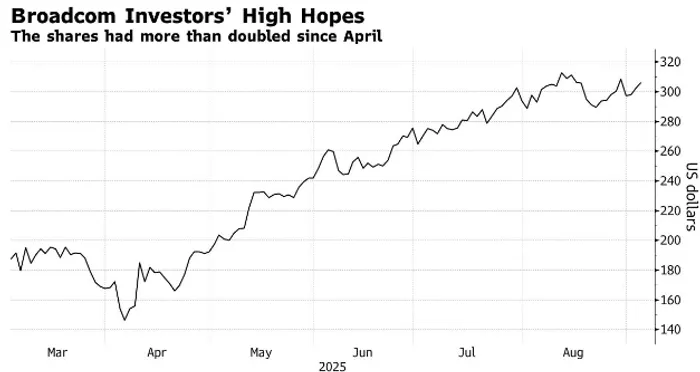
Investor sentiment has been a rollercoaster. Heading into earnings, expectations ran hot; shares had more than doubled since an April low, adding roughly $730 billion to Broadcom's market value and ranking it third in Nasdaq 100 performance. Year-to-date, the stock is up 32%, with a 12-month gain pushing the market cap beyond $1.4 trillion.
The initial post-earnings reaction was muted, as results met but didn't wildly exceed the loftiest forecasts. However, Tan's commentary on the conference call flipped the script, driving a more than 3% gain in extended trading. This rebound reflects relief: in an era of AI skepticism, Broadcom's tangible customer wins and upward revisions offer concrete evidence of enduring demand.
Leadership Continuity: Tan's Long-Term Vision
Amid the numbers, Tan dropped a personal bombshell: he's committed to steering Broadcom as CEO until at least 2030, with board approval. This assurance quells any whispers of succession drama, allowing investors to focus on execution. Tan's tenure has been defined by bold moves—acquisitions that have ballooned the company's scope—and his extended runway suggests more chapters in Broadcom's evolution.
A Resilient Path Forward
Broadcom's earnings underscore a company firing on all cylinders, leveraging AI's momentum while mitigating risks through diversification. The $10 billion mystery order isn't just a revenue boost; it's a declaration of intent in the battle for AI supremacy. As Nvidia contends with its own growth pains, Broadcom's custom-chip strategy could redraw the competitive map, offering cloud providers alternatives that prioritize customization over one-size-fits-all dominance.
Yet challenges loom: sustaining this growth amid economic headwinds, navigating geopolitical tensions in chip supply chains, and integrating acquisitions seamlessly. For now, though, Tan's vision resonates. In a market hungry for AI winners, Broadcom isn't just participating—it's positioning to lead. Investors betting on this trajectory might find their optimism rewarded, as the company's blend of hardware prowess and software depth cements its role in tech's next frontier.

Expert analysis on U.S. markets and macro trends, delivering clear perspectives behind major market moves.
Latest Articles
Stay ahead of the market.
Get curated U.S. market news, insights and key dates delivered to your inbox.




Comments
No comments yet